Why Antique Doll Lip Colors Are So Hard to Match
The Focal Point Problem
When someone looks at an antique doll's face, their eye goes to the lips first. This means lip color restoration carries disproportionate weight. A slightly off cheek blush might pass unnoticed, but a wrong lip color is immediately apparent.
The Complexity of Original Lip Colors
Antique doll lips were not painted in a single flat color. The original application involved:
- Base color: A wash of red china paint over the entire lip area
- Modulation: The center of the lower lip received slightly different treatment for a natural highlight
- Outline: A fine concentrated line defined the lip edges, especially the upper lip's bow shape
- Corners: Carefully shaded for natural transitions
- Finishing: Some manufacturers applied a thin clear glaze for slight sheen
This multi-step application means "lip color" is actually a composite of several layers, each aged differently.
Why Matching Is Difficult
Differential wear across the lip surface. Center of lower lip wears fastest; recessed corners retain more paint.
The outline dilemma. Too heavy looks cartoonish; too light and the lip shape is undefined.
Color shifts from overlapping layers. Where multiple layers survive at different thicknesses, the visible color varies across the lip.
Glaze variation. Partially surviving clear glaze creates areas with sheen and areas without.
Interaction with the bisque. If the base complexion wash has worn in the lip area, lip color appears different.
A Layered Matching Strategy
Match lips in layers, mimicking the original sequence:
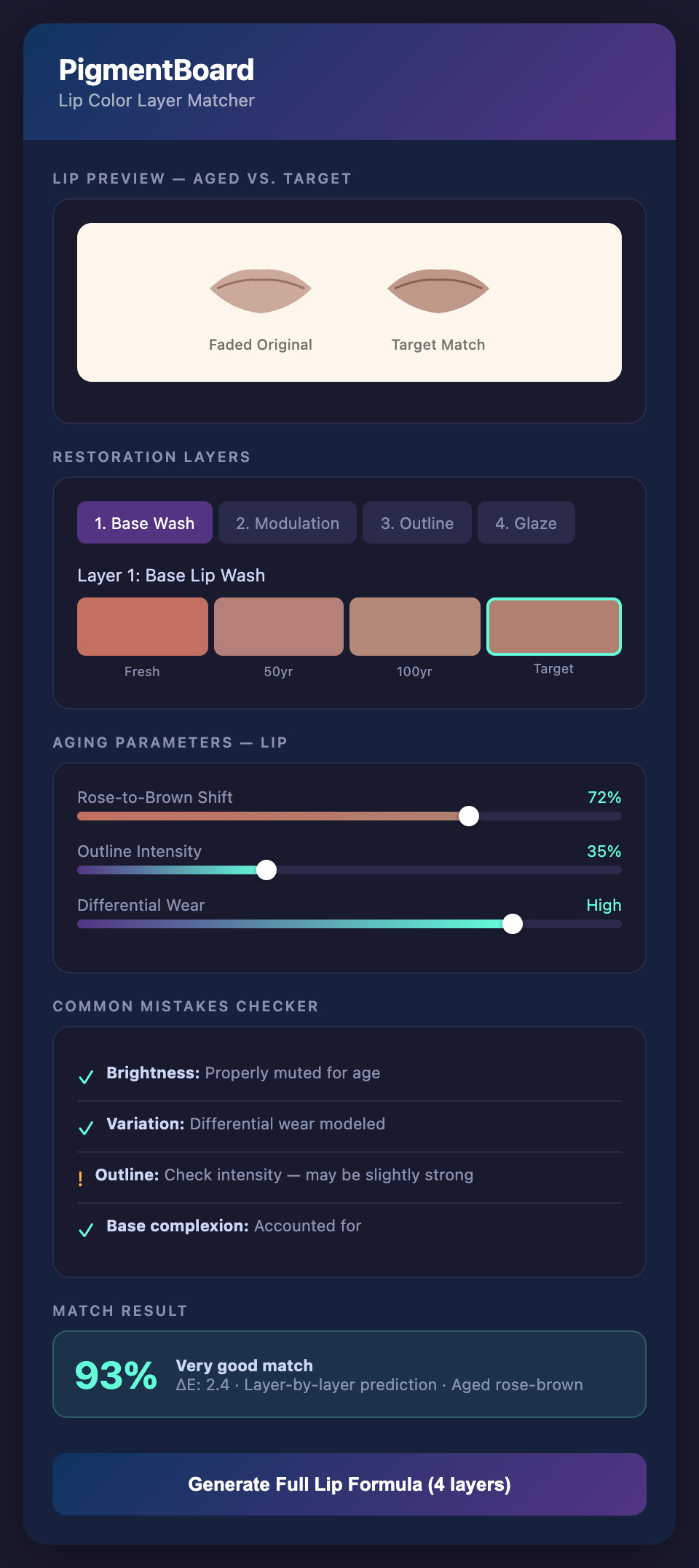
Layer 1: Base lip wash — Match the general lip color from best-preserved areas. Apply thinly. Fire.
Layer 2: Modulation — After firing, assess whether highlight and shadow variations need addition.
Layer 3: Outline — Match the surviving outline intensity. Apply with the finest brush. Slightly diffused edges.
Layer 4: Surface finish — If original had glaze sheen, apply thin clear glaze to match.
Common Mistakes
- Too bright — Fresh reds are much more vivid than 140-year-old aged reds
- Too uniform — Real aged lips have variation from differential wear
- Wrong outline intensity — Too strong looks modern; too weak loses the lip shape
- Ignoring the base — Address the complexion wash before lip color
- Wrong firing temperature — Shifts color unpredictably
Ready to predict aged lip colors before your first kiln firing? Join the PigmentBoard waitlist.