Building a China Paint Reference Library for Doll Restoration
Stop Throwing Away Your Test Tiles
Each fired test tile contains valuable information. By organizing tiles into a systematic reference library, you create a resource that accumulates value over time.
What to Include
Complexion tones — warm peach (French), cool pink (German), various opacities. Cheek blush — warm rose, bright pink, each at multiple intensities, over warm and cool bases. Lip reds — deep rose, bright red, orange-red, at multiple intensities. Eyebrow browns — warm, neutral, cool, near-black, at multiple transparencies. Eye colors — blues, browns, greens, grays. Specialty — aging effects, smoke-yellowed equivalents.
Preparation Standards
Use unglazed porcelain tiles with different base preparations. Apply each color at three intensities (light, medium, heavy). Fire at your standard temperature. Label with formula, brand/batch, firing conditions, and date.
Organization
Physical: Compartmented boxes organized by color family, arranged by value and chroma. Digital: Spreadsheet linking each tile to formula, photograph, and measurements. Searchable and cross-referenced to restorations.
Using the Library
For a new restoration: browse relevant section, find closest match, pull up the formula, adjust for the specific doll. For recurring colors (standard Jumeau blush, typical Simon & Halbig lip), the library eventually eliminates all trial and error.
The Combined Approach
The reference library gives physical fired references. The degradation model gives scientifically predicted targets when the library has no close match. Together they reduce iterations to near zero.
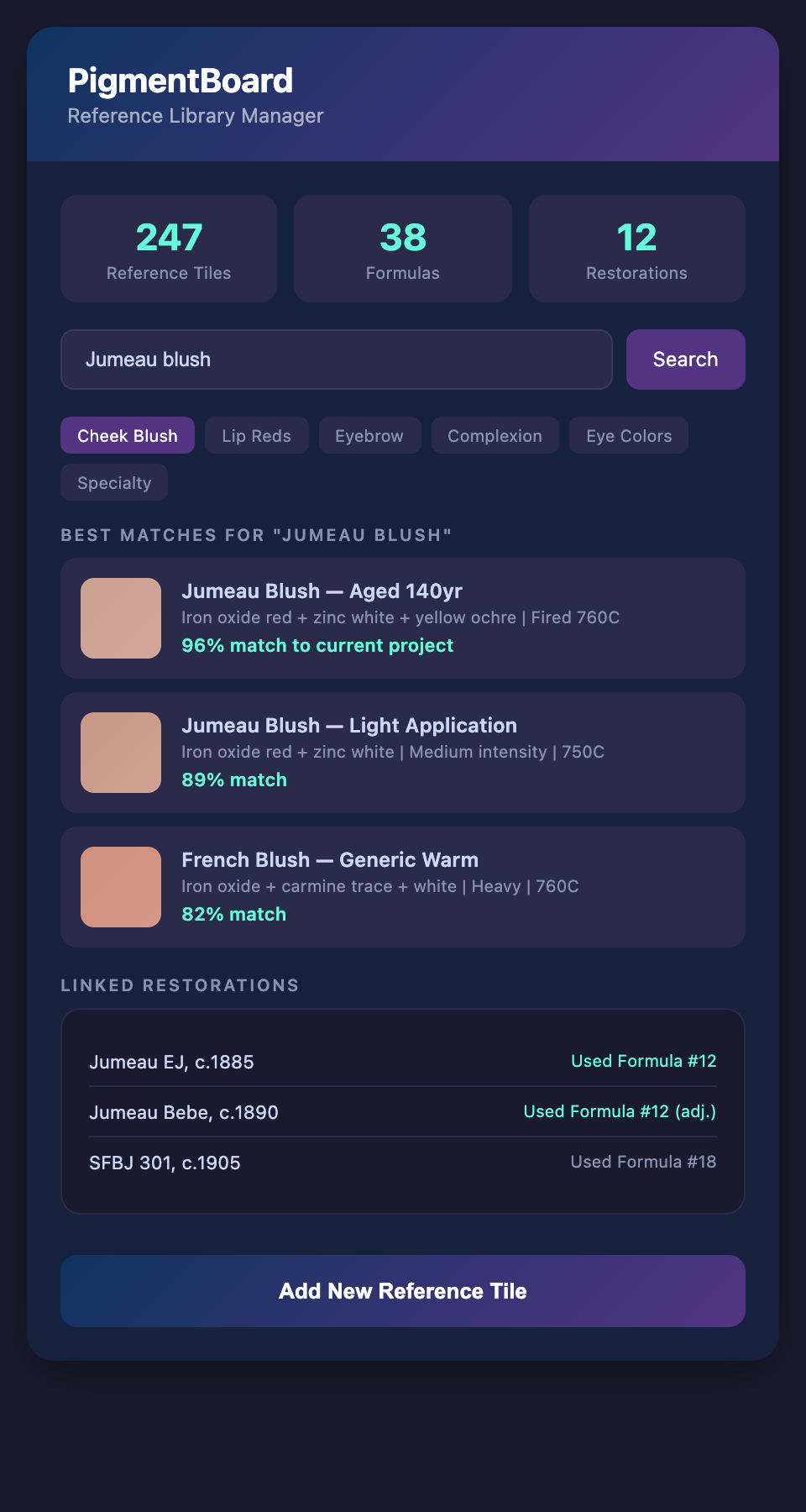
Ready to connect your reference library with degradation modeling? Join the PigmentBoard waitlist.