Why Kiln Temperature Matters for China Paint Color Accuracy
The Firing Transforms Everything
China paint is a two-state material. Before firing, its color bears almost no relationship to the final result. The transformation is temperature-dependent.
How Temperature Affects Color
Under-fired: Flux does not fully melt. Surface is matte and rough. Colors appear more opaque and less luminous. Paint is less durable.
Properly fired: Smooth thin glass layer. Optimal pigment color. Well-bonded and durable.
Over-fired: Some pigments burn out or shift. Reds shift toward brown. Pinks shift toward purple. Yellows fade. Flux becomes too fluid.
Critical Temperature Ranges
- Iron oxides: Tolerant, work well across 720-780°C
- Chrome greens, cobalt blues: Very stable
- Purple of Cassius (gold pinks): Extremely temperature-sensitive, shifting with 10-15°C variation
- Cadmium colors: Temperature-sensitive, can burn out
Kiln Management
Use a pyrometer for real-time temperature data. Use witness cones for independent confirmation. Fire consistently (same heating rate, hold time, cooling rate). Record everything.
Kiln Variation
Thermal mass, element degradation, loading, and ambient conditions all cause small variations (10-20°C) that can affect sensitive pigments.
Compensation Strategies
Fire test tiles in the same firing as the actual doll. Position consistently within the kiln. Build kiln-specific experience into your formulas.
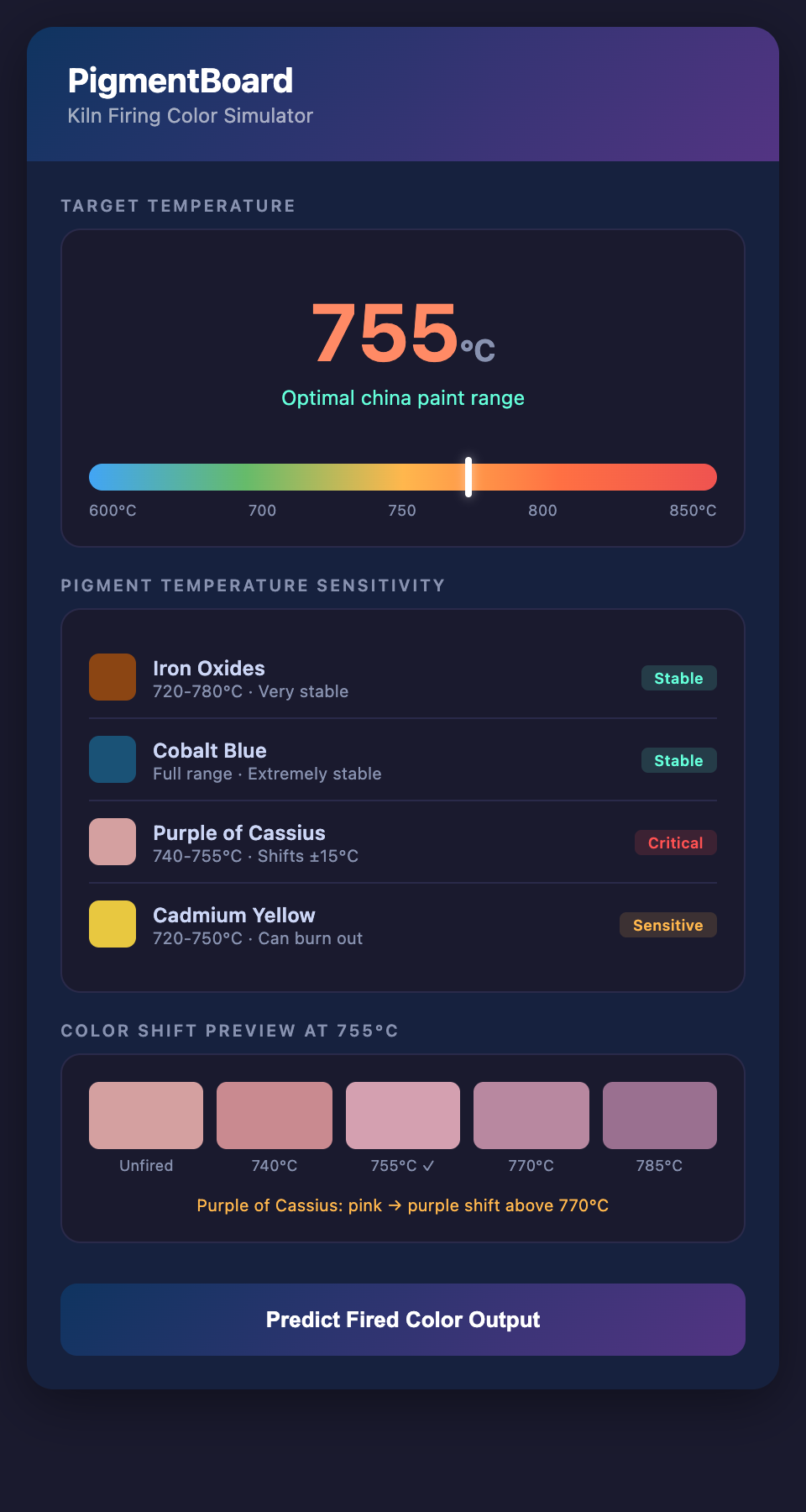
Want to predict fired color targets before opening the kiln? Join the PigmentBoard waitlist.