How to Age Fabric Colors Authentically for Period Costumes
The Aging Challenge
Every period production needs fabrics that look authentically aged. A Civil War drama needs sun-bleached indigo. A Victorian mystery needs smoke-darkened wool. A frontier story needs dust-worn cotton. The costume department must create these effects on modern fabrics, on deadline, within budget.
The traditional approach is intuitive: tea-staining, bleach washes, sandpaper distressing, and spray-painted shadows. These techniques can produce convincing results in the hands of experienced dyers, but they rely on individual skill and trial and error. When the designer says "1860s sun-bleached indigo," the dyer translates that into a series of experimental steps that may or may not hit the target.
Why Scientific Aging Matters
The problem with intuitive aging is inconsistency. When you need 40 identical "aged" shirts for a regiment of Civil War soldiers, trial and error becomes unacceptable. Shirt #1 might look perfect. Shirt #23 might be too dark. Shirt #38 might be too green. The audience notices inconsistency, even subconsciously.
Scientific aging starts with understanding what actually happens to specific dyes over time:
- Indigo fades from deep blue toward pale blue, then develops a brownish cast as oxidation products accumulate
- Madder red fades from crimson toward salmon-pink, losing warmth as the organic chromophore breaks down
- Chrome yellow maintains its hue but becomes chalky and muted
- Logwood black shifts toward rusty brown as the dye oxidizes past its stable range
- Synthetic aniline dyes (post-1856) fade unpredictably, often losing specific spectral components and shifting hue dramatically
The Degradation Modeling Approach
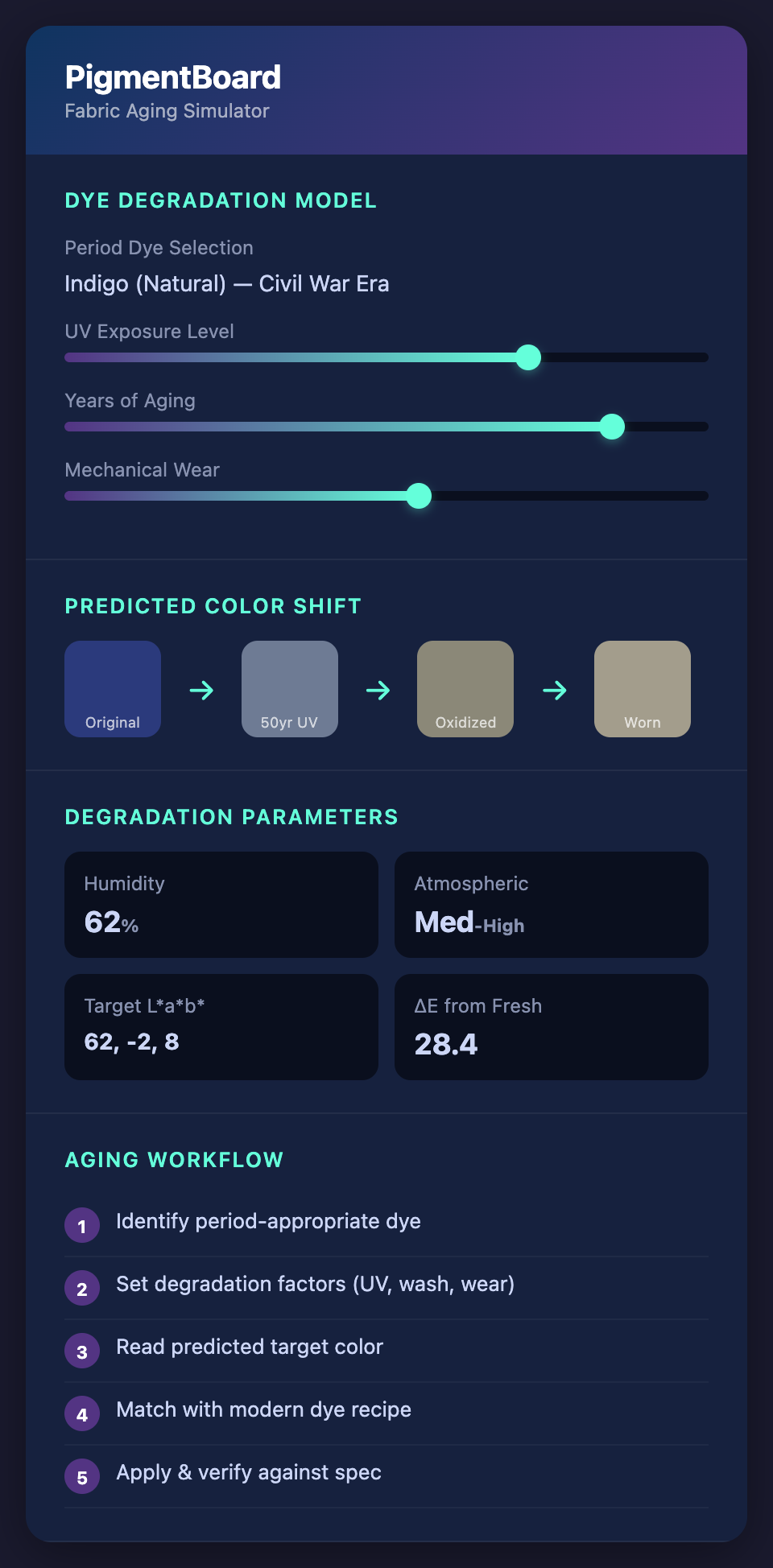
Instead of guessing at aging effects, model them:
- Identify the period-appropriate dye — What dye would have been used on this garment in this era and place?
- Determine the degradation factors — How much sun exposure, washing, wear, and atmospheric exposure would this garment have experienced?
- Set the parameters — UV exposure level, years of aging, humidity, mechanical wear
- Read the predicted color — The model outputs the target faded color
- Match with modern dyes — Use modern dyes and treatments to achieve the predicted color on modern fabric
This approach produces a specific, reproducible target color rather than an intuitive approximation.
Practical Aging Techniques Informed by Science
For UV fading effects:
- Discharge (bleach) methods remove dye, simulating photodegradation
- The key is knowing how much to remove and in which direction the color shifts
- Indigo discharged with sodium hydrosulfite loses blue evenly; bleach can shift it toward yellow-green (less authentic)
For oxidation effects:
- Tea and coffee staining adds brown tones that simulate oxidation products
- Potassium permanganate creates selective oxidation that mimics natural aging patterns
- The model tells you which brown tone to target and how much
For mechanical wear effects:
- Sandpaper, pumice, and washing simulate physical abrasion
- The model predicts how much dye loss occurs at different levels of wear
- Combine with selective bleaching for areas of greatest wear (shoulders, cuffs, knees)
For atmospheric effects:
- Smoke chambers (controlled exposure to wood or coal smoke) add authentic period yellowing
- Ammonia fuming darkens certain dyes (indigo, tannins) as it would in a gas-lit interior
- The model predicts the degree and character of atmospheric discoloration
Standardizing for Production Scale
The model's greatest value is in production consistency:
- Generate the target color once
- Create a dye recipe that hits that target
- Apply the recipe identically to every garment in the run
- Verify each piece against the target specification
This transforms aging from an art practiced by one skilled individual into a reproducible process that the entire dyeing team can execute.
Ready to age costumes with scientific precision? Join the PigmentBoard waitlist.