How to Age Printed Fabrics Without Losing Pattern Definition
The Print Preservation Challenge
Printed fabrics are common in period costumes — calico, chintz, toile, and printed cottons appear across centuries of fashion. Aging these fabrics is more complex than aging solid-color fabric because you must fade the colors while preserving the pattern.
How Printed Fabrics Age Naturally
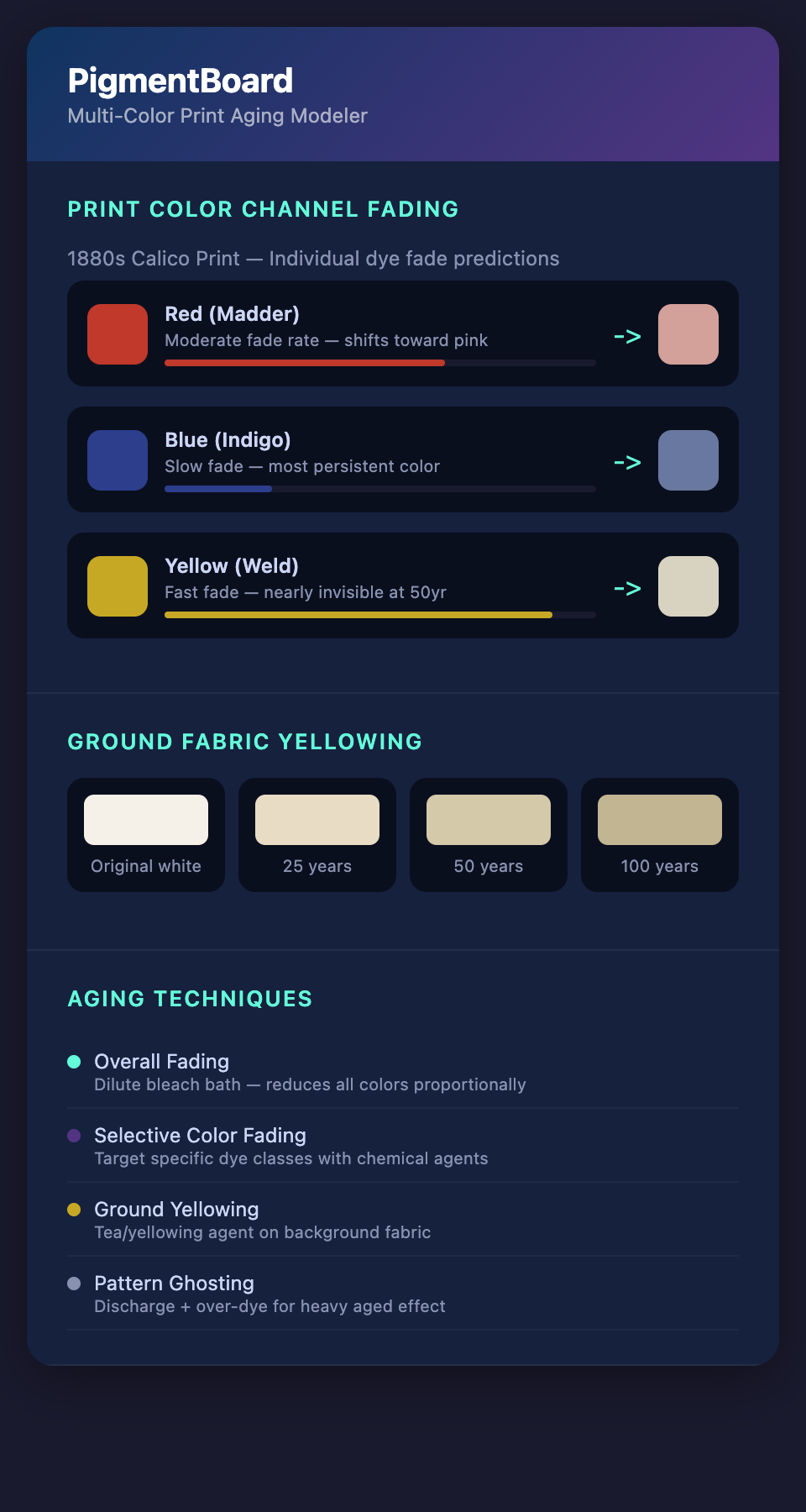
Differential fading by color. In a multi-color print, each color fades at its own rate. Red madder fades faster than blue indigo. Yellow weld fades fastest of all. Over decades, a multicolor print becomes increasingly dominated by its most light-fast colors.
Pattern ghosting. Heavily faded prints retain faint outlines of the original pattern — the dye is mostly gone but not completely. This ghosted quality is characteristic of authentically aged prints.
Ground fabric change. The undyed ground fabric yellows with age, changing the background against which the printed colors are seen.
Selective wear at folds. Printed fabrics folded for storage show sharper fading at fold lines (from mechanical stress and concentrated atmospheric exposure).
Aging Techniques for Prints
Overall fading: A controlled bleach bath (very dilute, short duration) reduces all colors proportionally. Check frequently — over-bleaching quickly destroys pattern definition.
Selective color fading: Some colors can be selectively faded by choosing chemicals that attack specific dye classes. Sodium hydrosulfite reduces indigo without affecting iron oxide prints. This creates the differential fading characteristic of natural aging.
Ground yellowing: After fading the print colors, tone the entire fabric with a dilute tea or yellowing agent. This affects the ground more than the already-faded print areas.
Pattern ghosting: For heavy aging, a combination of discharge and over-dyeing can create the ghosted quality: discharge to near-white, then over-dye with a pale uniform tone.
The Model Advantage
A degradation model can predict how each color in a multicolor print will fade independently:
- Red component: predict the faded shade of the specific red dye used in the era
- Blue component: predict the faded blue
- Yellow component: predict the faded yellow (often nearly invisible)
- Ground: predict the yellowed background
These individual predictions guide the aging process — you know which colors should fade most and can target your treatments accordingly.
Ready to model multi-color print aging with precision? Join the PigmentBoard waitlist.