Aging White and Natural Fabrics for Period Authenticity
White Was Never White
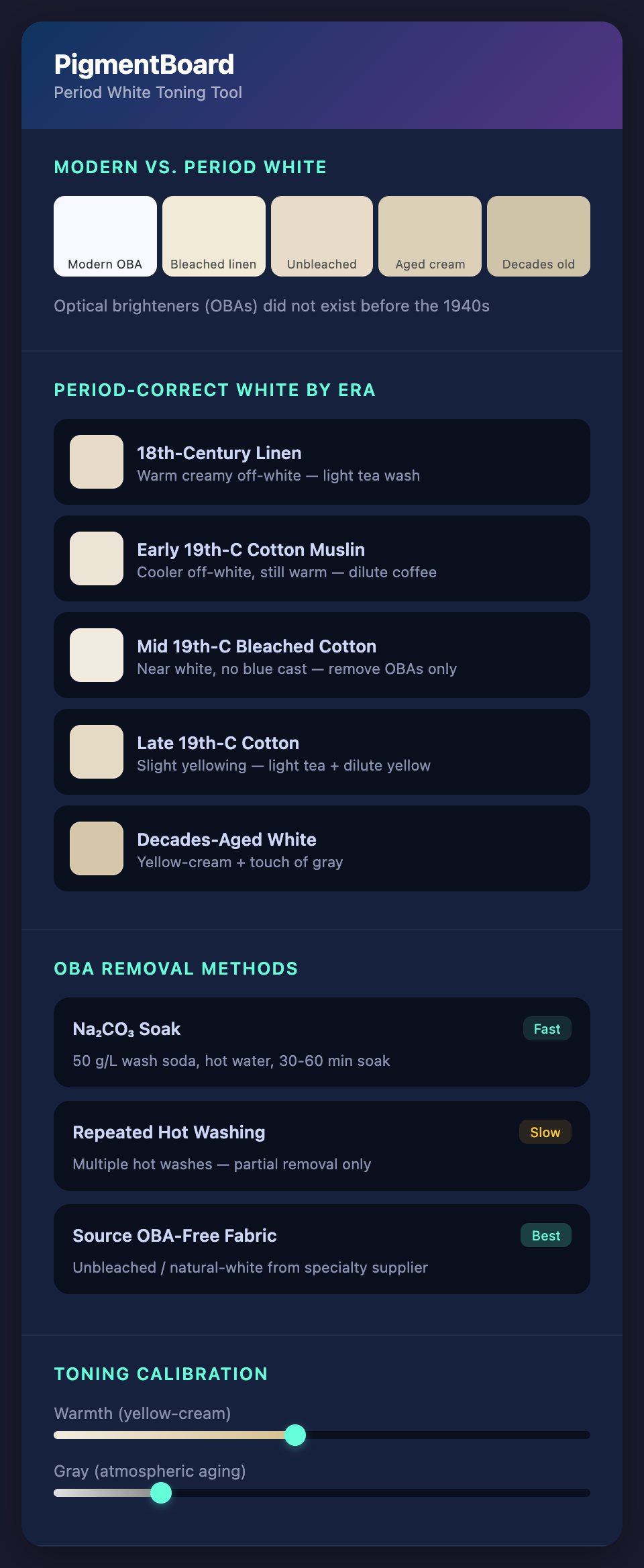
Modern fabrics are treated with optical brightening agents (OBAs) that absorb UV light and re-emit it as visible blue-white light, making the fabric appear brighter-than-white. This effect did not exist before the 1940s.
Historical "white" fabrics were:
- Unbleached linen: a warm grayish-cream
- Bleached linen: an off-white with a slight warm tone
- Cotton: naturally cream to pale yellow
- Bleached cotton: closer to true white but without the blue-cast brightness of OBA-treated modern cotton
- Wool: naturally cream to pale yellow, even when bleached
Putting modern bright-white fabric on a period stage is an immediate anachronism.
Removing Optical Brighteners
Washing. OBAs are partially removed by repeated washing, especially in hot water. But this is slow and incomplete.
UV exposure. Ironically, prolonged UV exposure degrades OBAs. But this takes days and is impractical for production timelines.
Sodium carbonate soak. A wash soda solution (50g/L, hot water, 30-60 minute soak) helps remove OBAs more quickly. Multiple treatments may be needed.
Choosing the right base fabric. The easiest solution is to source fabric without OBAs. Unbleached or natural-white fabrics from specialty suppliers are available and eliminate the problem entirely.
Period-Appropriate White Tones
18th-century linen: A warm, creamy off-white. Achieve with a light tea wash or very dilute iron acetate solution.
Early 19th-century cotton muslin: A slightly cooler off-white, still warm but less cream than linen. Light tea wash or very dilute coffee.
Mid-19th-century bleached cotton: Closest to true white but without the blue brightness. Remove OBAs; may not need additional toning.
Late 19th-century cotton: May be slightly yellowed from age and atmospheric exposure. Light tea toning or very dilute yellow dye.
Aged white (decades old): Distinctly yellow-cream from oxidation and atmospheric deposits. Stronger tea toning, possibly with a touch of gray (dilute black dye).
Consistency Across the Run
White toning is one of the most difficult aging effects to keep consistent. The margin between "too white" and "too yellow" is narrow, and small variations in treatment produce visible differences.
Use the model to define a specific target tone, prepare a reference swatch, and check every piece against it. For white and near-white tones, spectrophotometer measurement is especially valuable because the eye is more sensitive to small differences in light colors than in dark ones.
Ready to nail the period-perfect off-white on the first try? Join the PigmentBoard waitlist.