Matching Sun-Bleached Indigo for Civil War Costume Productions
The Indigo Problem
Every Civil War production needs faded blue uniforms. And every production discovers that simply bleaching modern indigo-dyed fabric does not produce the right look. The result is too clean, too even, too purely "light blue" — missing the complex, lived-in quality of authentically aged indigo.
How Indigo Actually Ages
Indigo (indigotin, C16H10N2O2) degrades through a specific chemical pathway:
Stage 1: Surface fading. UV light breaks down indigotin molecules on the fiber surface. The interior of the fiber retains more dye. The result is a characteristic unevenness — the surface appears lighter while thread interiors remain darker, creating visual depth.
Stage 2: Oxidation to isatin. Indigotin oxidizes to isatin (C8H5NO2), which is yellowish. The blue + yellow = a subtle green or gray-green cast. This is why old indigo has a quality that pure light blue does not.
Stage 3: Further oxidation. Isatin continues oxidizing to colorless or brownish products. Areas of heaviest exposure show a brown cast over the remaining blue.
Stage 4: Mechanical loss. Physical wear removes dye-bearing fiber from the surface, especially at creases, folds, and abrasion points. This creates the white-at-creases characteristic of well-worn denim and uniforms.
Why Simple Bleaching Fails
Commercial bleach (sodium hypochlorite) removes indigo by a different chemical mechanism than UV degradation. Bleach oxidizes indigo directly and uniformly, producing a flat, even lightening without the characteristic surface-interior variation, green/brown undertones, or wear-pattern emphasis that natural aging produces.
The result of bleach aging looks bleached. The result of natural aging looks lived-in. Audiences perceive the difference, even if they cannot articulate it.
Replicating Authentic Aging
For the UV fading component: Use sodium hydrosulfite (rather than chlorine bleach) for indigo reduction. Hydrosulfite reduces indigo to its soluble leuco form and removes it from the fiber, more closely mimicking UV degradation.
For the oxidation component: After lightening, apply a dilute tea or tannin wash to add the warm, brownish undertone that oxidation products (isatin and its derivatives) contribute to aged indigo.
For the green cast: A very dilute yellow dye (turmeric, quercitron, or synthetic yellow) over-dyed on the lightened blue can replicate the isatin-induced greenish quality.
For the mechanical wear: Selective distressing at creases, wear points, and edges using sandpaper, pumice stones, or industrial garment washing. The degradation model tells you how much dye loss to target at each wear point.
The Model Advantage for Production Scale
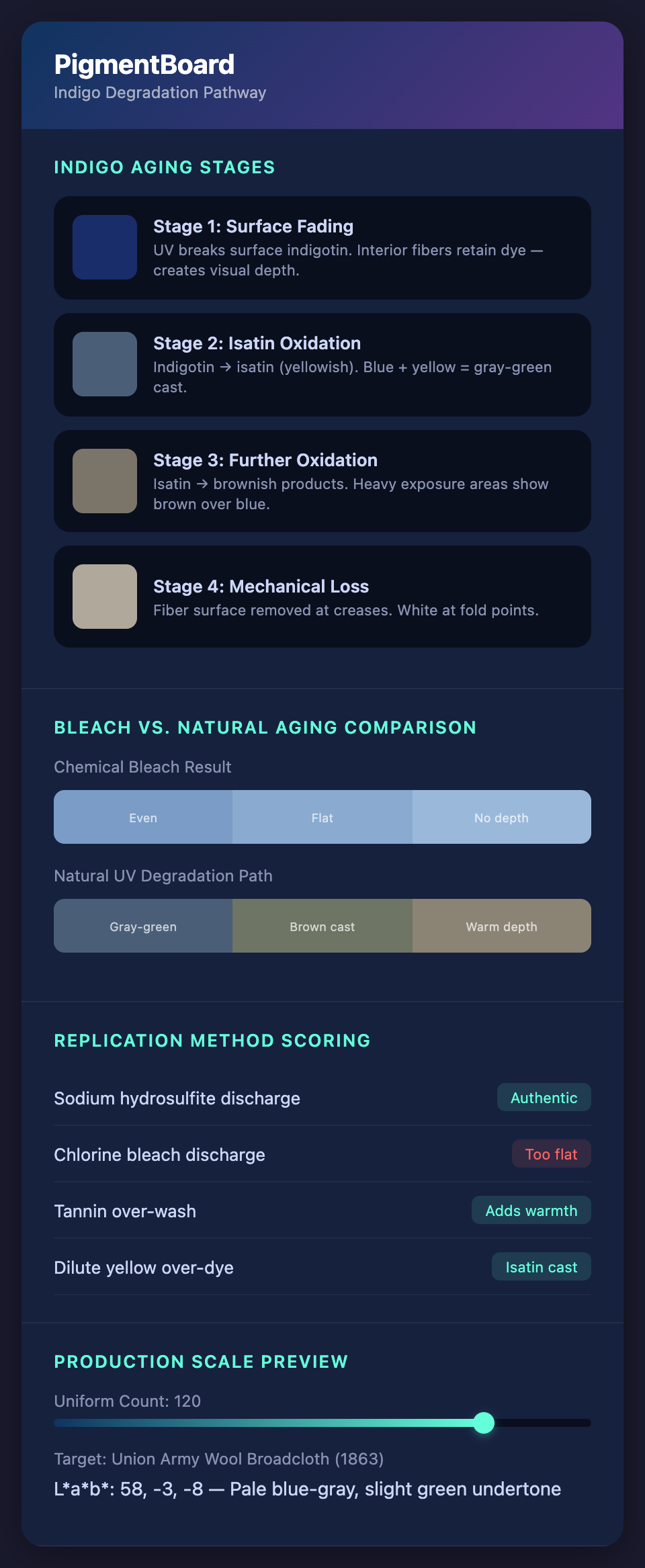
A Civil War production might need 50-200 identical "aged" blue uniforms. Without a model:
- Each garment is aged individually by a skilled dyer
- Consistency depends on the dyer's eye and memory
- Variations between garments create continuity problems on camera
With a model:
- The target color is defined once with specific parameters
- A dye recipe is developed to hit that target
- Every garment receives the same recipe
- Consistency is built into the process
Period-Specific Indigo Notes
Union army wool broadcloth (1861-1865) was typically dyed with natural indigo in a fermentation vat. The dye penetration was moderate. After 3-4 years of field service (plus ~160 years of subsequent aging), surviving examples show:
- Pale blue-gray on exposed surfaces
- Slightly greenish or brownish undertone
- Darker blue retained in seams and protected areas
- White fiber visible at crease points
Confederate army fabric varied widely in quality and dye. Butternut (a brown from walnut or copperas-treated logwood) and gray (from mixed indigo/brown dyes) were common. Aging these requires different modeling than Union blue.
Ready to model period-specific indigo aging for your next production? Join the PigmentBoard waitlist.