Building a Period Dye Color Reference Library for Costume Houses
Invest Once, Benefit Forever
Every costume house that does period work repeatedly solves the same aging problems: "What does 1860s faded indigo on cotton look like?" "What is the right aged tone for 1890s cream silk?" "How brown should a Civil War-era logwood black be?"
A reference library of physically aged (or aged-to-specification) fabric swatches, organized by era, dye type, and fabric type, answers these questions instantly.
Library Structure
Organize by era, then by color family:
Pre-1856 Natural Dyes
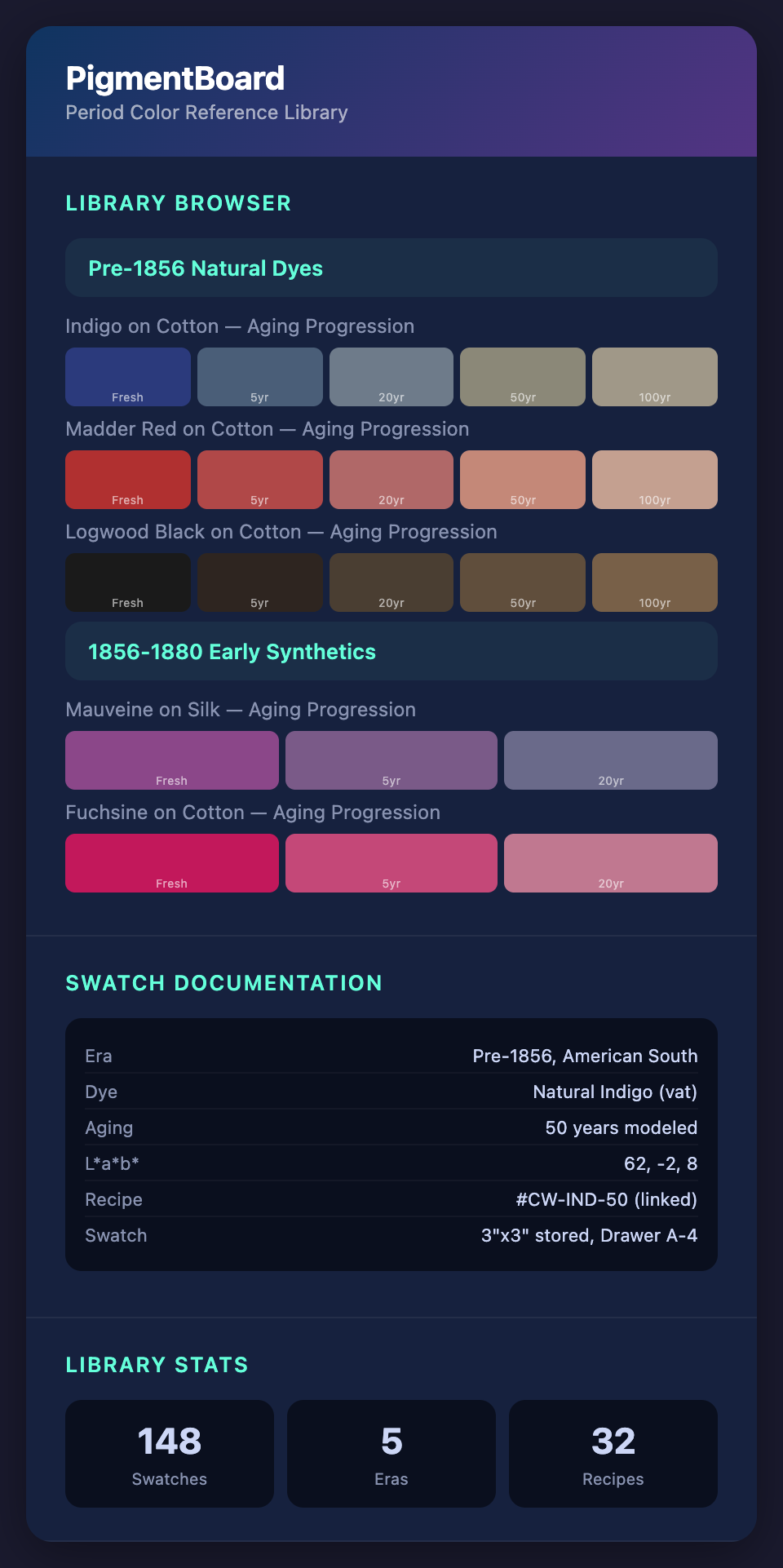
- Indigo on cotton: fresh, 5yr aged, 20yr aged, 50yr aged, 100yr aged
- Madder red on cotton (aluminum mordant): same progression
- Weld yellow on wool: same progression
- Logwood black on cotton (iron mordant): same progression
- [Continue for all major dye-fiber combinations]
1856-1880 Early Synthetics
- Mauveine on silk: fresh, 5yr aged, 20yr aged
- Fuchsine on cotton: same progression
- [Continue]
1880-1910 Late Victorian
- Congo red on cotton: fresh through aged
- Methyl violet on wool: fresh through aged
- [Continue]
Creating the Swatches
Method 1: Degradation-modeled dyeing. Dye modern fabric to the predicted aged color for each era/dye/age combination. This is fast and produces consistent results.
Method 2: Accelerated aging. Dye fabric with period-appropriate dyes, then accelerate aging using UV chambers, heat, and humidity. This produces more authentic degradation products but takes weeks.
Method 3: Natural aging. Dye fabric with period dyes and expose to natural conditions over years. Most authentic but requires long-term planning.
Recommended: Use Method 1 for the working library (available immediately) and supplement with Methods 2 and 3 over time for validation.
Documentation
Each swatch should include:
- Era and geographic context
- Original dye identification
- Aging duration modeled
- Degradation parameters used
- Lab* values measured
- Physical swatch (minimum 3" x 3")
- Digital photograph (controlled lighting, color card)
- Recipe used to achieve the color
Using the Library
For a new production:
- Identify the era and geographic setting
- Browse the relevant era section of the library
- Select the appropriate aged colors for each costume
- Pull up the recipes for those colors
- Begin aging with validated, pre-tested recipes
Time saved: Days of development testing eliminated for every production that falls within the library's coverage.
Consistency gained: Colors are historically validated and visually calibrated against a growing body of reference material.
Growing the Library
After each production, add the successfully used aging recipes and swatches to the library. Over years, the library becomes increasingly comprehensive — covering more eras, more dyes, more fabrics, and more aging levels.
Ready to build your reference library from degradation model predictions? Join the PigmentBoard waitlist.