Atmospheric Pollutants and Their Effects on Museum Textile Colors
The Invisible Threat to Your Collection
Museum environmental controls focus on temperature, humidity, and light. Air quality is often an afterthought — filtered HVAC systems are assumed to handle the problem. But many museum buildings, especially historic structures repurposed as galleries, have imperfect air filtration. And textiles that entered the collection after decades in uncontrolled environments carry the chemical legacy of atmospheric pollutant exposure.
For conservators, understanding pollutant-driven color change is essential for accurate color matching — because pollutant damage produces color shifts that are distinct from UV or humidity degradation and cannot be predicted by UV-only models.
The Three Major Pollutants
Sulfur dioxide (SO2) enters museums from vehicle exhaust, industrial emissions, and natural sources. In the presence of moisture, SO2 forms sulfuric acid on fiber surfaces.
Effects on pigments:
- Lead white darkens to gray-black as lead sulfide forms — one of the most dramatic pollutant effects in art conservation
- Copper-based pigments (verdigris, malachite) shift toward black as copper sulfide forms
- Organic dyes experience accelerated hydrolysis as the acid environment breaks molecular bonds
- Iron-mordanted textiles show accelerated darkening as iron sulfide compounds form
Nitrogen oxides (NOx) come from combustion sources and can penetrate museum buildings through ventilation systems. NOx are powerful oxidizers.
Effects on pigments:
- Accelerate oxidation of all organic dyes, producing effects similar to but faster than atmospheric oxygen alone
- Particularly destructive to indigo, which oxidizes to yellow isatin much faster in NOx-rich environments
- Can cause yellowing of undyed textile fibers, changing the "background" color against which dyed areas are perceived
Ozone (O3) is a potent oxidizer that can reach significant indoor concentrations, especially in urban areas during summer.
Effects on pigments:
- Extremely destructive to organic dyes — some dyes lose significant color in just weeks of elevated ozone exposure
- Attacks double bonds in dye molecules, which are the structural features responsible for color absorption
- Produces color shifts toward brown and gray across nearly all organic dye classes
- Effects are accelerated by humidity
Historic vs. Current Exposure
A critical distinction for conservators: you need to account for both the textile's historic pollutant exposure and its current museum environment.
Historic exposure may include:
- Decades in coal-heated homes (high SO2, soot particles)
- Urban environments with heavy industrial pollution (pre-Clean Air Act)
- Display in gas-lit galleries (combustion products including SO2 and NOx)
- Storage near materials that off-gas (acidic cardboard, certain woods, rubber)
Current museum exposure is typically much lower but not zero:
- Urban museums may have measurable indoor NOx and ozone levels
- Historic building museums often have limited air filtration
- Display cases made from certain materials can create microenvironments with elevated pollutant levels
- Temporary exhibitions in non-museum venues may expose textiles to uncontrolled air quality
Diagnosing Pollutant Damage
Several clues help conservators identify pollutant-driven color change:
- Uniform surface discoloration — Unlike UV damage (which is directional, affecting the light-exposed side more), pollutant damage is often more uniform because air contacts all surfaces
- Darkening rather than lightening — Many pollutant reactions produce darker degradation products, while UV often produces lighter ones
- Fiber damage patterns — SO2 damage is often accompanied by fiber weakening (acid hydrolysis), especially in cellulosic fibers
- Metallic pigment changes — Dramatic darkening of lead white or copper greens is a strong indicator of sulfur-containing pollutants
- Object history — A textile from a 19th-century industrial city has a very different pollutant profile from one kept in a rural area
Incorporating Pollutant Effects Into Color Matching
Step 1: Assess the pollutant exposure history. Where was the textile for the last 150 years? Urban or rural? Industrial or residential? Climate-controlled or not?
Step 2: Identify the dominant pollutant effects. Are you seeing the darkening characteristic of sulfide formation? The accelerated oxidation typical of NOx/ozone exposure? The acid damage signature of SO2?
Step 3: Adjust your degradation model. A comprehensive model needs pollutant exposure as an independent variable, separate from UV and humidity. The effects of SO2 are chemically different from the effects of ozone, and both differ from UV — they cannot be lumped together.
Step 4: Account for synergies. Pollutants interact with UV and humidity:
- Humidity + SO2 = sulfuric acid formation (accelerated acid hydrolysis)
- UV + ozone = accelerated photo-oxidation
- NOx + humidity = nitric acid formation
These synergies mean you cannot simply add pollutant effects on top of UV and humidity effects — the combined impact is greater than the sum.
The Case for Multi-Factor Modeling
This is now the fourth major degradation factor we have discussed (after UV, oxidation, and humidity). Each one affects pigments through a different chemical pathway, interacts with the others in non-linear ways, and produces different color shifts.
No conservator can hold all of these interactions in their head simultaneously. This is not a criticism — it is a statement about the complexity of the chemistry involved. A four-factor degradation model with interaction terms requires computational support.
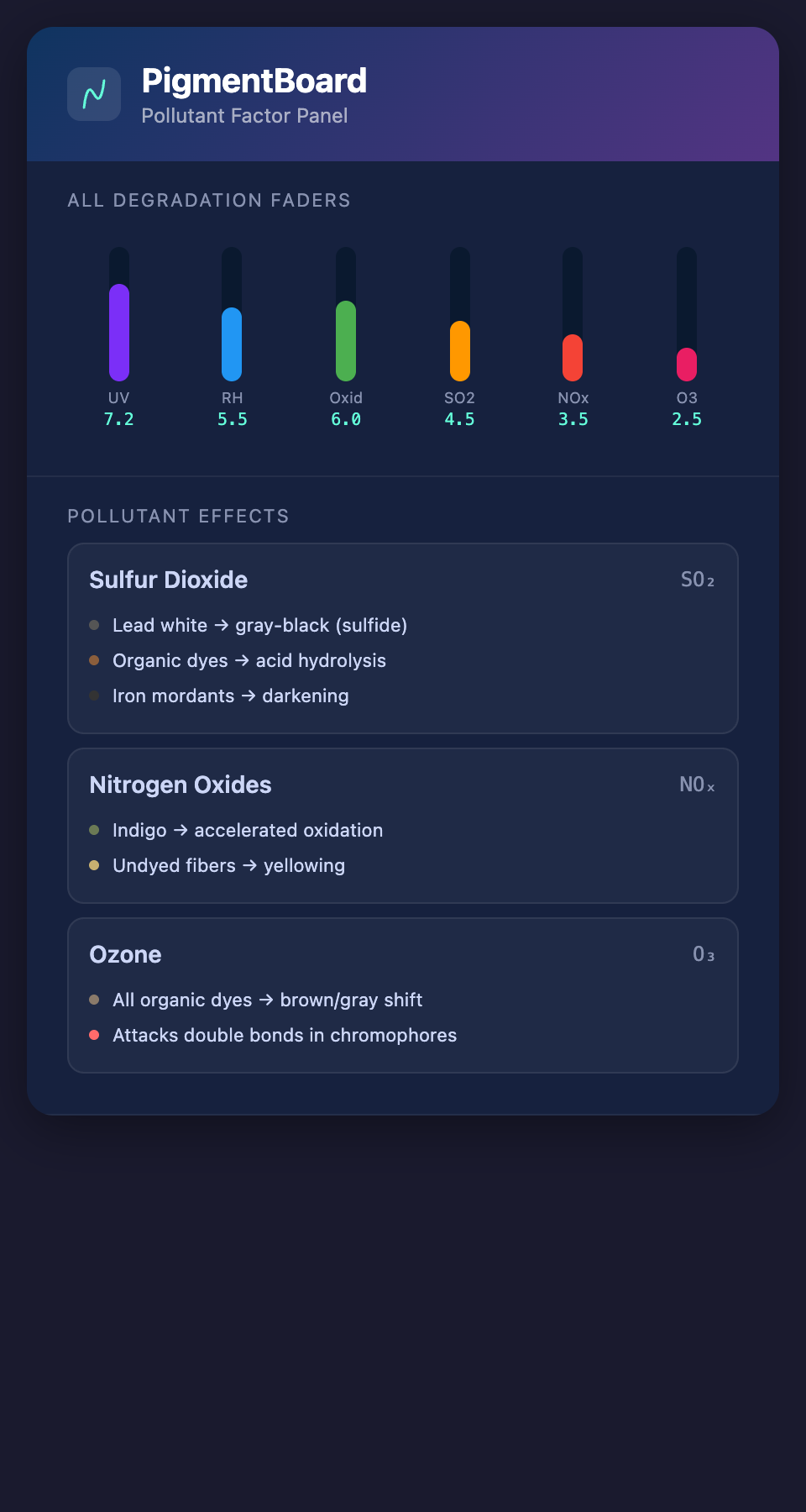
A soundboard interface makes this complexity manageable:
- One fader for UV exposure
- One fader for humidity
- One fader for SO2 / acid pollutants
- One fader for oxidizing pollutants (NOx, ozone)
- The model computes interactions automatically
- The conservator evaluates and adjusts
Protecting Your Collection Going Forward
Understanding pollutant effects also helps with preventive conservation:
- Prioritize air filtration in galleries housing sensitive textiles
- Monitor indoor air quality — inexpensive sensors can detect SO2, NOx, and ozone levels
- Use activated carbon filtration in display cases for the most sensitive objects
- Avoid materials that off-gas in display and storage (acidic cardboard, certain adhesives, rubber gaskets)
- Document current air quality conditions so future conservators can assess ongoing exposure
Building the Complete Picture
Accurate color matching requires accounting for all significant degradation factors. For a textile that spent 80 years in a coal-heated urban home and then 70 years in a museum, the color you see today is the result of UV exposure, oxidation, humidity, and atmospheric pollutants — all acting simultaneously and synergistically.
Modeling any one factor alone gives an incomplete prediction. Modeling all four, with their interactions, gives you a prediction that is close enough to serve as a reliable starting point for physical mixing.
Ready to model UV, humidity, oxidation, and pollutant effects in one integrated interface? Join the PigmentBoard waitlist.