Why Conservation-Grade Pigment Matching Still Relies on Guesswork
The Gap Between Science and Practice
Conservation science has never been more advanced. Researchers have published detailed photodegradation curves for madder, indigo, cochineal, Prussian blue, chrome yellow, and dozens of other historic pigments. We know exactly which chemical bonds break under UV exposure, how humidity accelerates oxidation, and how atmospheric pollutants alter color over decades.
And yet, in most conservation labs around the world, the actual process of matching a degraded pigment still looks like this:
- Stare at the faded area under a daylight lamp
- Squeeze out some pigment onto a palette
- Mix by instinct and experience
- Apply to a test card
- Wait for it to dry
- Compare
- Adjust and repeat — sometimes five, ten, or fifteen times
This is not a criticism of conservators. They are among the most skilled and dedicated professionals in any field. The problem is that the tools available to them have not kept pace with the science they already understand.
Why the Knowledge Exists But the Tools Do Not
The disconnect has three root causes:
1. Conservation is a small market. Commercial color-matching technology serves the automotive, architectural, and cosmetics industries — markets worth billions. Museum conservation is a global market of perhaps a few thousand active labs. No major software company has found it profitable to build tools specifically for historic pigment degradation.
2. The science is published in academic journals, not software. The photodegradation curves, spectral data, and chemical pathways exist in peer-reviewed papers. Converting that data into a usable, interactive tool requires software development resources that conservation labs do not typically have.
3. Conservators are trained in material skills, not digital tools. Conservation education emphasizes hands-on material knowledge — and rightly so. But this means many conservators are more comfortable with a palette knife than a software interface, and there has been little institutional pressure to change this.
What the Guesswork Actually Costs
The trial-and-error approach works. Skilled conservators do eventually arrive at excellent matches. But the process carries hidden costs that are rarely accounted for:
- Time — An experienced conservator spends 30-90 minutes matching a single degraded color. Over a large project, this adds up to weeks.
- Material waste — Each failed test batch consumes conservation-grade pigments, which are expensive and sometimes difficult to source.
- Inconsistency — When multiple conservators work on the same collection, their independent color matches often diverge slightly, creating a patchwork effect.
- Lost knowledge — When a conservator retires or moves to another institution, their accumulated color-matching intuition goes with them.
- Stress and frustration — Color matching is frequently cited by conservators as one of the most stressful parts of their work, precisely because it feels uncertain despite their expertise.
The Myth of the "Good Eye"
There is a persistent belief in conservation that color-matching is fundamentally an art — that some people simply have a "good eye" and others do not, and that no tool can replace human perception.
This is partially true and mostly misleading.
Human color perception is extraordinary. We can distinguish millions of hues. But perception is also:
- Variable — It changes with fatigue, age, ambient lighting, and even what you ate for lunch (blood sugar affects retinal function)
- Relative — We perceive colors in context. The same swatch looks different against a white background versus a dark one.
- Subject to metamerism — A match that looks perfect under one light source can look wrong under another
- Non-transferable — You cannot share your perception with a colleague
A "good eye" is invaluable for evaluating a final result. But the process of arriving at that result — the mixing, testing, adjusting cycle — can be dramatically shortened by starting from a scientifically informed prediction rather than a blank palette.
What a Better Workflow Looks Like
Imagine this alternative process:
- Identify the original pigment based on the textile's age, origin, and fiber type (this step already happens in current practice)
- Input the degradation parameters — estimated UV exposure, humidity history, atmospheric conditions — into a modeling tool
- Receive a predicted target color and a suggested pigment formula
- Compare the prediction to the actual faded sample under controlled lighting
- Fine-tune — adjust the degradation parameters until the model output matches the physical sample
- Mix the formula — once, with confidence
- Apply and verify — using your trained eye for the final judgment
This workflow does not eliminate the conservator's expertise. It amplifies it. The conservator still makes every critical decision — identifying the original pigment, evaluating the match, approving the result. What changes is that the laborious middle steps — the guessing, mixing, drying, comparing, remixing — are compressed from hours to minutes.
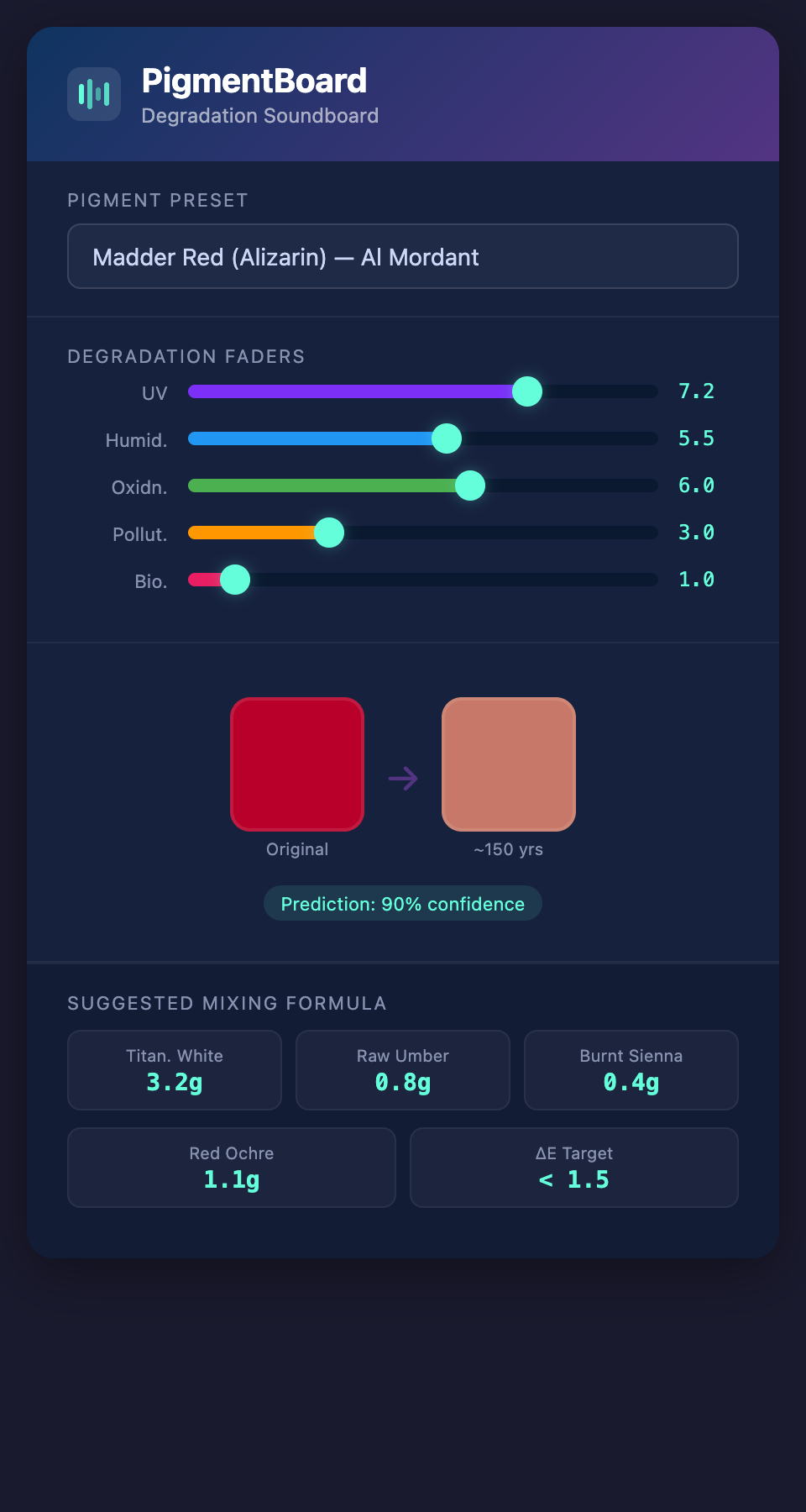
The Soundboard Analogy
Audio engineers do not mix music by randomly adjusting levels until it sounds right. They use mixing boards with individual channel faders that give precise, independent control over each element. They can solo a channel, adjust it in isolation, and hear the result in real time.
Pigment degradation has the same multi-variable structure:
- UV exposure is one channel
- Humidity is another
- Chemical pollutants are another
- Biological agents are another
- Temperature cycling is another
Each factor affects the pigment independently, and their combined effect produces the final degraded color. A "degradation soundboard" lets conservators adjust each factor independently, see the predicted result in real time, and arrive at a precise match without iterative physical mixing.
Bridging the Gap
The knowledge is there. The science is published. The need is clear. What has been missing is a tool that translates conservation science into a practical, intuitive interface that fits naturally into a conservator's workflow.
This is not about replacing the conservator. It is about giving them a better starting point — so their expertise is spent on judgment calls and quality evaluation, not on repetitive trial-and-error mixing.
Moving Forward
The next time you spend 45 minutes matching a faded madder red, consider: what if you had started with a prediction that was already 90% accurate? How would that change your day? Your project timeline? Your confidence in the result?
The tools to make this possible are coming. Join the PigmentBoard waitlist to be among the first conservators to leave guesswork behind.