The Cost of Patchwork Repairs in Museum Exhibition Quality
When Repairs Become the Story
A well-executed conservation repair is invisible. The visitor sees a historical textile and engages with its story, craftsmanship, and cultural significance. A poorly matched repair breaks that engagement. The visitor's eye is drawn to the patch, the color mismatch, the visible seam. The textile becomes "that repaired thing" rather than "that extraordinary 18th-century embroidery."
This is not merely an aesthetic problem. It has tangible costs for the museum — costs that are rarely quantified but are very real.
The Visitor Experience Cost
Museum visitor studies consistently show that perceived authenticity is a primary driver of engagement. Visitors come to museums to see "the real thing." When repairs are visible, the perception of authenticity diminishes.
Specific impacts include:
- Reduced dwell time — Visitors spend less time with objects that look repaired or compromised
- Diminished emotional response — The sense of connection to history is weakened when the object looks patched together
- Negative word-of-mouth — Visitors who notice poor repairs mention it to others, affecting reputation
- Photography avoidance — In the social media era, visitors photograph objects that look impressive, not ones that look repaired. This affects the museum's organic reach.
The Scholarly Cost
Art historians, textile historians, and other researchers rely on museum displays and collections for their work. Visible repairs create problems:
- Misinterpretation of original color — If a repair is close but not exactly right, researchers may incorporate the inaccurate color into their analysis of period dyeing practices
- Publication limitations — Photographs of visibly repaired textiles are less useful for publication than photographs of intact or invisibly repaired ones
- Reduced research access — Some researchers avoid working with heavily repaired objects because they cannot confidently distinguish original from restored material
The Financial Cost
Visible repairs have direct financial implications:
- Retreatment cost — When a patchwork repair is deemed unacceptable, the textile may need retreatment — doubling the conservation labor cost
- Exhibition design workarounds — Curators may request specific lighting, display angles, or barrier distances to minimize the visibility of poor repairs, increasing exhibition costs
- Loan refusal — Lending institutions and borrowing institutions both assess object condition. Visible repairs can make a textile less desirable as a loan, reducing exhibition opportunities and the revenue they generate
- Insurance and valuation — Visible, poorly matched repairs can affect appraised value
Why Patchwork Happens
No conservator intends to create a visible repair. Patchwork results happen for identifiable reasons:
Time pressure. The most common cause. Exhibition deadlines, project timelines, and budget constraints pressure conservators to "good enough" rather than perfect matches. When you have 30 textiles to treat and a fixed deadline, each one gets less time.
Skill variation. In multi-conservator projects, different team members produce different quality matches. Without standardized formulas and evaluation criteria, variation is inevitable.
Lighting mismatch. The repair looked perfect in the lab but wrong in the gallery. This is a metamerism issue that proper workflow can prevent.
Material degradation. The repair itself can change color over time if conservation materials are not fully stable. What was an invisible match at application may become visible in five or ten years.
Wrong identification. If the original pigment was misidentified, the degradation model (whether mental or digital) produces the wrong target color. The match may look acceptable in the lab but diverge when viewed alongside properly matched areas.
Quantifying the Problem
To build a case for better color-matching tools and workflows, quantify the current cost of patchwork repairs:
Track retreatment rates. What percentage of treatments require color-matching revision after initial application? Each retreatment represents wasted labor and materials.
Measure matching time. How many hours does your lab spend on iterative color matching per year? This is the time that could be reduced by more efficient methods.
Survey exhibition reviews. Collect feedback from curators, exhibition designers, and visitor studies about repair visibility. Specific complaints about specific objects create a concrete improvement target.
Calculate material waste. How much conservation-grade pigment is discarded in failed test batches? At $20-100+ per pigment, this adds up.
The Business Case for Better Tools
Once you have quantified the problem, the business case for better color-matching tools becomes straightforward:
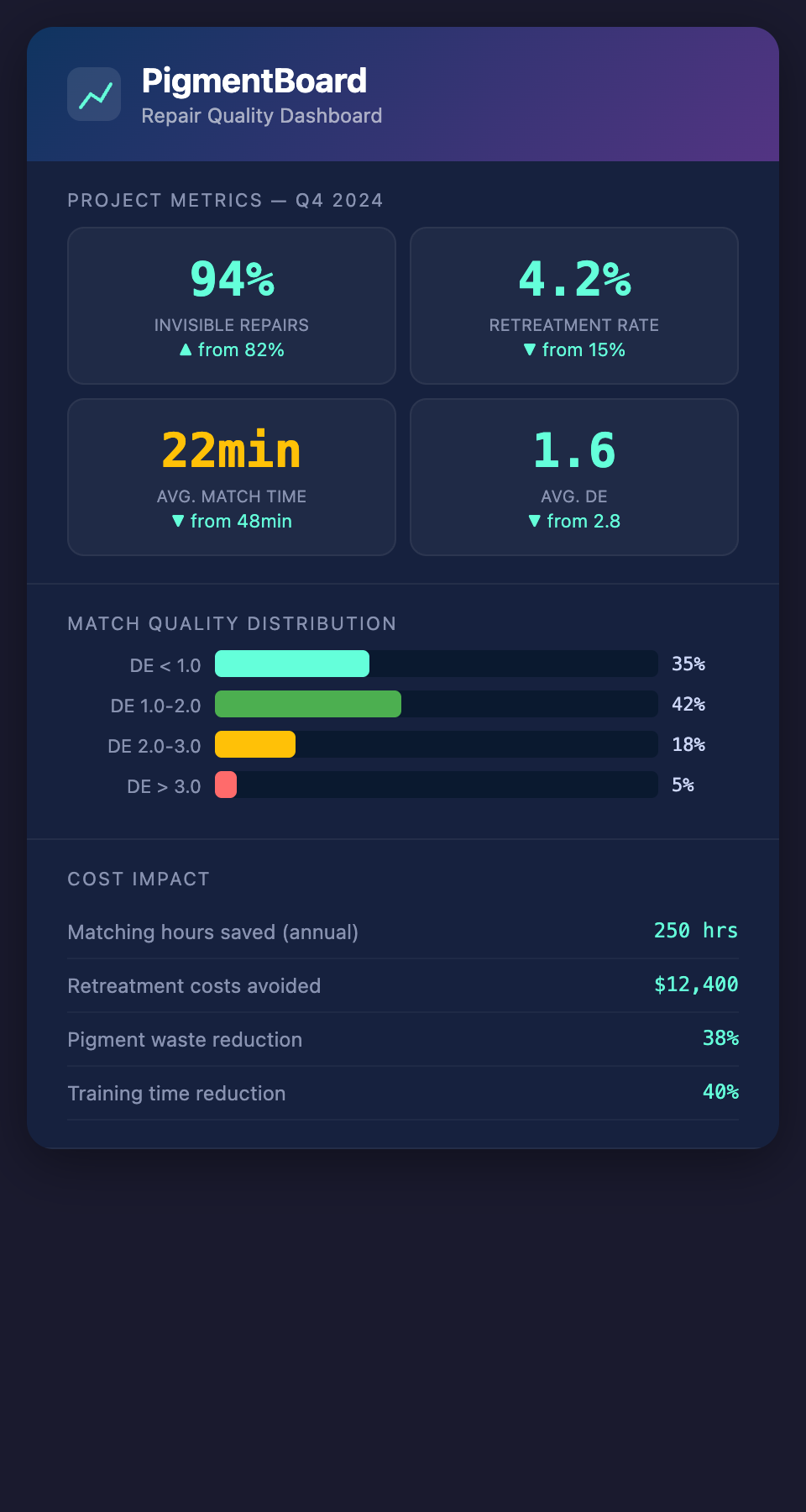
- If your lab spends 500 hours/year on iterative color matching, and a modeling tool reduces this by 50%, that is 250 hours freed for other conservation work
- If retreatment rates drop from 15% to 5%, that is a measurable reduction in wasted labor and materials
- If exhibition quality improves measurably (fewer visible repairs noted in reviews), that supports the museum's mission and reputation
- If training time for junior conservators decreases, the lab can bring new staff to productivity faster
These are not speculative benefits — they are directly measurable outcomes that justify investment in tools, training, and workflow improvements.
Moving Beyond Patchwork
The solution is not to work harder. The solution is to work more systematically:
- Invest in proper identification before matching — know what you are looking at
- Use degradation modeling to generate an informed starting point
- Standardize evaluation conditions — lighting, surroundings, viewing distance
- Verify under gallery conditions before final application
- Document everything — so successful formulas can be reused and improved
- Measure results — track match quality, retreatment rates, and time investment
Every visible repair that could have been invisible is a missed opportunity. The knowledge and technology to prevent patchwork results exist. The question is whether your lab is equipped to use them.
Ready to eliminate patchwork repairs with degradation-informed color matching? Join the PigmentBoard waitlist.