Why Gallery Lighting Decisions Should Involve Conservators
Two Roles for One Light Source
Gallery lighting serves two purposes that can conflict:
- Aesthetic presentation — Making objects look their best for visitors
- Preservation — Minimizing light-induced degradation
Curators and lighting designers focus primarily on the first. Conservators focus primarily on the second. But there is a third consideration that is often overlooked: how lighting affects the visibility of conservation repairs.
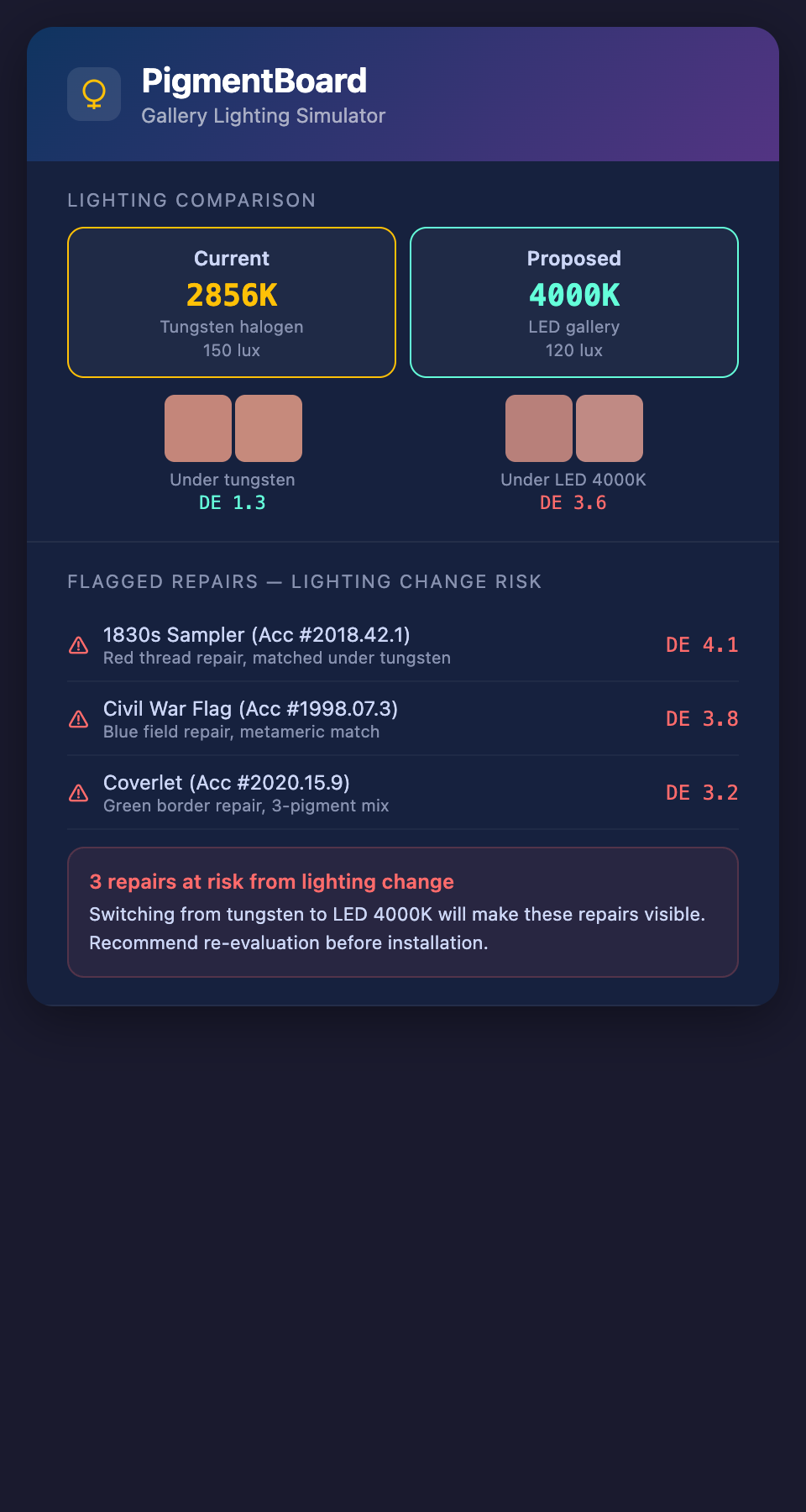
A repair that is invisible under one lighting condition may become visible under another. If the gallery lighting changes — due to a reinstallation, a technology upgrade, or a move to a new venue — repairs that were previously undetectable may suddenly stand out.
The Repair Visibility Problem
Conservation repairs are designed to be invisible under specific viewing conditions. When a conservator matches a degraded pigment, they (should) evaluate the match under the gallery's actual lighting. But gallery lighting is not permanent:
- Technology upgrades — Many museums have transitioned from tungsten to LED in recent years. The spectral distribution is fundamentally different.
- Reinstallations — When textiles move to different galleries, lighting conditions change.
- Traveling exhibitions — At each venue, lighting is different.
- Dimming and programming — Automated lighting systems that change intensity throughout the day can reveal repairs during certain periods.
Each of these changes can expose previously invisible repairs — not because the repair was poorly done, but because the metamerism properties of the repair pigments were optimized for the original lighting.
The Preservation Impact
Lighting decisions also directly affect how quickly the original pigments will continue to degrade:
- UV content — LED and filtered halogen sources have minimal UV, while older fluorescent and unfiltered daylight sources can have significant UV output
- Intensity — Every increase in lux level increases the rate of photodegradation proportionally
- Duration — Longer gallery hours mean more total light exposure
- Spectral distribution — Some wavelengths are more damaging to specific pigments than others. Blue light is more energetic than red light and generally causes more damage.
A conservator who has just spent hours matching a faded pigment has a professional interest in ensuring the textile does not fade further — making their careful match obsolete.
What Conservators Bring to the Conversation
Conservators contribute specific, practical knowledge to lighting decisions:
Knowledge of vulnerable materials. A conservator can identify which textiles in a gallery are most light-sensitive and should receive the lowest light levels. This allows lighting designers to allocate their "light budget" strategically rather than applying a blanket standard.
Repair visibility data. A conservator knows which textiles have repairs that are sensitive to lighting changes. If a lighting upgrade is planned, the conservator can flag specific objects that may need retreatment.
Degradation rate estimates. Given a proposed lighting level and duration, a conservator can estimate how much additional fading will occur over a given display period. This puts a concrete cost on lighting decisions.
Metamerism assessment. When new lighting is being evaluated, a conservator can check existing repairs under the proposed light source before it is installed — identifying problems before they become visible to the public.
Practical Recommendations
For conservators:
- Request notification of any planned lighting changes in galleries containing treated textiles
- Document the lighting conditions under which every repair was optimized (illuminant type, color temperature, lux level)
- Maintain a list of "lighting-sensitive repairs" — objects where a lighting change is most likely to reveal conservation work
- Offer to evaluate existing repairs under proposed new lighting before it is installed
For curators and lighting designers:
- Include the conservator in lighting decisions from the design phase, not as an afterthought
- Provide conservators with the spectral power distribution data for proposed light sources — not just the color temperature and lux level
- Allow conservators to evaluate sensitive objects under proposed lighting before final installation
- Consider maintaining consistent lighting for galleries with extensively repaired textiles
For institutions:
- Establish a policy that lighting changes in galleries with conservation-treated objects require conservator review
- Include lighting condition documentation in conservation treatment reports
- Budget for potential repair retreatment when major lighting upgrades are planned
The LED Transition: A Current Example
The museum world's ongoing transition from tungsten to LED lighting is a case study in why conservators need to be involved in lighting decisions.
LED sources have many advantages: energy efficiency, low heat output, minimal UV emission, long life, and precise control. From a preservation standpoint, they are generally superior to tungsten.
But LED spectral distribution is fundamentally different from tungsten. Tungsten produces a smooth, continuous spectrum weighted toward red. LED spectra typically have a sharp blue peak (from the blue LED chip) and a broad phosphor emission peak, with potential gaps or dips in between.
This means:
- Colors that looked correct under tungsten may look different under LED
- Metameric matches optimized for tungsten will likely fail under LED
- The overall color appearance of the gallery changes, affecting how visitors perceive both the original textiles and any repairs
Conservators who matched pigments under tungsten may find that years of careful work is now visible under the new LED lighting. This is not a failure of the original conservation — it is a predictable consequence of changing the illuminant.
Planning for Lighting Change
Since lighting will inevitably change over a textile's museum life, conservators can build resilience into their repairs:
- Minimize metamerism by using pigments with spectral properties similar to the original (as discussed in earlier posts)
- Document the spectral match quality, not just the visual match — so future conservators know how robust the match is
- Keep detailed formula records so repairs can be adjusted without starting from scratch
- Use degradation models that predict color at the spectral level, making it possible to re-optimize for new lighting conditions by adjusting the model rather than re-mixing from zero
Ready to build lighting-resilient repairs with spectral-level degradation modeling? Join the PigmentBoard waitlist.