Matching Faded Pigments Across Large Museum Collections
The Scale Problem in Museum Conservation
A single textile repair is manageable. A conservator can spend a morning matching one faded indigo, mix the formula, document it in their notebook, and move on. But what happens when your museum is reinstalling an entire gallery — 200 textiles, 15 different degraded pigments, three conservators working in parallel, and a hard deadline from the curatorial team?
The traditional approach does not scale. Every conservator matches colors slightly differently. Formulas documented by hand are difficult to replicate. Lighting conditions vary between workstations. And the cumulative time cost — even at 30 minutes per color match — becomes hundreds of hours that blow through project timelines and budgets.
This is not a hypothetical problem. Major museums face this challenge every time they rotate permanent collection galleries, prepare traveling exhibitions, or undertake large-scale conservation campaigns.
Why Inconsistency Creeps In
Even highly skilled conservators produce inconsistent color matches when working independently on similar textiles. The reasons are systemic, not personal:
- Perceptual variation — Human color perception varies between individuals and changes throughout the day based on fatigue, ambient lighting, and even what the conservator looked at immediately before.
- Metamerism — Two color mixtures can look identical under one light source and visibly different under another. A match made under north-facing daylight may fail under gallery tungsten.
- Batch variation in pigments — Even the same brand and product line of conservation-grade pigments varies slightly between batches.
- Documentation gaps — When Conservator A mixes "a touch more raw umber" into a formula and writes that down, Conservator B interprets "a touch" differently.
Building a Standardized Workflow
Solving the scale problem requires three things: shared reference standards, reproducible formulas, and centralized documentation.
Shared reference standards mean that every conservator on the project is calibrating their eye to the same physical or digital target. In practice, this might be:
- A set of Munsell color chips placed alongside every textile being treated
- Spectrophotometer readings of each target area, stored in a shared database
- Digital degradation profiles that model the exact aging conditions of each textile
Reproducible formulas mean moving beyond "a touch more raw umber" to quantified recipes:
- Pigment ratios by weight (e.g., 3.2g titanium white, 0.8g raw umber, 0.15g burnt sienna)
- Binder ratios specified as percentages
- Application method and layer count documented
Centralized documentation means every formula lives in one place, accessible to every team member, tagged to the specific textile and area it matches.
The Role of Degradation Modeling
Here is where degradation modeling transforms the workflow. Instead of matching each textile independently, you can:
- Classify textiles by degradation type — Group the collection by original pigment, exposure history, and storage conditions
- Build degradation profiles for each group — Model the aging process once per group rather than once per textile
- Generate formulas from profiles — Derive color-match formulas directly from the degradation model
- Fine-tune per textile — Adjust individual formulas only for the specific variations within each group
This approach reduces the number of independent color-matching sessions from 200 (one per textile) to perhaps 15-20 (one per degradation group), with minor adjustments for individual pieces.
Case Study: A Hypothetical Gallery Reinstallation
Imagine a regional history museum reinstalling its 19th-century textile gallery. The collection includes:
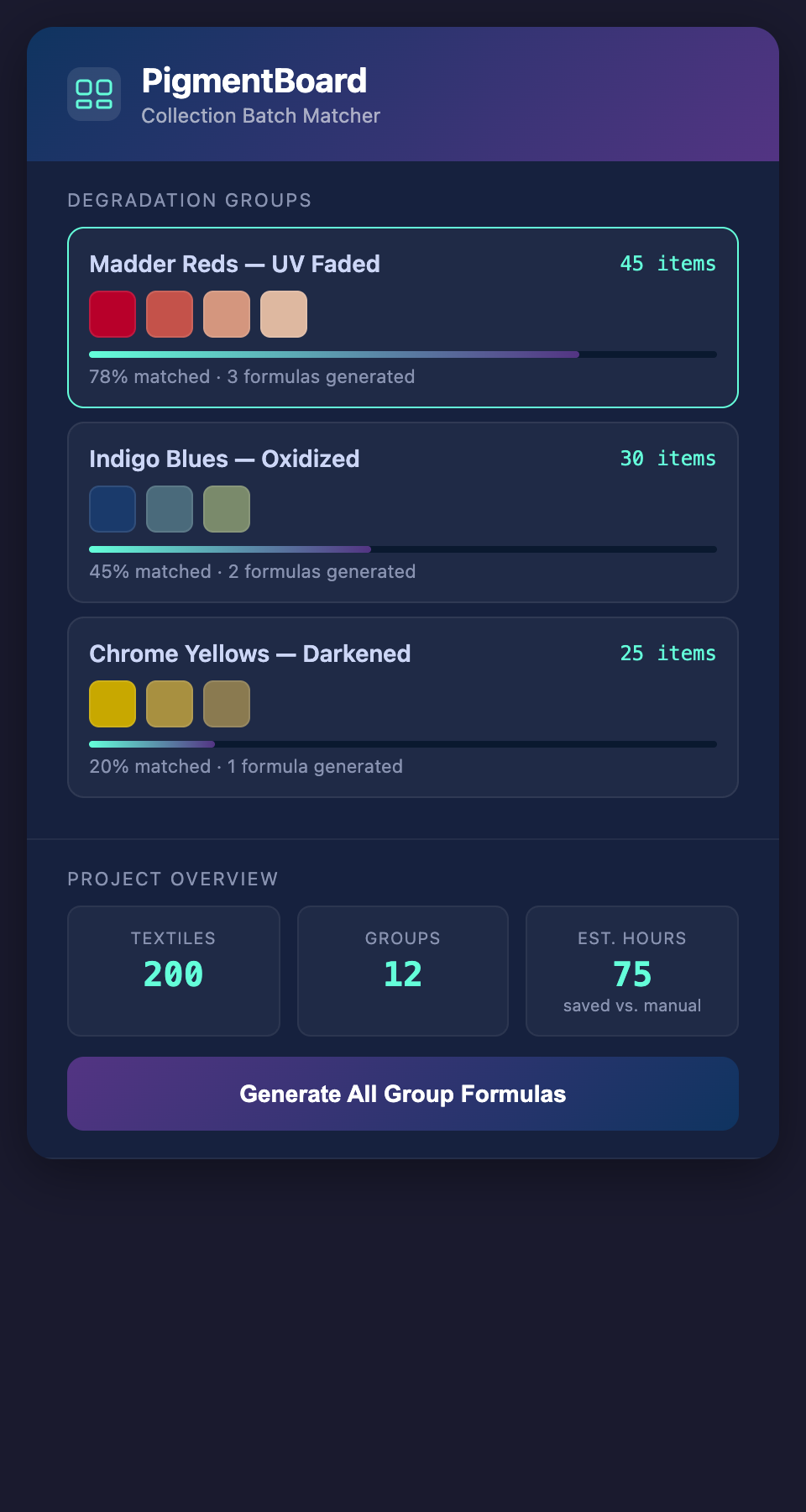
- 45 quilts with faded cotton dyes (primarily madder reds, indigo blues, chrome yellows)
- 30 embroidered samplers with degraded silk threads
- 25 woven coverlets with wool dyes
- 20 printed cotton textiles with roller-printed designs
- Various flags, banners, and ceremonial textiles
Without a systematic approach, three conservators would spend an estimated 400+ hours on color matching alone — nearly three months of dedicated work.
With degradation-group modeling, the same team could:
- Identify 12 distinct degradation groups across the collection
- Build a degradation profile for each group in approximately 2 hours per group (24 hours total)
- Generate base formulas for each group
- Fine-tune individual textiles with adjustments averaging 15 minutes each (50 hours total)
- Total estimated time: 75 hours — an 80% reduction
Practical Tips for Scaling Color Matches
Even without specialized software, you can improve consistency across large projects:
- Designate one conservator as the color-match lead who establishes all base formulas. Others adjust but do not create from scratch.
- Use spectrophotometer readings as objective checkpoints, not just visual assessment.
- Mix larger batches of base colors and distribute them across the team, rather than having each person mix independently.
- Standardize your lighting — everyone works under the same calibrated light source, at the same time of day if using daylight.
- Document with photographs taken under controlled conditions, not just written descriptions.
Where Technology Fits
The conservation field has been slow to adopt digital color-matching tools, partly because the available tools were designed for commercial paint-matching (architectural, automotive) and do not account for the specific degradation chemistry of historic pigments.
What conservators need is a tool that:
- Models degradation pathways specific to historic dye and pigment chemistry
- Allows independent control of multiple aging factors (UV, humidity, atmospheric pollutants, biological agents)
- Stores and shares profiles across a team
- Outputs formulas in conservation-grade pigment systems, not commercial paint codes
This is precisely the gap that degradation modeling soundboards are designed to fill — giving conservators the same kind of precise, repeatable, sharable control over color that audio engineers have over sound.
Making It Work for Your Institution
Start small. Pick your next multi-textile project and try the grouped approach:
- Sort textiles by probable original pigment and degradation type
- Build a reference set of color-match formulas for each group
- Document everything in a shared, searchable format
- Measure the time savings and consistency improvements
Once you see the results, the case for systematic degradation modeling makes itself.
Want to bring systematic pigment matching to your conservation lab? Join the PigmentBoard waitlist and be first in line when we launch.