Building a Pigment Degradation Reference Collection for Your Lab
Why You Need Physical References
Digital models predict. Physical references confirm. No matter how sophisticated your degradation modeling software becomes, there is no substitute for a physical collection of pigment samples at known stages of aging that you can hold next to a textile and compare directly.
A pigment degradation reference collection serves three functions:
- Calibration — Compare model predictions against real aged samples to verify accuracy
- Training — Give junior conservators tangible examples of how specific pigments change over time
- Matching — Use as a starting point for color matching by finding the reference sample closest to your target
What to Include
A useful reference collection covers the major historic pigment families at multiple stages of degradation:
Red dyes:
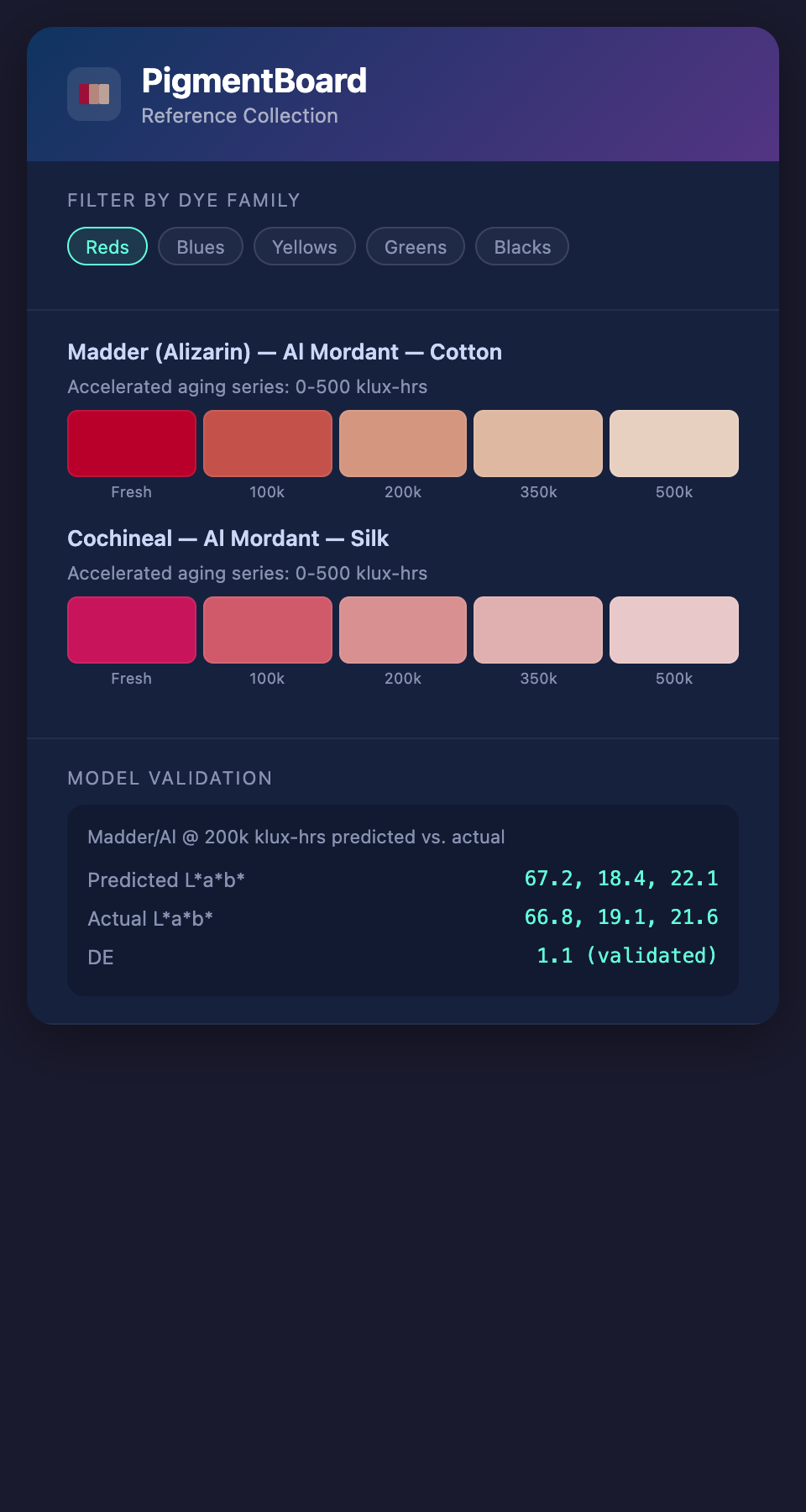
- Madder (alizarin) on aluminum mordant — fresh, lightly faded, moderately faded, heavily faded
- Madder on iron mordant — same progression
- Cochineal on aluminum mordant — fresh through heavily faded
- Brazilwood — fresh through heavily faded (degrades rapidly)
- Early synthetic alizarin (post-1869) — fresh through heavily faded
Blue dyes:
- Indigo on cotton (vat-dyed) — fresh through heavily faded
- Indigo on wool — fresh through heavily faded
- Prussian blue — fresh through heavily faded
- Early synthetic ultramarine — fresh through heavily faded
Yellow dyes:
- Weld (luteolin) on aluminum mordant — fresh through heavily faded
- Quercitron on aluminum mordant — fresh through heavily faded
- Chrome yellow — fresh through heavily faded
- Turmeric — fresh through heavily faded (degrades extremely rapidly)
Green dyes (mixed):
- Indigo + weld combination — fresh through heavily faded
- Saxon green (indigo + fustic) — fresh through heavily faded
Black dyes:
- Logwood on iron mordant — fresh through heavily faded
- Iron gall — fresh through heavily faded
Brown dyes:
- Cutch — fresh through heavily faded
- Walnut — fresh through heavily faded
How to Create Aged Samples
There are two approaches to creating degraded reference samples:
Accelerated aging uses controlled exposure to light, heat, and humidity to simulate years of natural aging in weeks:
- Light aging — Expose samples in a light-aging chamber (xenon arc or fluorescent UV) at controlled intensity and duration. Standard test methods (e.g., AATCC TM 16, ISO 105-B02) provide protocols.
- Thermal aging — Expose samples to elevated temperatures (typically 70-100°C) in controlled humidity to accelerate oxidation.
- Combined aging — Some chambers allow simultaneous light, heat, and humidity control.
Advantages: Fast, controlled, reproducible. Limitations: Accelerated aging does not perfectly replicate natural aging. The degradation products can differ, and the relative rates of competing degradation pathways may shift at elevated temperatures.
Natural aging uses real-world exposure over years:
- Mount samples in a south-facing window (for UV exposure) with systematic rotation and removal at intervals
- Store samples in various controlled environments (high humidity, low humidity, normal conditions) and retrieve at intervals
- Keep unexposed control samples sealed in dark, stable storage
Advantages: Produces authentic degradation products. Limitations: Takes years to decades for meaningful results. Requires institutional commitment to very long-term projects.
Best practice: Use accelerated aging for rapid creation of a working reference set, and supplement with naturally aged samples over time.
Sample Preparation Standards
For your reference collection to be useful, samples must be prepared consistently:
- Fiber type: Prepare each dye on all relevant fiber types (cotton, wool, silk, linen). The same dye on different fibers ages differently.
- Mordant type: For mordant dyes, prepare versions with each historically relevant mordant (aluminum, iron, tin, copper, chromium).
- Application method: Use historically appropriate dyeing methods, not just surface application. The dye's penetration into the fiber affects its degradation rate.
- Documentation: Record every detail of preparation — dye source, concentration, mordant type and concentration, dyeing time, pH, temperature. Without this documentation, the samples have limited reference value.
- Controls: Keep an unexposed control sample for every dyed sample, sealed in dark storage.
Organizing and Storing the Collection
Physical organization:
- Mount samples on acid-free card stock with clear labels
- Organize by dye family, then by degradation stage
- Store in flat archival boxes, separated by interleaving tissue
- Keep in dark, climate-controlled storage when not in active use
Digital catalog:
- Photograph each sample under controlled lighting with a color reference target
- Measure each sample with a spectrophotometer and record Lab* values and spectral data
- Link photographs and spectral data to the physical samples through a consistent numbering system
- Make the digital catalog searchable by dye type, mordant, fiber, and degradation stage
Using the Collection
For color matching:
- Identify the original pigment on the textile you are treating
- Find the corresponding sample series in your reference collection
- Select the reference sample that most closely matches the current state of the textile
- Use the reference sample's spectral data as a starting point for your matching formula
- Fine-tune from there
For model validation:
- Run your degradation model with the known parameters for a reference sample (pigment type, aging conditions, duration)
- Compare the model's predicted color to the actual measured color of the reference sample
- Note any discrepancies and adjust the model's parameters accordingly
- Over time, this calibration loop improves the model's accuracy for your specific pigments and conditions
For training:
- Present junior conservators with the series showing progressive degradation
- Have them predict the next stage of degradation before seeing it
- Compare their predictions to the actual samples
- Use discrepancies as teaching moments about specific degradation chemistry
Long-Term Value
A well-maintained reference collection increases in value over time. Naturally aged samples that have been in the collection for 10, 20, or 30 years provide increasingly rare and valuable data points. The institutional investment pays compounding returns.
Start your collection now, even if it begins small. Every sample you prepare and document today is more valuable in ten years than it would be if you started then.
Ready to validate your degradation models against physical references? Join the PigmentBoard waitlist and connect digital predictions to real-world results.