Preserving Color Data From Deaccessioned Museum Textiles
Data That Walks Out the Door
Deaccessioning is a normal part of museum collection management. Objects leave collections through sale, transfer, exchange, or disposal for legitimate curatorial reasons. But when a textile leaves your museum, it takes something with it that is rarely considered: its color degradation data.
A 150-year-old textile with a documented provenance is a physical record of how specific pigments age under specific conditions over a specific timeframe. That data — the exact shade of a faded madder red, the precise brown shift of an oxidized indigo, the degree of yellowing in a silk ground — is irreplaceable once the object is gone.
Why This Data Matters
Calibration reference. Degradation models are only as good as the real-world data they are calibrated against. Every textile with a known history (identified pigments, documented storage conditions, measured age) is a data point that makes predictions more accurate.
Future matching reference. When a conservator in 2035 needs to match a faded cochineal red on a textile from the same era and region as the one you just deaccessioned, having your color data on file gives them a head start.
Research resource. Conservation science researchers need large datasets of degradation examples to identify patterns and refine models. Individual measurements contribute to collective knowledge.
Institutional memory. Even if the object leaves, the knowledge gained from it should remain.
What to Capture Before Deaccessioning
Spectrophotometric measurements:
- Measure multiple points across each significant color area
- Record full spectral reflectance curves, not just Lab* summaries
- Measure both degraded areas and any protected areas (seam allowances, folds, reverse) that may retain closer-to-original color
- Measure the undyed ground fabric as well — its yellowing or discoloration is part of the degradation record
Photography:
- Photograph under controlled, documented lighting (D65, specific lux level)
- Include a color reference card (X-Rite ColorChecker or equivalent) in every photograph
- Photograph detail areas of significant color change
- Capture UV fluorescence photographs if possible
Physical analysis (if policy allows):
- FORS readings for dye identification
- XRF readings for mordant identification
- If fiber sampling is permitted before deaccessioning, preserve samples for potential future analysis
Contextual documentation:
- Date of manufacture (known or estimated)
- Geographic origin
- Known or estimated display history (how many years in light? What kind of light?)
- Known or estimated storage history (climate-controlled? Attic? Basement?)
- Previous conservation treatments
- Any known environmental incidents (flood, fire, pollution exposure)
Creating a Color Degradation Record
Organize the captured data into a standardized record format:
Object identifier: [Accession number, even after deaccessioning] Deaccession date: [Date] Deaccession reason: [Brief note] Recipient: [If transferred or sold]
Color data:
| Area | Description | L* | a* | b* | Spectral file | Photo ref |
|---|---|---|---|---|---|---|
| [Location] | [e.g., "main field, faded red"] | [Value] | [Value] | [Value] | [Filename] | [Filename] |
Pigment identification:
| Area | Method | Result | Confidence |
|---|---|---|---|
| [Location] | [FORS/XRF/etc.] | [Identified pigment] | [High/Medium/Low] |
Degradation assessment:
- Estimated UV exposure: [None/Low/Moderate/High/Very High]
- Estimated humidity exposure: [Controlled/Moderate/High/Very High]
- Estimated pollutant exposure: [Low/Urban/Industrial]
- Dominant degradation mechanism: [UV/Oxidation/Humidity/Pollutant/Combined]
Building a Degradation Reference Library
Over time, systematically capturing this data from deaccessioned textiles builds a reference library of extraordinary value:
- Cross-reference by pigment type to see how the same dye ages under different conditions
- Cross-reference by geography to understand regional environmental effects
- Cross-reference by era to track changes in dye chemistry over time
- Use as calibration data for degradation models
This library does not need to be huge to be useful. Even 50 well-documented records provide a rich resource for color matching and model calibration.
Sharing the Data
Consider sharing your color degradation records with the broader conservation community:
- Inter-institutional databases — Several conservation organizations maintain shared databases. Contributing your data benefits everyone.
- Published case studies — Particularly interesting or well-documented degradation records can be published in conservation journals.
- Teaching resources — Training programs for junior conservators need real-world examples with known parameters.
The Ethics of Data Capture
A brief note on ethics: capturing color data from deaccessioned textiles is entirely non-destructive (spectrophotometry and photography do not alter the object) and serves a legitimate conservation purpose. There is no ethical conflict between deaccessioning an object and preserving its scientific data.
However, ensure that your data capture activities do not delay the deaccessioning process or create ownership ambiguities. The data belongs to the institution, not to any individual, and should be stored in institutional systems.
Practical Implementation
Make it routine. Add color data capture to your deaccessioning workflow checklist, alongside condition reporting and photography.
Budget the time. A thorough color data capture takes 1-2 hours per textile. This is a small investment compared to the value of the data.
Use consistent methods. Every record should follow the same template and measurement protocol. Inconsistent data is almost as useless as no data.
Store securely. Digital files should be backed up in at least two locations. Print reference copies of the most critical records.
Tag for searchability. Use consistent metadata tags so the records can be found by pigment type, era, origin, degradation type, and other relevant categories.
From Data to Better Matching
Every color degradation record you capture today is a resource that future conservators will draw on. When they need to match a faded pigment and can find a documented example of the same pigment at a similar stage of degradation — with spectral data, photographs, and contextual history — they start from knowledge rather than guesswork.
This is how institutional knowledge grows: not through individual expertise alone, but through systematic data capture that outlasts any single career.
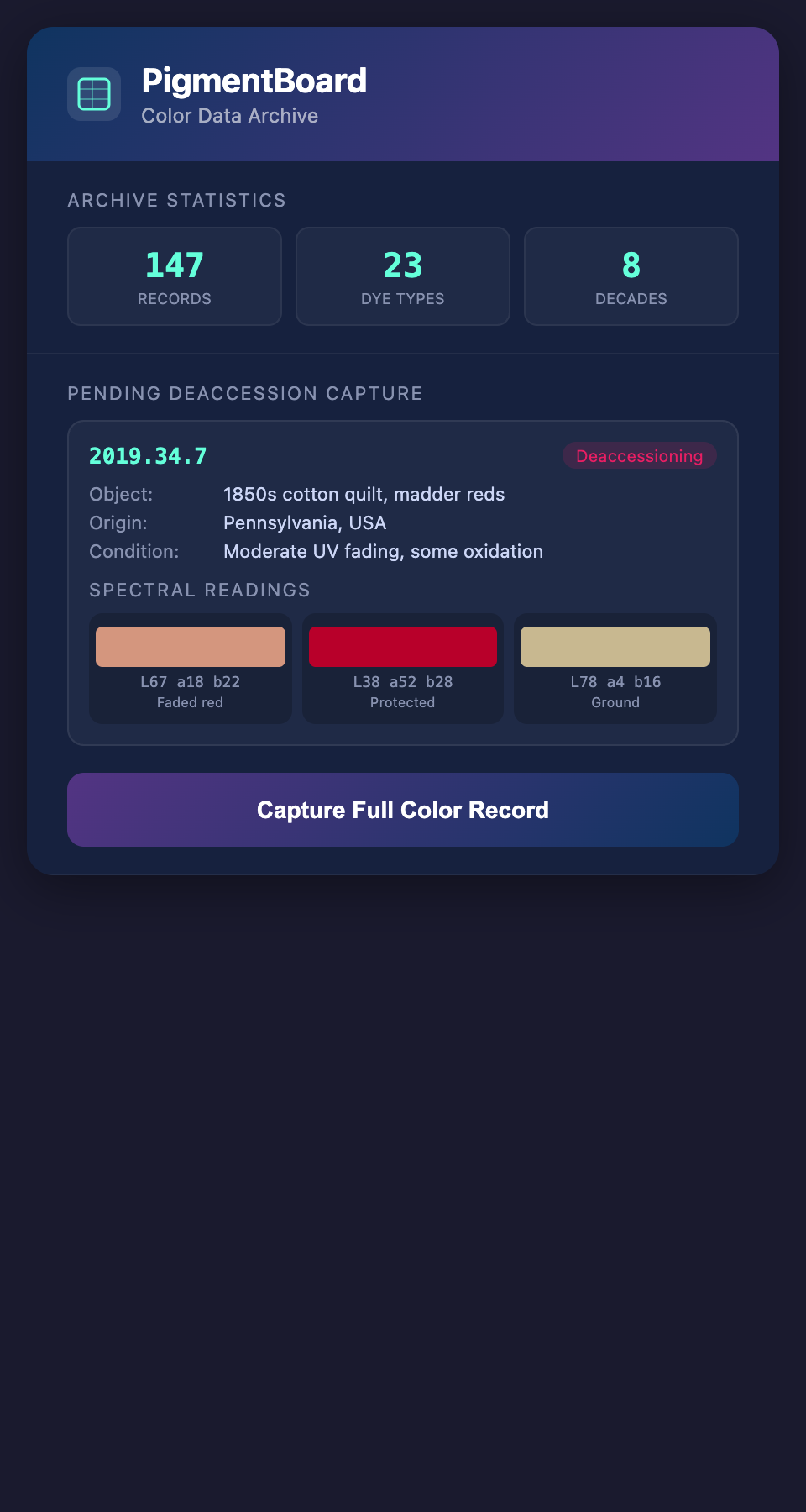
Want to turn your degradation reference data into actionable matching predictions? Join the PigmentBoard waitlist.