Authenticating Textile Age Through Fiber Degradation Analysis
Two Clocks, Same Time
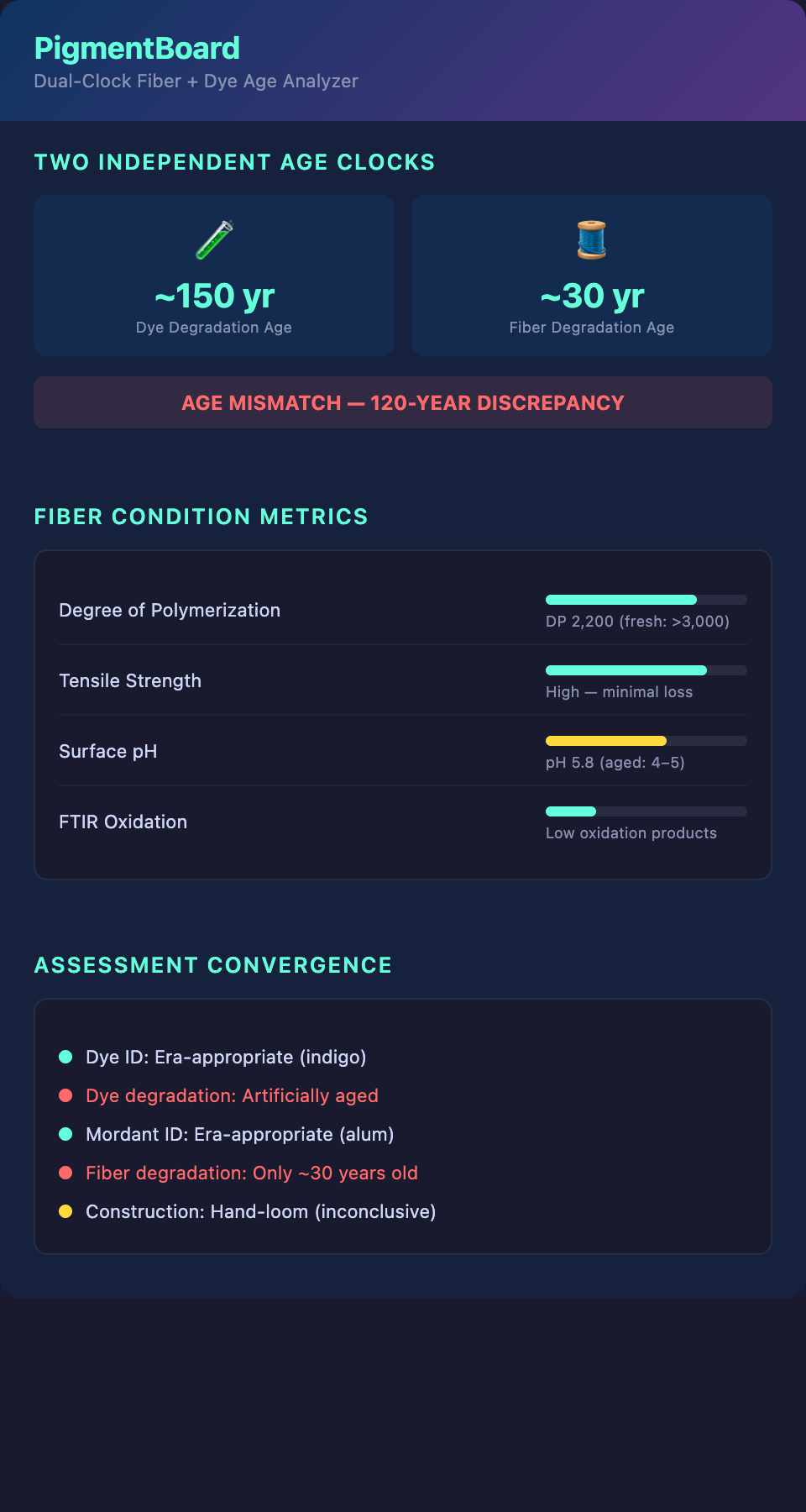
A textile carries two independent aging clocks: the dye degradation and the fiber degradation. For a genuine textile, both clocks should indicate approximately the same age. When they disagree, something needs explaining.
How Fibers Age
Cellulose fibers (cotton, linen):
- Chain scission (polymer chains break, reducing degree of polymerization)
- Yellowing (oxidation of cellulose produces chromophoric groups)
- Embrittlement (loss of flexibility as polymer chains shorten)
- Strength loss (measured by tensile testing)
Protein fibers (wool, silk):
- Disulfide bond breakage (in wool, causes loss of crimp and elasticity)
- Peptide bond hydrolysis (causes strength loss)
- Yellowing (Maillard-type reactions with environmental sugars)
- Silk shattering (tin-weighted silk becomes brittle and fragments)
Measurement Methods
Degree of polymerization (DP): Measured by viscometry of dissolved fiber. Fresh cotton has DP > 3,000. Aged cotton may be 500-1,000. Severely degraded cotton may be below 300.
Tensile testing: Requires a fiber sample. Measures breaking strength and elongation. Age reduces both.
FTIR spectroscopy: Non-destructive. Can detect oxidation products, hydrolysis, and other chemical changes in the fiber. Specific absorption bands correlate with age.
pH measurement: Surface pH of aged cellulose fibers decreases as acidic degradation products accumulate. Fresh cotton: pH 6-7. Aged cotton: pH 4-5.
Using Fiber Data for Authentication
Cross-check with dye degradation: If dye analysis suggests 150 years of aging but fiber analysis suggests 30 years, the dye aging may be artificial.
Detect artificial aging methods: Some artificial aging methods (bleach, heat, acid treatment) degrade fibers in specific ways that differ from natural aging. FTIR can sometimes distinguish these.
Establish minimum age: Even if dye identification is ambiguous, fiber degradation can establish a minimum age. A textile with DP of 600 and pH 4.5 has undergone significant aging — it is unlikely to be recent, even if the dyes are ambiguous.
Limitations
- Fiber degradation is influenced by environmental conditions, not just time. A textile stored in poor conditions for 50 years may show more degradation than one stored in ideal conditions for 150 years.
- Testing methods that require fiber samples are destructive (though only tiny samples are needed).
- Natural variation in fiber quality affects degradation rate — different cotton varieties degrade at different rates.
The Combined Assessment
The strongest authentication combines:
- Dye identification (era-appropriate?)
- Dye degradation assessment (consistent with claimed age?)
- Mordant identification (era-appropriate?)
- Fiber degradation assessment (consistent with claimed age?)
- Construction analysis (era-appropriate techniques?)
- Provenance documentation (paper trail)
When all lines of evidence converge on the same conclusion, authentication confidence is high.
Ready to model both dye and fiber degradation for comprehensive authentication? Join the PigmentBoard waitlist.