Authentication Red Flags in Textile Surface Examination
The First Line of Detection
Experienced authentication specialists begin every examination with systematic surface assessment. This low-tech, high-skill evaluation often reveals the most compelling evidence — for or against authenticity — before any instruments are employed.
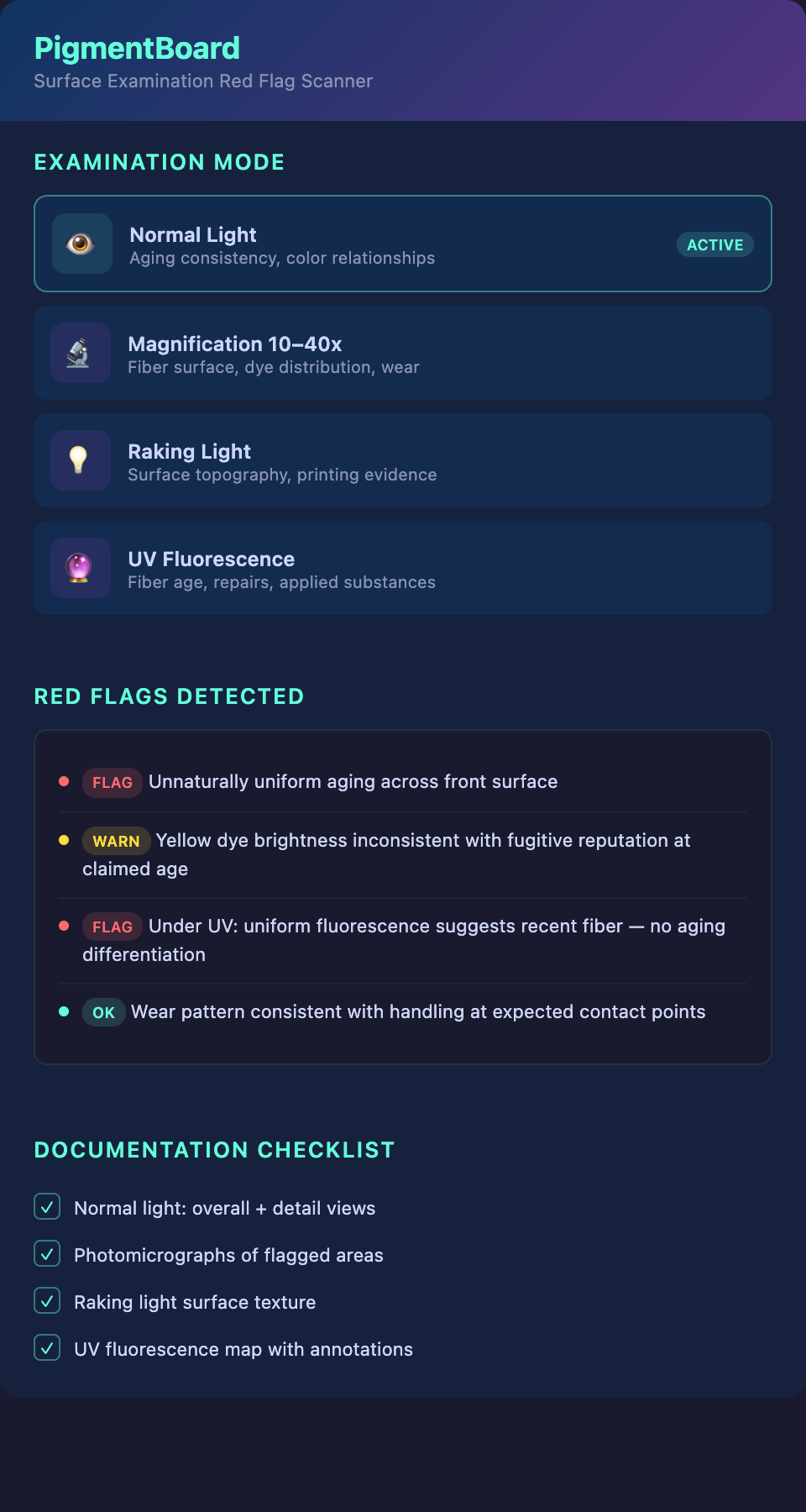
Visual Examination Under Normal Light
Consistency of aging. Is the aging pattern consistent across the textile? Natural aging creates predictable gradients (more faded on the display side, more worn at handling points). Inconsistent or unnaturally uniform aging is suspicious.
Color relationships. In a multicolor textile, do the colors show the expected differential fading? If a typically fugitive yellow is as bright as a typically stable indigo, the aging is suspicious.
Surface quality. Naturally aged textile surfaces develop a specific quality — a softness, a patina, a depth that comes from accumulated micro-changes over decades. New textiles, even when artificially aged, often have a different surface character.
Magnification (10-40x)
Fiber surface. Naturally aged fibers show accumulated evidence: surface oxidation products, embedded environmental particles, biological traces. Artificially aged fibers may show aggressive chemical damage on the surface without the accumulated environmental evidence.
Dye distribution. Natural dyeing produces specific dye distribution patterns within fibers and yarns. Artificially applied aging dyes may not penetrate correctly.
Wear patterns. Natural wear is concentrated at specific points (selvages, folds, contact areas) and has a progressive, three-dimensional quality. Artificial distressing often looks two-dimensional — surface damage without the depth of natural wear.
Raking Light
Surface topography. Low-angle lighting reveals the surface texture, including:
- Nap or pile condition (even wear vs. selective wear)
- Surface deposits (genuine grime has a specific distribution pattern)
- Applied substances (artificial aging agents may be visible as surface coatings)
Printing evidence. On printed textiles, raking light can reveal:
- Block printing pressure variations (authentic prints from wooden blocks show characteristic irregularities)
- Screen printing mesh patterns (anachronistic for pre-20th-century textiles)
- Ink-jet printing artifacts (very modern forgeries)
UV Fluorescence
Fiber fluorescence. Different fibers fluoresce differently. More importantly, aged fibers fluoresce differently from new fibers. Fresh cotton typically fluoresces brighter than aged cotton.
Dye fluorescence. Some dyes fluoresce characteristically. More importantly, degradation products of some dyes have specific fluorescence signatures.
Applied substances. Sizing agents, finishing chemicals, and artificially applied aging agents often have distinctive fluorescence that differs from naturally accumulated surface substances.
Repair and reweaving. Any later additions or repairs typically fluoresce differently from the original textile, revealing alterations.
Documenting Surface Examination
Record all observations with photographs:
- Normal light: overall and detail views
- Magnification: photomicrographs of significant areas
- Raking light: surface texture and topography
- UV fluorescence: mapped with annotation
This photographic record is essential for the authentication report and for comparison with instrumental data.
Want to complement surface examination with quantitative degradation modeling? Join the PigmentBoard waitlist.