Comparing UV Lamp Aging to Natural Aging in Authentication
The Lamp Test
UV lamps (xenon arc, fluorescent UV, mercury vapor) are the most commonly used tools for artificial textile aging. They produce UV radiation that genuinely degrades dyes — the same photochemistry that occurs in natural aging. But the conditions differ from natural aging in important ways.
How UV Lamps Differ From Natural Light
Spectral distribution. UV lamps produce a specific spectral distribution that differs from sunlight. Xenon arc lamps are closest to sunlight but still differ in the UV-B region. Fluorescent UV lamps have a narrow spectral output. These spectral differences can produce different degradation product ratios.
Intensity. Artificial aging uses much higher UV intensity than natural light to compress years of exposure into weeks. Higher intensity can favor different degradation pathways — some reactions that are minor at low intensity become dominant at high intensity.
Continuity. UV lamps provide continuous exposure. Natural light is intermittent (day/night, seasonal variation, cloud cover). The rest periods in natural exposure allow partial recovery and competing dark reactions that continuous exposure does not.
Temperature. UV lamps generate heat. Unless the aging chamber is temperature-controlled, the textile experiences higher temperatures during UV exposure than it would under natural conditions. Higher temperature accelerates thermal degradation pathways alongside UV degradation.
Absence of other factors. A UV lamp provides UV. It does not provide the simultaneous humidity cycling, atmospheric pollutant exposure, biological colonization, and mechanical handling that natural aging includes.
Detectable Differences
Surface-depth gradient. Natural UV aging produces a gradual gradient from heavily faded surface fibers to less-faded interior fibers (because UV penetrates only the surface). High-intensity UV lamp aging can drive degradation deeper into the fiber, altering this gradient.
Degradation product ratios. The ratio of primary to secondary degradation products differs between high-intensity and low-intensity aging. Mass spectrometry or advanced spectroscopic methods can detect these differences.
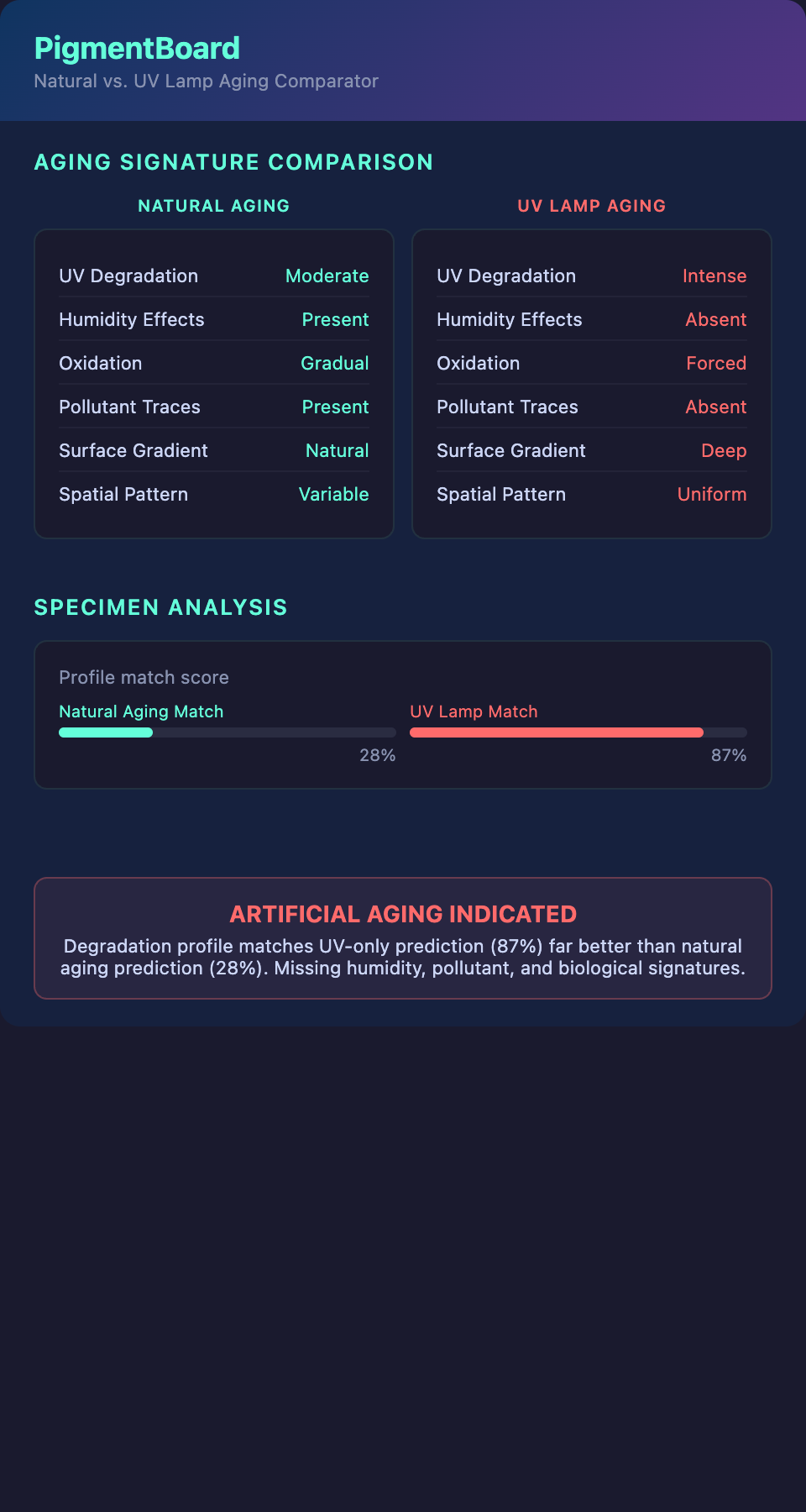
Missing non-UV degradation. The absence of humidity, oxidation, and pollutant degradation signatures — despite the presence of UV degradation — is a flag for artificial aging.
Too-uniform fading. UV lamps in aging chambers provide relatively uniform illumination. Natural UV exposure is directional and variable, producing spatial gradients that lamp aging does not replicate.
Using the Model for Detection
A degradation model that independently controls UV, humidity, oxidation, and pollutant factors can generate predictions for both natural and artificial aging:
- Natural aging prediction: All factors active at levels appropriate for the claimed provenance
- UV-only prediction: Only UV active, simulating lamp aging
If the textile's actual degradation profile matches the UV-only prediction better than the natural prediction, artificial aging is indicated.
Want to compare natural vs. artificial aging predictions side by side? Join the PigmentBoard waitlist.