Documenting Pigment Degradation for Authentication Reports
Documentation as Evidence
Authentication reports are used in high-stakes contexts: art market transactions, insurance claims, legal disputes, museum acquisitions, and scholarly publications. The documentation supporting an authentication opinion must withstand scrutiny from opposing experts, lawyers, and courts.
What a Defensible Report Includes
1. Object identification and provenance claims.
- Physical description of the textile
- Claimed date of manufacture
- Claimed geographic origin
- Claimed history (display, storage, ownership)
- Source of provenance claims (documentation, oral history, seller representation)
2. Analytical methods employed. For each method (FORS, XRF, spectrophotometry, visual examination):
- Equipment used (make, model, calibration date)
- Measurement parameters (wavelength range, aperture, number of measurements)
- Standards used for calibration
- Operator qualifications
3. Results.
- Raw data (spectra, measurements, photographs)
- Interpreted results (dye identification, mordant identification, color values)
- Comparison to reference standards
4. Degradation analysis.
- Model used (with version/source reference)
- Parameters input (based on claimed provenance)
- Predicted degradation state
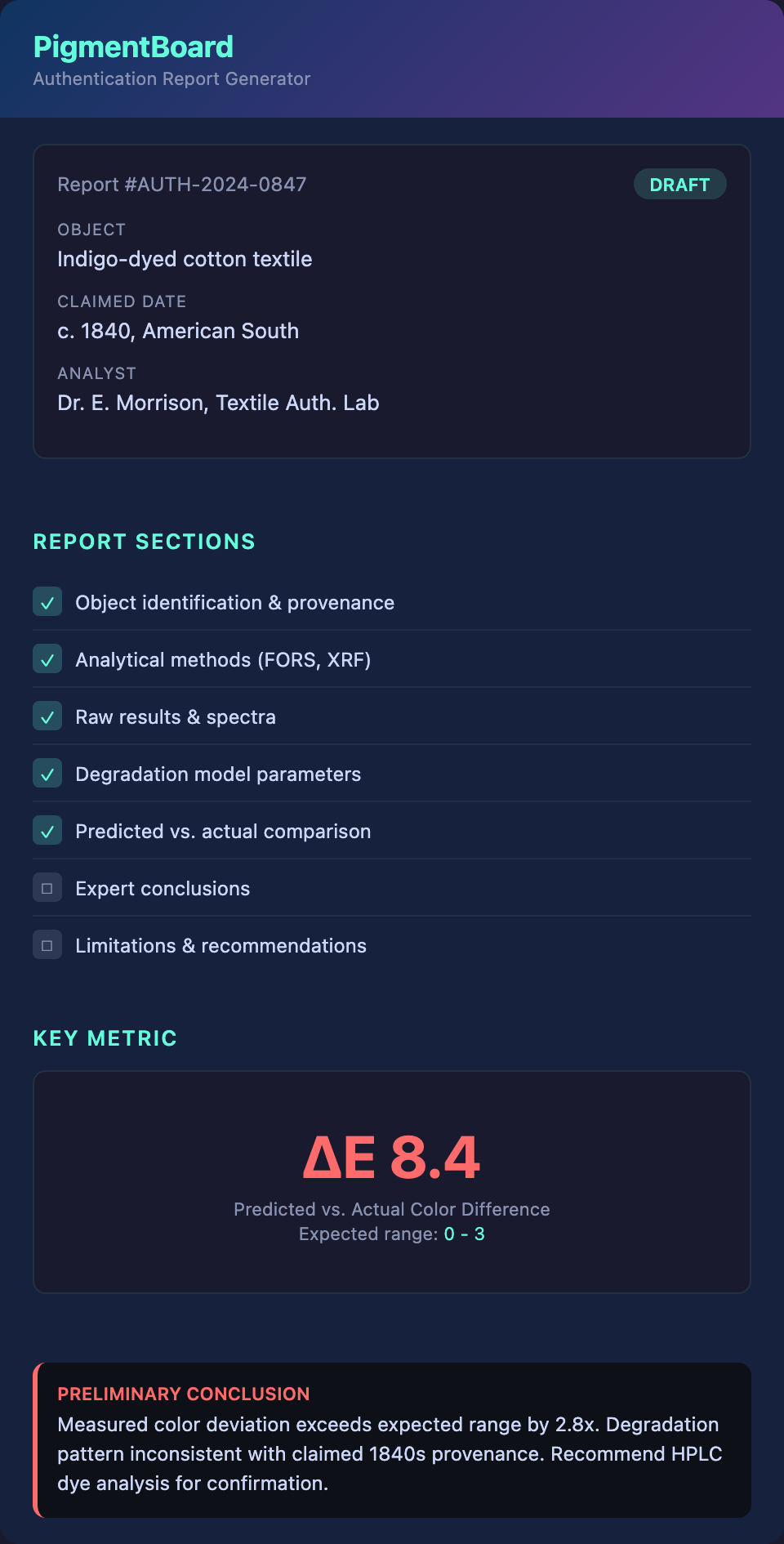
- Comparison of predicted vs. actual
- Quantification of discrepancies (ΔE, spectral difference metrics)
5. Conclusions.
- Statement of opinion (consistent with claimed provenance, inconsistent, or inconclusive)
- Confidence level and basis
- Limitations of the analysis
- Recommendations for additional testing if applicable
Quantifying Discrepancies
"It does not look right" is an opinion. "The measured ΔE between the predicted and actual color is 8.4, which exceeds the expected range of 0-3 for a genuine textile of this type and age" is evidence.
Quantification enables:
- Reproducibility — Another expert can repeat the analysis and arrive at the same numbers
- Comparison — Different textiles can be compared on the same scale
- Statistical rigor — With sufficient reference data, confidence intervals can be established
- Legal credibility — Courts value quantified evidence over subjective assessment
The Degradation Model as a Standard
When you use a degradation model as part of authentication, document:
- The model's underlying assumptions and data sources
- The specific parameters you set and why (linking each to the claimed provenance)
- The model's output (predicted color, spectral curve, degradation state)
- The comparison methodology (how you measured the actual vs. predicted difference)
- The interpretation framework (what magnitude of discrepancy is normal, suspicious, or conclusive)
This documentation makes the analysis transparent and reproducible — the foundation of defensible expert opinion.
Peer Review and Reproducibility
The gold standard for authentication is independent reproducibility — another expert, using the same methods and data, reaching the same conclusion. Degradation modeling promotes this because:
- The model is deterministic (same inputs produce same outputs)
- The parameters are documented and justifiable
- The comparison is quantified
- The entire analysis can be replicated by another expert with the same tools
Limitations to Acknowledge
No authentication method is infallible. Responsible documentation includes:
- Acknowledging the model's uncertainty range
- Noting any factors not accounted for (unknown storage conditions, possible previous treatments)
- Distinguishing between "inconsistent with claimed provenance" and "definitely a forgery"
- Recommending additional testing when results are ambiguous
Want to generate documented, quantified degradation predictions for your authentication reports? Join the PigmentBoard waitlist.