The Role of Mordant Analysis in Textile Dating and Authentication
The Hidden Evidence
Mordants — the metal salts used to fix dyes to fibers — are invisible in the finished textile but carry significant information about the textile's origin, date, and production method. Because mordants are metallic, they survive when organic dyes have faded to near-invisibility.
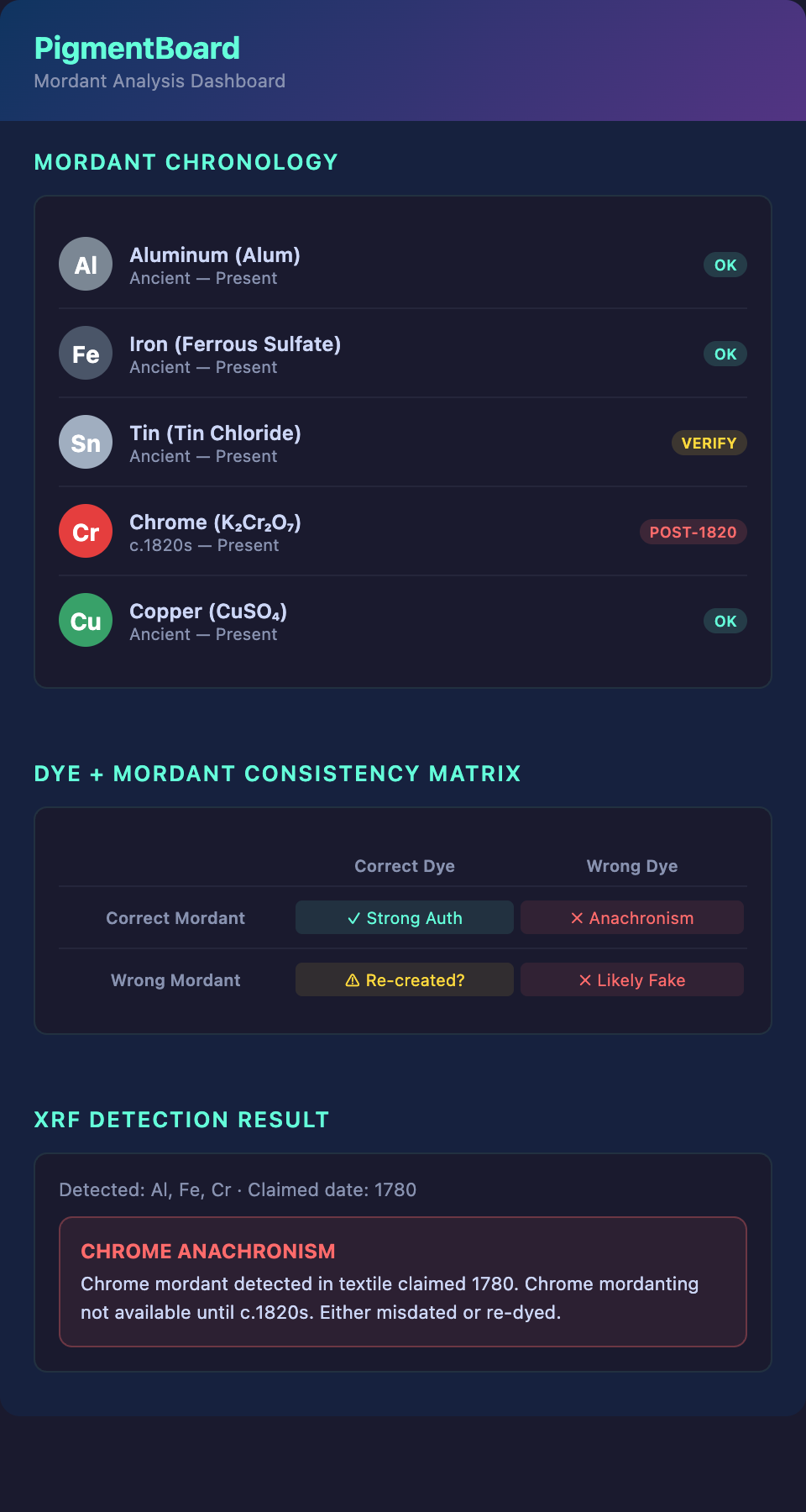
Mordant Chronology
Ancient through 18th century:
- Aluminum (from alum): The most common mordant, used worldwide
- Iron (from ferrous sulfate): For dark colors
- Tin (from tin chloride): Brightening agent, used sparingly due to fiber damage
19th century additions:
- Chrome (from potassium dichromate): Introduced for wool dyeing circa 1820s-1840s, widespread by 1860s
- Copper (from copper sulfate): Used for greens and blues, also as a mordant modifier
Key dating markers:
- Chrome mordant before ~1820 is anachronistic
- Specific tin mordanting techniques have era-specific patterns
- The ratio and method of alum application changed over time
Detection Methods
XRF detects all metallic mordants non-destructively. A single XRF measurement can identify aluminum, iron, tin, chrome, copper, and other metals present.
SEM-EDS (Scanning Electron Microscopy with Energy Dispersive Spectroscopy) provides both elemental identification and spatial distribution within the fiber cross-section.
Authentication Applications
Dating support: If chrome mordant is detected in a textile claimed to be from 1780, the textile is either misdated or the area has been re-dyed.
Regional attribution: Different dyeing traditions used different mordanting practices. Mediterranean traditions used alum heavily. Asian traditions used specific aluminum sources. These differences can support or challenge regional attribution.
Degradation modeling: The mordant type affects the dye's degradation pathway. Iron-mordanted areas degrade differently from aluminum-mordanted areas. The degradation model needs the mordant identification to produce accurate predictions.
Consistency check: If the mordant and dye are inconsistent (e.g., a dye typically used with alum mordant is found with chrome mordant), it suggests non-traditional production — possibly a later re-creation.
Combining Mordant and Dye Evidence
The most powerful authentication uses mordant and dye identification together:
- Correct dye + correct mordant + correct degradation = strong support for authenticity
- Correct dye + wrong mordant = production inconsistency (possibly re-created using historical dye with modern technique)
- Wrong dye + correct mordant = anachronism (the dye was not available in the claimed era)
- Correct dye + correct mordant + wrong degradation = artificial aging suspected
Want to integrate mordant data with multi-factor degradation modeling? Join the PigmentBoard waitlist.