Accelerating Business Decisions With Instant Tab Content Search
The Decision Velocity Hypothesis
Competitive advantage increasingly comes from decision velocity. If Competitor A makes a strategic decision in 5 days and Competitor B makes the same decision in 20 days, Competitor A wins.
Decision velocity depends on information availability. If you can search "do we have data on this?" and get answers instantly, decisions accelerate. If you have to hunt through research for hours, decisions decelerate.
This is why instant tab content search is becoming a strategic capability.
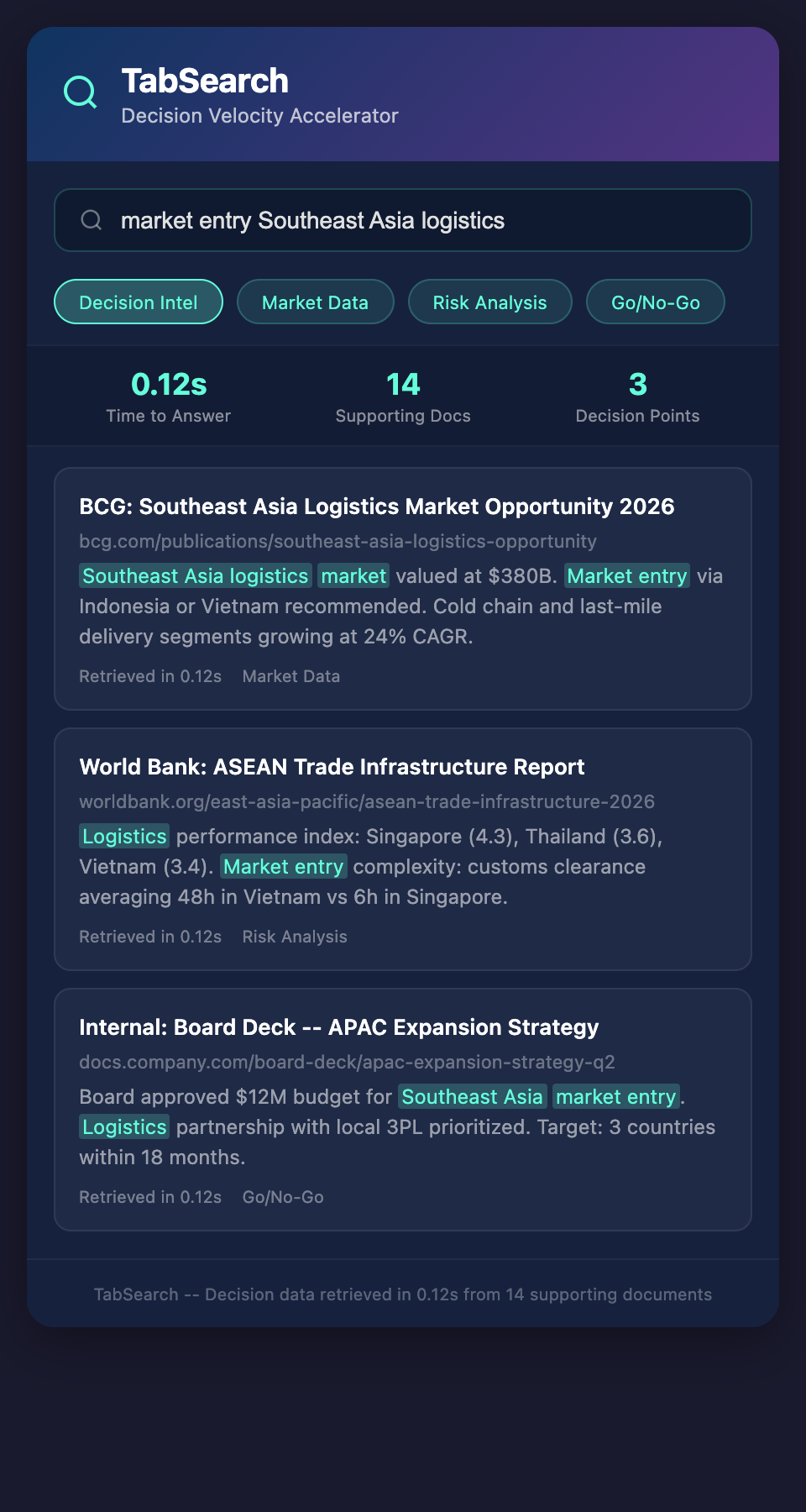
Where Time Gets Lost in Decision-Making
-
Information gathering: 60-70% of decision time (finding data)
-
Information synthesis: 20-30% of decision time (analyzing data)
-
Decision framing: 10-20% of decision time (formulating recommendation)
Most optimization focuses on synthesis and framing—the analytical work. But information gathering is the largest time sink and the easiest to optimize.
If you can cut information gathering from 3 hours to 15 minutes through instant search, your decision time drops from 5 days to 1 day.
How Instant Search Accelerates Decisions
Price Decision Example
Scenario: Your CFO says "I want to raise prices 15% next quarter. What's the competitive and customer impact?"
Without instant search (current way):
-
You remember reading about competitor pricing somewhere (15 min searching memory)
-
You search browser history for pricing pages (30 min searching, finding broken links)
-
You manually dig through competitor websites for current pricing (1 hour)
-
You find 3-month-old customer research on price sensitivity (30 min searching email)
-
You reassemble information into a brief (1 hour)
-
Total: 3.5 hours
With instant search:
-
You search "competitor pricing 2026"—all pricing research surfaces in 30 seconds
-
You search "customer price sensitivity"—all pricing research and feedback surfaces in 30 seconds
-
You search "pricing power elasticity"—related analysis surfaces in 30 seconds
-
You synthesize into a brief (45 min)
-
Total: 1.25 hours (minus 2 hours 15 minutes vs without search)
Result: Decision moves from "I'll get back to you tomorrow" to "I'll brief you this afternoon."
Real-World Impact: M&A Analysis
Your CEO says: "Should we acquire CompanyX?"
Decision requires:
-
Competitive threat assessment (what market share could they take?)
-
Product overlap analysis (what duplicates exist?)
-
Technology assessment (what IP do they have?)
-
Market analysis (is this the right market to be in?)
-
Financial modeling (what's a fair price?)
Without instant search: 40 hours of analysis work over 2 weeks
-
Research gathering scattered across tabs, notes, previous analysis
-
Lots of time spent relocating information
-
Analysis is sequential (can't parallelize without multiple people)
-
Decision delayed while all analysis completes
With instant search: 20 hours of analysis work over 3-5 days
-
Search "CompanyX competitive threat" (all competitive data surfaces)
-
Search "CompanyX product features" (all product research surfaces)
-
Search "CompanyX technology patents" (all technical analysis surfaces)
-
Multiple people analyze simultaneously using same indexed data
-
Analysis parallelizes; decision accelerates
Decision moves from 2 weeks to 3-5 days. For acquisitions, timing matters—faster decisions beat slower decisions.
The Compounding Advantage
Decision velocity advantage compounds:
Quarter 1: You make 8 strategic decisions vs competitor's 6. You win 3 decisions through faster execution.
Quarter 2: You make 10 strategic decisions vs competitor's 7. Compounding advantage starts to show.
Year 1: You've made ~12 more strategic decisions than slower competitors. Each decision generates data for future decisions. You accumulate faster.
Over time, decision velocity creates compounding competitive advantage.
How To Measure Decision Velocity
Track this for your organization:
-
Decision identification (when do you recognize a decision needs to be made?)
-
Information gathering (how long to collect relevant research?)
-
Analysis time (how long to synthesize into recommendation?)
-
Decision making (how long to make the actual choice?)
-
Execution (how long to implement the decision?)
Most time loss is in information gathering. That's where instant search helps most.
Set targets:
-
Current decision cycle: 10 days
-
With instant search: 6 days
-
Improvement: 40% faster decisions
Building the Foundation for Instant Search
Instant search requires:
-
Automatic capture: Research flows into the system as you discover it
-
Full-text indexing: Every word is searchable
-
Smart ranking: Most relevant results appear first
-
Fast retrieval: Results in under a second
-
Accessible interface: Search is easier than navigating folders
This isn't science fiction. It's achievable today with the right infrastructure.
The Tools You'll Need
For instant search to work:
-
Browser integration: Content is captured as you browse
-
Search engine: Full-text indexing of all content
-
Interface: Fast, intuitive search UI
-
Metadata: Dates, sources, topics for smart filtering
-
Integration: Works with your decision tools (briefing docs, spreadsheets, presentations)
Organizational Benefits Beyond Speed
Faster decision-making has ripple effects:
Better execution: Decisions informed by current research beat decisions made on old assumptions.
Faster adaptation: Market changes require rapid strategic response. Instant search enables faster pivots.
Stronger culture: Teams that make decisions quickly maintain momentum.
Competitive signal: Competitors notice when you respond to market moves faster than they do.
Employee satisfaction: People love working in organizations that make decisions quickly. Faster decisions reduce uncertainty and enable faster progress.
The Training Requirement: Minimal
Most people get instant search immediately:
"Search for what you need" is easier to teach than "navigate this folder structure" or "remember where you saved it."
Learning curve: 1-2 hours. Value realized: immediately.
Starting This Week
-
Identify your slowest current decision (that requires information gathering)
-
Estimate time spent on information gathering for that decision
-
Imagine instant search: How much faster would information gathering be?
-
Calculate impact: What does 50% faster decision-making mean for your business?
If your decisions currently take 10 days and instant search cuts it to 5 days, the ROI is significant.
The Future: Instant vs Slow
In three years, organizations will be polarized:
Fast organizations: Decisions informed instantly by searchable intelligence. Decision cycles measured in days.
Slow organizations: Decisions delayed by information gathering. Decision cycles measured in weeks.
The margin between them will be measured in market share and competitive position.
Decision velocity is your competitive advantage. Instant search is how you build it.
Join the waitlist to accelerate decisions by making all your research instantly searchable.