Finding Market Insights Across Your Research Tabs in Seconds
The Market Insight Extraction Bottleneck
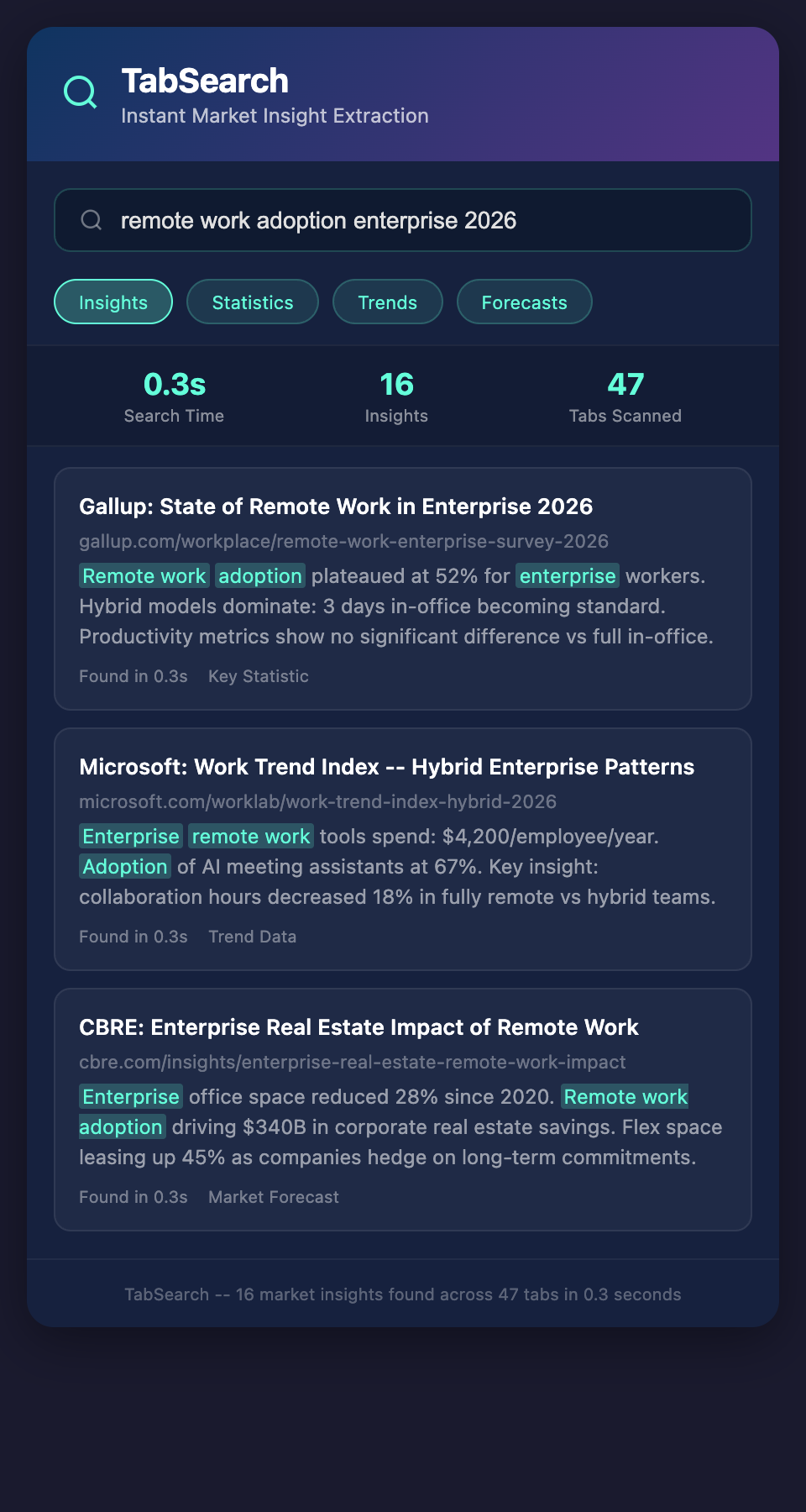
A strategy director needs to answer an urgent question: "Are we losing market share to competitors in the mid-market segment?" She has a strong intuition that yes, but the CEO is skeptical. She needs data in the next three hours for a board conversation.
The insights she needs are somewhere in her research. A customer conversation from last month mentioned competitive pressure. An earnings call transcript she read two months ago had relevant guidance. A competitor pricing page she bookmarked contains pricing changes. A news article she saw last week discussed market consolidation. Customer pipeline data is in the CRM.
But extracting these insights requires:
-
Remembering which tabs have relevant information
-
Manually re-reading or searching through documents
-
Copying data into a new document
-
Synthesizing multiple data points manually
-
Checking for contradictions or corroboration
What should take 20 minutes of analysis takes two hours of search and retrieval. By the time she has synthesized the insights, the meeting is in 30 minutes.
This scenario is endemic to knowledge work. The bottleneck isn't gathering information—it's extracting insights from information you've already gathered.
Why Insight Extraction Fails
Fragmentation Across Systems
Market research lives in multiple systems:
-
Browser bookmarks and open tabs
-
PDFs and documents in cloud storage
-
News articles in email
-
Customer conversations in CRM and call recordings
-
Industry reports in subscription databases
-
Public data in financial platforms
-
Spreadsheets with manually compiled data
Extracting insights requires accessing and synthesizing across all these systems. Most of them aren't designed for cross-system search.
Keyword-Only Search Misses Patterns
When you search your research for "market share loss," you might find articles mentioning those specific words. But the real insight might live in related keywords: "competitive pressure," "win rates declining," "deal velocity slowing," "customer churn increasing."
Insight lives in connections and patterns. Keyword search finds keywords, not patterns.
Time Decay and Version Confusion
That comprehensive competitive analysis you created three months ago? You remember it exists but can't find it. You open what you think is the latest version and discover it's v2, not v4. The insights are there, but retrieving them requires hunting and version verification.
Loss of Source Attribution
The most useful insights come with source attribution. "We're losing deals to Competitor A" is actionable. "We're losing deals to Competitor A—we know this from five customer conversations in the last three months, plus two lost deal analyses, plus one earnings call reference" is strategic.
Without systematic source tracking, you lose the evidence trail that makes insights credible to decision-makers.
A System for Rapid Insight Extraction
Unified Search Across Data Sources
The foundation is search that works across everything: browser tabs, PDFs, articles, emails, CRM notes, customer conversations, and structured data.
This search should:
Handle synonym understanding: Searching for "competitor outperforming" finds articles about "competitive advantage," "market leadership," and "winning deals"
Support natural language queries: "Which competitors are expanding into verticals we own?" returns relevant results across multiple sources, rather than requiring you to formulate 12 different keyword combinations
Rank by relevance and recency: The most recent mention of "market consolidation" appears first, but the system also highlights corroborating mentions from earlier
Surface conflicting data: When multiple sources suggest different things, the system flags contradictions, prompting deeper analysis
Insight Synthesis Tools
Once you've retrieved relevant sources, tools should help you synthesize insights:
Timeline reconstruction: Select sources, and the system creates a chronological narrative of how an insight or trend evolved
Evidence compilation: Gather sources supporting a claim, and the system creates a summary with proper sourcing and quotes
Pattern detection: Upload your research sources and ask the system to identify patterns across them without biasing it toward your hypothesis
Comparative analysis: Select multiple competitors and automatically surface areas where their strategies diverge or align
Real-World Insight Extraction Scenarios
Scenario 1: Rapid Competitive Response
The question: "Is Competitor A's new feature a threat?"
The research: You have a feature announcement, a customer conversation mentioning the feature, an article about competitive trends, and internal discussion notes.
Time with fragmented system: 45 minutes of searching, reading, and synthesizing
Time with unified system: 3 minutes to search "Competitor A feature," see relevant sources ranked by recency and relevance, read the key excerpts, and identify whether this aligns with a known strategic direction (trend toward mid-market focus) or represents a new move
Scenario 2: Market Opportunity Identification
The question: "Are there emerging segments we should enter?"
The research: Industry reports discussing market trends, customer conversations mentioning emerging needs, competitive job postings in new verticals, patent filings suggesting capability investments
Time with fragmented system: 2-3 hours of manual analysis across industry reports, email, bookmarks, and CRM
Time with unified system: 15 minutes. Search "emerging market segments." The system identifies correlated signals: (1) three competitors hiring in a new vertical, (2) customer conversations mentioning that vertical's unique pain points, (3) analyst reports flagging it as high-growth. Synthesize insights in 15 minutes vs. 2-3 hours.
Scenario 3: Win Rate Analysis
The question: "Why are our win rates declining against Competitor X specifically?"
The research: Lost deal analyses, customer conversations, sales call recordings, competitive intelligence on their recent changes, our own product roadmap
Time with fragmented system: 4+ hours searching for all lost deals, manually categorizing by competitor, reading through each deal narrative
Time with unified system: 10 minutes. Search "lost to Competitor X." Review 15 most recent lost deals. Identify pattern: "pricing" is mentioned in 12/15. Search "Competitor X pricing." Discover their recent price reduction. Connect to win rate decline. Recommendation: counter-offer competitive pricing structure or emphasize value differentiation.
Implementing Rapid Insight Extraction
Step 1: Centralize your research sources
This is prerequisite. If research lives across 8 systems, you cannot extract insights quickly. Identify your primary system and establish intake processes for everything else.
Step 2: Implement full-text search
Search should cover every word in every source. This is table stakes.
Step 3: Add entity recognition
The system should automatically identify mentions of specific competitors, customers, executives, and markets. This enables pattern recognition.
Step 4: Build synthesis tools
Once search is working, add tools that help you compile evidence, create timelines, and identify patterns.
Step 5: Establish insight hygiene
When you extract a critical insight, document it. Update your insight database with:
-
The insight statement
-
Supporting sources and quotes
-
Confidence level
-
Recommended actions
-
Date extracted
Over time, your insight database becomes cumulative institutional knowledge.
The Compounding Effect
In the first week, rapid insight extraction feels like a nice-to-have. By week four, it becomes standard. By month three, your organization responds to competitive threats 70% faster because insights that once took two hours to find now take three minutes.
The companies winning in competitive markets aren't out-researching competitors—they're out-synthesizing competitors. They find insights in existing research faster, identify patterns others miss, and respond more quickly.
Stop drowning in browser tabs and documents. Join our waitlist to see how to instantly find and synthesize market insights from all your research sources.