The Hidden Cost of Losing Track of Competitive Intelligence Data
The Expensive Silence: When Intelligence Data Vanishes
Your company loses a deal to a competitor. The sales team asks: "What's their competitive positioning? What are they claiming?"
Your competitive intelligence gets pulled up on a call, but it's outdated. Nobody can remember what the competitor announced last quarter. Research that was done—competitive analysis that existed—simply vanished into inaccessible browser history.
The deal is lost. The question never gets asked, "How much did we lose because we couldn't access our own intelligence?"
This is the true cost of losing track of competitive intelligence: not just inefficiency, but lost revenue, missed strategy adjustments, and slower market response.
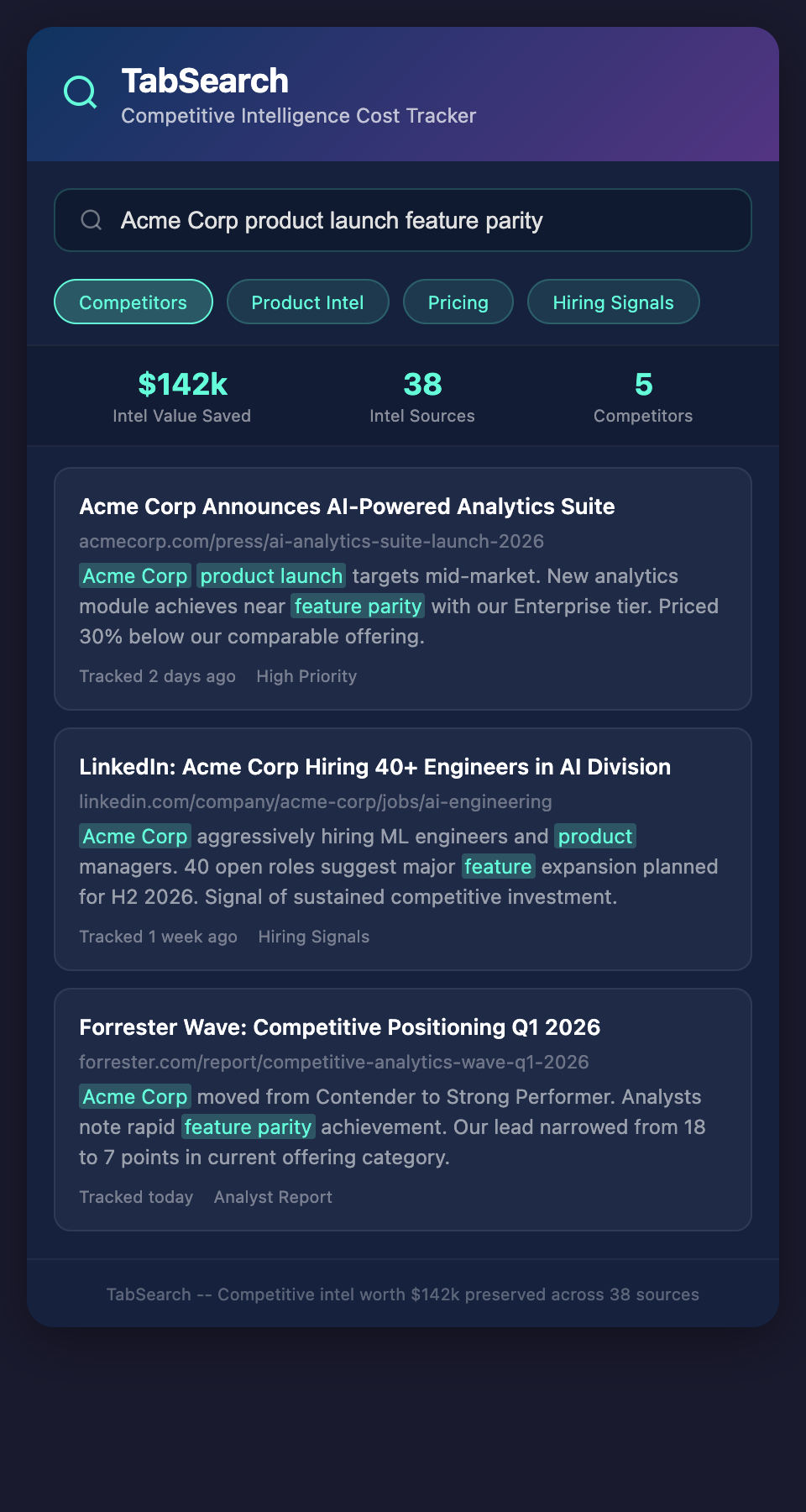
Types of Losses
1. Direct Revenue Impact
The deal loss: Sales team goes into competitive deal without current intelligence
-
Competitor claims something your team didn't know was launched
-
Your positioning doesn't address current competitive threat
-
Customer wins deal because your team was unprepared
-
Revenue lost: $50K–$500K per deal depending on company size
The pricing miss: You don't know what competitors are charging
-
You price conservatively when market would support premium pricing
-
Or you price aggressively and lose deals to undercut competitors
-
Revenue impact: 2–8% of total revenue annually from suboptimal pricing
The feature gap: Your roadmap doesn't address competitive threats you research but forget
-
Customers request features competitors have
-
Your team re-requests the same feature later because analysis was lost
-
Time-to-market delays and customer churn
2. Team Productivity Cost
Redundant research: Your team researches the same competitive topic twice
-
Initial research: 8 hours to understand competitor X's capabilities
-
Six weeks later: New project requires the same analysis
-
Nobody remembers the previous research; it's redone
-
Cost per redundancy: 16 person-hours
In a competitive intelligence team of 3, this might be:
-
Redundant research happening 10 times per quarter
-
160 lost hours per quarter = 40 hours per person, or 1 week per quarter
3. Strategic Decision Delays
Slower reaction to competitive threats
-
Competitor launches new product or enters new market
-
Your team delays response because finding competitive analysis takes time
-
By the time decision is made, competitor has 6-month head start
-
Competitive advantage gap: months of lost development time
Missed market signals
-
Your research contained data indicating market shift
-
Research disappeared; signal was never analyzed
-
By the time trend becomes obvious, competitors have already positioned
-
Missed opportunity: market position in emerging category
4. Institutional Knowledge Loss
Turnover costs
-
Analyst researches competitive landscape over 6 months
-
Analyst leaves company
-
Intelligence investment walks out the door
-
Cost to replace knowledge: $100K+ in new hire onboarding and 3-month knowledge gap
Inefficient onboarding
-
New team member can't access historical competitive research
-
Spends first month rediscovering what's already been learned
-
Cost per new hire: 200–300 hours of lost productivity
The Compounding Effect
These losses aren't independent. They compound:
-
Redundant research (productivity loss) delays decision making (strategic delay)
-
Delayed decisions make you less competitive, increasing time-to-market
-
New staff can't find historical intelligence (knowledge loss), repeating cycle
-
Competitive gaps grow, directly impacting revenue
For a $10M SaaS company, the annual cost of losing track of competitive intelligence might be:
-
Redundant research: 160 hours/quarter × $150/hour = $96K/year
-
Deal losses: 2-3 lost deals at $200K average value = $400K-$600K/year
-
Pricing inefficiency: 3% revenue loss on $10M = $300K/year
-
Time-to-market delays: 1-2 month lag on strategic response, customer churn impact = $100K-$200K/year
Total: $896K–$1.196M per year in lost value from inaccessible competitive intelligence.
This doesn't include the strategic consequences of being perpetually behind competitors on market intelligence.
Why Organizations Aren't Measuring This
Most companies don't track lost competitive intelligence as a cost because:
-
Losses are distributed: One team loses a deal, another does redundant research, another delays a decision. No centralized measure.
-
Opportunity costs are invisible: You never know what competitive threat you missed because your research was lost.
-
It's considered "normal inefficiency": Researchers retelling analysis and sales scrambling for competitive intel is treated as standard workflow overhead, not a problem to solve.
-
Knowledge loss compounds slowly: One person leaving costs $100K in knowledge loss. But if people leave quarterly, it becomes a $400K-per-year drain that's hard to attribute to research system failures.
Where the Waste Concentrates
High-touch, knowledge-intensive roles:
-
Competitive analysts
-
Product strategists
-
Sales engineers preparing for complex deals
-
Business development
-
Customer success managing strategic accounts
These teams depend on institutional competitive knowledge. When that knowledge vanishes, their effectiveness drops dramatically.
Quantifying Your Own Losses
Run this calculation for your organization:
Monthly redundant research hours: How often does your team research the same competitive topic twice? Estimate hours.
-
Multiply by your fully-loaded hourly rate
-
Multiply by 12 for annual cost
Quarterly deal losses attributable to poor competitive intelligence: How many deals were lost where sales/product said "We didn't have current competitive intel"?
-
Multiply by average deal value
-
Multiply by 4 for annual cost
Time-to-market delays in strategic response: How many quarters have you been behind competitors on a major market shift or competitive announcement?
-
Estimate development cost of accelerated work to catch up
-
Or estimate customer churn from being behind
New hire onboarding inefficiency: How many new staff spend 3+ months gaining competitive knowledge that already existed?
- Multiply by cost per new hire and frequency
Your actual cost is likely $500K–$2M+ annually if you're a knowledge-intensive organization.
The Solution Economics
The cost to implement a system that:
-
Automatically captures all competitive research
-
Makes it searchable and retrievable
-
Prevents institutional knowledge loss
-
Accelerates decision-making
...is typically 1–5% of the losses that system prevents.
If your organization loses $1M annually to lost competitive intelligence, investing $20K–$50K in a system to prevent that loss has obvious ROI.
Taking Action: Start Measuring
-
Track one type of loss for next month: redundant research, delayed decisions, or deal losses attributed to poor intel
-
Calculate the cost using your actual data
-
Extrapolate annually
-
Compare to the cost of solving it
Once you're measuring the loss, solving it becomes a financial priority, not a productivity nice-to-have.
The most expensive competitive intelligence is the intelligence your organization already collected but can't retrieve when it matters.
Ready to stop losing competitive intelligence? Join the waitlist to preserve and instantly retrieve every research insight your team discovers.