Managing Market Research Information Overload: A Practical Framework
The Research Paralysis Problem
Your inbox has three market research reports, Slack has five competitive updates, you've got 23 open browser tabs on different analyses, and someone just sent a LinkedIn article about industry consolidation. You feel like you should read everything, understand everything, and synthesize it all into strategic decisions.
This is information paralysis. You're drowning not in lack of information, but in too much information with no system to process it efficiently.
The average knowledge worker encounters more data in a week than someone fifty years ago encountered in a lifetime. But our brains haven't evolved to handle this volume. We respond by either:
-
Over-collecting: Saving everything "just in case," creating impossible review backlogs
-
Under-processing: Scanning headlines without deep analysis, missing critical insights
-
Memory reliance: Hoping to recall the exact article when you need it (spoiler: you won't)
-
Decision delay: Waiting for perfect information before committing to strategy
Why Existing Solutions Fail
Email forwarding to note apps creates duplicate information scattered across systems.
Browser extensions that clip content give you the articles but not a way to search across them efficiently.
Tab management tools help organize, but organizing isn't the same as making content actionable.
Subscription research services add more sources when you're already overwhelmed by current ones.
The missing piece is a system that handles the full research lifecycle: capture, indexing, retrieval, and synthesis.
A Framework for Research That Scales
Instead of trying to process everything equally, structure your research by intentional depth:
Tier 1: Immediate Scanning (10% of content)
Read summaries and headlines. Mark interesting items for deeper review. Use search to find related previous research quickly.
Tier 2: Active Analysis (20% of content)
Deep read articles that directly inform current decisions. Extract key metrics, quotes, and implications. Cross-reference with related research.
Tier 3: Archive & Retrieve (70% of content)
Index everything but don't force yourself to read it now. Trust the system to surface it when relevant through search.
This tiered approach prevents paralysis—you're not trying to process all information equally. You're being intentional about depth based on relevance to your current work.
The Technical Foundation: Full-Text Search Over Volume
The cognitive load of managing research drops dramatically when you can instantly find what you've already collected instead of re-discovering it.
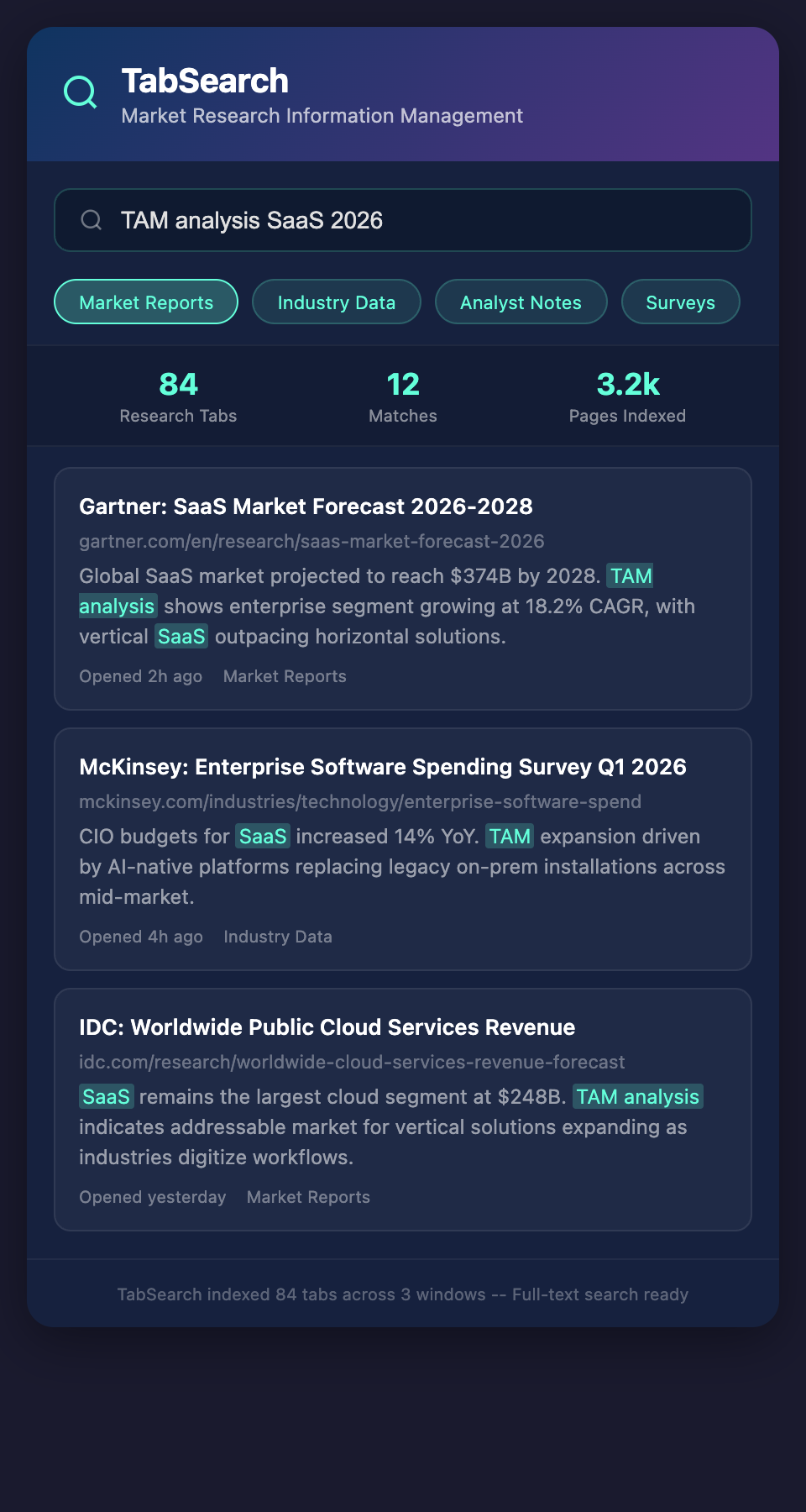
Imagine searching "customer churn SaaS" and seeing every article, report, and competitive mention you've encountered, ranked by relevance, with original source links preserved. No need to remember which tab had the churn data. No need to re-read three articles to find the specific statistic.
This shift from "organization" to "retrieval" changes everything. You can:
-
Collect aggressively without guilt—the system handles storage and discoverability
-
Search by concept instead of trying to guess where you filed something
-
Make connections by searching related topics and seeing unexpected patterns
-
Update decisions rapidly when new research surfaces
Practical Implementation: Starting Today
You can't eliminate information overload, but you can transform how you process it:
Immediate actions:
-
Stop trying to organize perfectly. Create one "to process" space.
-
Open research as needed without worrying about filing.
-
Use search instead of browsing through saved items.
This week:
-
Commit to a simple rule: one research source per day gets active analysis time.
-
Everything else gets indexed passively.
-
Notice how often search surfaces something useful you'd forgotten about.
This month:
-
Build a backlog of searchable research in your domain.
-
Reference it in decisions ("Our research shows...").
-
Watch decision velocity improve as information becomes instantly accessible.
The Competitive Edge
Teams that manage information overload systematically maintain perspective when their competitors are drowning in noise. You're making decisions with confidence, backed by organized research, without the paralysis of trying to process everything equally.
The research workers who thrive aren't those who read the most—they're the ones who retrieve what they need fastest and act decisively.
Ready to transform information overload into organized intelligence? Join the waitlist to index your research without drowning in it.