How to Organize Competitive Intelligence Research Across Multiple Sources
The Competitive Intelligence Organization Crisis
If you're responsible for tracking competitors, you know the pain. Every week brings a flurry of industry reports, news articles, product updates, and social media mentions. You bookmark them in different places, take notes in separate documents, and by the time you need to reference something from three weeks ago, you're searching through dozens of tabs wondering which one had that pricing announcement.
Knowledge workers face a critical gap: the tools that help us consume information (browsers, email, news apps) aren't designed to make that information findable again. A study by McKinsey found that knowledge workers spend 1.8 hours per day searching for and gathering information, and 19% of their time duplicating work already done elsewhere in their organization.
Why Traditional Organization Methods Fail
Most competitive intelligence professionals start with spreadsheets or shared drives. You create columns for company name, topic, date, and key insight. This works for a few sources, but within weeks, you're juggling:
-
Multiple formats: PDFs, articles, screenshots, emails, and quotes scattered everywhere
-
Context decay: That quote about "new market strategy" makes sense today; in two weeks, you've forgotten why it mattered
-
Search friction: Finding "that competitor's Q3 announcement" means either remembering where you saved it or re-reading entire documents
-
Version chaos: Three versions of the same report, and you're never sure which one contains your best notes
-
Team silos: When team members find useful intelligence, they're likely to bookmark it personally rather than share it
The fundamental issue is that information organization requires multiple retrieval paths. You might search by competitor name one day, by topic the next, and by date on a third. No spreadsheet efficiently handles all three without becoming unwieldy.
A Framework for Effective Competitive Intelligence Organization
The best competitive intelligence systems recognize that the source material is everywhere—in browser tabs, emails, PDFs, and specialized databases. Rather than fighting that reality, successful organizations build systems that capture information at the point of discovery.
Establish Clear Capture Points
Every piece of intelligence enters your system through a specific channel. For most knowledge workers, the browser is ground zero. Before organizing anything, you need a reliable way to capture web-based sources with:
-
The exact URL (so you can revisit the original source)
-
The publication date (critical for understanding market timing)
-
The full article or key excerpts (so you can search across content later)
-
Your own notes (why this matters to your company)
Without standardized capture, your system becomes a graveyard of half-forgotten bookmarks.
Create a Unified Index
Once sources are captured, they need to live somewhere searchable. The most effective systems use full-text indexing, which means every word in every article is indexed and instantly searchable. This is fundamentally different from:
-
Folder structures: Finding something requires knowing how you categorized it
-
Manual tagging: Tags drift and become inconsistent over time
-
Database searches: Databases are fast but only for structured data
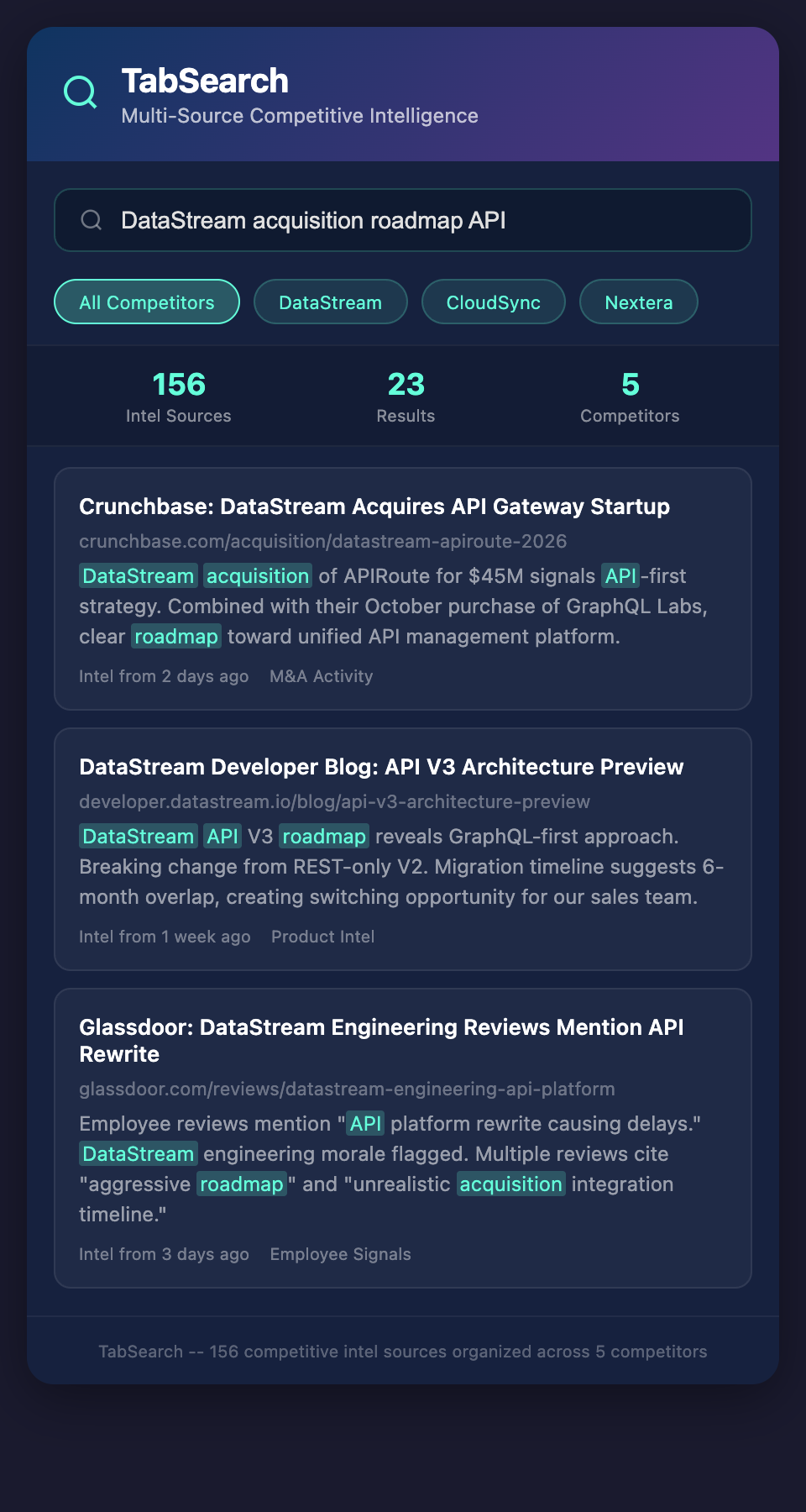
Full-text indexing works like Google for your proprietary competitive intelligence. You search for "market consolidation" and instantly find every article mentioning those words, regardless of when you captured them or which competitor they reference.
Segment by Relevance and Urgency
Not all intelligence is equally actionable. Develop a simple rating system:
Strategic signals (act within months): New market entries, major pricing changes, product pivots, M&A rumors
Tactical updates (act within weeks): Feature releases, hiring patterns, campaign launches, regional expansions
Contextual intelligence (for reference): Industry trends, regulatory changes, economic indicators
Your system should surface strategic signals prominently while keeping tactical and contextual intelligence accessible but not overwhelming.
Practical Implementation Steps
Week 1: Establish your data model
Define what you capture for each piece of intelligence. Minimum fields: source URL, publication date, company/competitor, topic category, full content, your notes, and date added.
Week 2: Implement capture infrastructure
Whether through browser extensions, email forwarding rules, or API integrations, make it frictionless for team members to add sources. A system requiring three clicks gets used; one requiring five clicks gets abandoned.
Week 3: Build your search layer
Enable full-text search across all captured content. This is where the magic happens—sudden connections between seemingly unrelated articles, patterns across months of research, and rapid answers to management questions.
Week 4: Establish review and maintenance cadence
Dedicate 30 minutes weekly to reviewing newly captured intelligence, updating relevance ratings, and pruning outdated information.
Real-World Results
Companies implementing unified competitive intelligence systems report:
-
60% reduction in time spent searching for previous research
-
3x faster response to competitive threats
-
40% improvement in team alignment on competitive positioning
-
Consistent access to historical context for board presentations
The difference between a mature intelligence operation and a chaotic one isn't the sources they access—it's their ability to find and act on what they've already discovered.
The Evolution Continues
As your competitive intelligence operation matures, you'll likely add automation (setting up alerts for specific competitors or keywords), collaboration features (team-wide access to curated intelligence), and synthesis tools (AI-powered summaries of recent activity around specific competitors).
But before any of that, solve the fundamental problem: making your scattered research findable and actionable. Everything else builds on this foundation.
Start this week. Choose one source of intelligence you access regularly—maybe a specific news site or competitor dashboard. Capture everything for the next 10 days without worrying about organization. Then test yourself: can you quickly find that one specific insight? If searching feels difficult now, you've identified your system's first priority.
Ready to stop losing competitive intelligence to the chaos of unorganized tabs? Join our waitlist to be among the first to access a solution that makes every piece of research you discover instantly searchable and shareable with your team.