Building a Personal Knowledge Management System for Researchers and Analysts
Why Personal Knowledge Management Matters
A researcher's competitive advantage isn't just what they know—it's what they can quickly retrieve and apply. The researcher who can instantly recall that a competitor announced feature X, priced at Y, in market Z has a 10-minute decision advantage over someone searching through three months of research.
This is why knowledge workers—analysts, competitive intelligence specialists, product strategists—are increasingly building personal knowledge management systems. Not as nice-to-have, but as critical professional infrastructure.
The Three Levels of Knowledge Management
Level 1: Passive Collection
You open research, read it, forget it. No system. Highest effort to retrieve. Lowest utility.
Level 2: Active Organization
You consciously file research into folders, create tags, write summaries. Requires discipline. Some utility if you stay consistent.
Level 3: Systematic Indexing
Research is automatically captured, indexed, searchable by content, and contextualized. Minimal effort. Maximum utility.
Most knowledge workers operate between Levels 1 and 2, spending significant time on organization that yields diminishing retrieval benefits. Level 3 systems are traditionally expensive and complex. This is changing.
Core Components of an Effective System
A researcher's knowledge management system should handle:
Capture without friction
-
Research flows into the system as part of your normal workflow
-
No manual copying, pasting, or organizing
-
Everything from browser tabs gets preserved
Search across content
-
Find information by concept, not by remember where you filed it
-
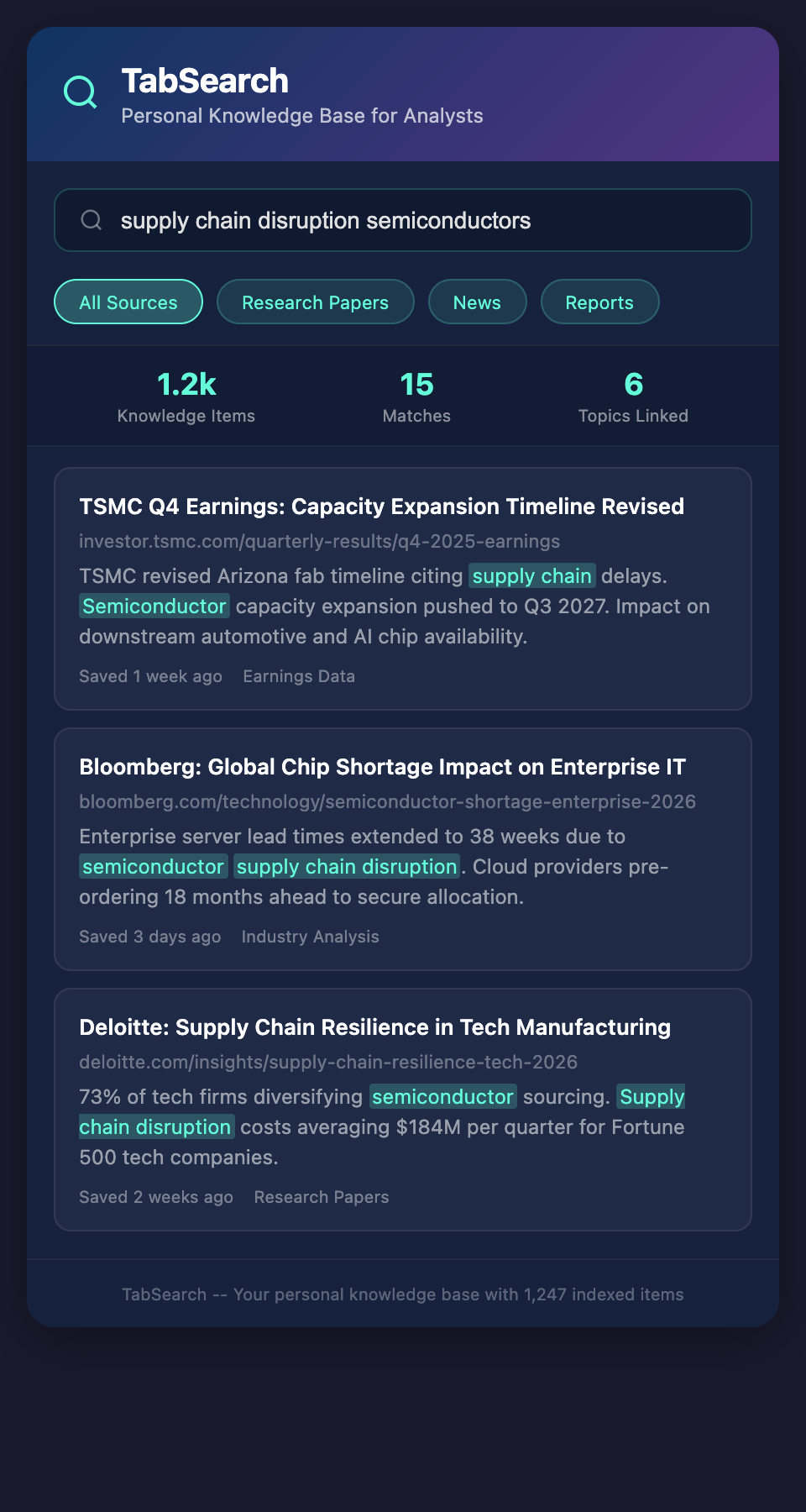
Search "regulatory changes" and surface every article you've read on the topic
-
Search "pricing analysis" and get all competitive pricing research in one place
Preserve context
-
Know why you captured something (decision context, stakeholder request, comparative analysis)
-
Link related research (all your competitor intelligence is connectable)
-
Maintain source attribution (original URL, author, date)
Enable synthesis
-
Pull related insights together for analysis
-
See patterns across research without manually reviewing every source
-
Build reports and briefs backed by actual collected data
The Shift From Organization to Retrieval
Traditional knowledge systems (folders, tagging, manual notes) optimize for organization—making things easy to find if you remember where you filed them.
Modern systems should optimize for retrieval—making things easy to find regardless of how they were filed.
This shift changes how you work:
Old approach: "I need to organize this research perfectly or I'll lose it"
New approach: "I'll index it automatically, then search for it when I need it"
The second approach is less stressful and more effective.
Building Your System: Four Essential Practices
1. Continuous Capture
Whatever research you're currently doing—competitive analysis, market trends, regulatory changes—gets captured into your system automatically. No decision required. No friction.
2. Semantic Tagging (Optional but Powerful)
Add 1-2 tags per research item that describe intent rather than location:
-
"pricing analysis" instead of "Competitor A/Pricing"
-
"market trend" instead of "Industry/Trends"
-
"regulatory risk" instead of "Compliance/Alerts"
These tags cluster related research by meaning, not hierarchy.
3. Regular Search and Rediscovery
Once a week, search your knowledge base for topics you work on frequently. You'll find forgotten research that's still relevant. This practice keeps your system "alive" and prevents knowledge from going stale.
4. Synthesis Over Collection
Track how often you pull research into actual decisions, briefings, and analysis. A system that contains 1000 sources you never use is less valuable than one containing 200 sources you reference weekly.
Real-World Example: Quarterly Competitive Brief
You have to deliver a competitive landscape brief to executive stakeholders. The brief needs:
-
Pricing comparison across 8 competitors
-
Recent feature launches and product roadmaps
-
Market positioning statements
-
Financial performance metrics
-
Customer satisfaction and NPS references
Without a knowledge management system: 40 hours of research
-
Revisit competitor websites (pricing changes often)
-
Search for recent news articles
-
Pull financial data from earnings reports
-
Hunt for competitive references in analyst reports
-
Reassemble information you might have already compiled
With an indexed system: 5 hours of analysis
-
Search "pricing comparison" and surface all pricing research in seconds
-
Search "feature launch" and get recent product announcements
-
Search "market positioning" and find strategic statements
-
Search "financial performance" and retrieve metrics
-
Focus time on analysis and synthesis, not re-discovery
The difference: 35 hours saved per quarter per analyst.
Scaling Personal Knowledge to Organizational Knowledge
As your personal system grows, it becomes valuable to share:
-
Team research: Share indexed competitive intelligence with colleagues
-
Institutional knowledge: Prevent knowledge loss when people leave
-
Faster onboarding: New analysts start with existing research instead of starting from zero
-
Pattern recognition: Systems can identify trends across research that individuals might miss
Your personal knowledge management system becomes the foundation of organizational competitive intelligence.
Choosing Tools vs. Building
Pre-built note apps (Notion, Obsidian, OneNote) require manual transcription of research—you read something, then copy it into your system. This creates friction and data loss.
The most effective systems for knowledge workers automatically capture sources as you research, index them fully, and surface them through search. This is becoming table stakes for professional researchers.
Getting Started
-
Commit to continuous capture: Everything you research gets indexed, starting now
-
Use search, not memory: Instead of trying to remember what you've read, search for it
-
Allow the system to grow: Your first month will be sparsely indexed; by month six you'll have meaningful searchable depth
-
Measure impact: Track how often you reference your knowledge base in actual decisions
A personal knowledge management system transforms from a nice-to-have organizational tool to a critical competitive advantage when it's built into your natural workflow.
Ready to build a knowledge system that scales with your research? Join the waitlist to get automatic capture and full-text search of every tab you open.