Creating Searchable Research Databases Without Spreadsheets or Spreadsheet Hell
The Spreadsheet Compromise
Your competitive analysis starts in a spreadsheet:
| Competitor | Feature | Pricing | Launch Date | Notes |
|------------|---------|---------|------------|-------|
| CompA | AI Search | $99/mo | Q1 2026 | Real-time indexing |
| CompB | AI Search | $149/mo | Q2 2026 | Semantic search + synthesis |
It's better than nothing. It's searchable (technically). It's organized. But:
-
Rich content becomes a cell: A 50-page regulatory filing becomes a single "Notes" column entry. The actual insight is lost.
-
Context flattens: The reasoning behind a finding, source citations, temporal context—all compressed into a text field.
-
Searching doesn't work: You can search "AI Search" but not "Does competitor have real-time indexing?" or "Which competitors launched Q1 2026?" Those queries require rebuilding the spreadsheet structure.
-
Related research disconnects: You have pricing data in one sheet and feature data in another. Connections between them don't exist.
-
Synthesis becomes manual: Creating a "pricing benchmark" report requires copying data, reformatting, and often re-analyzing.
Spreadsheets are great for structured data (lists, comparisons, metrics). They're terrible for knowledge (analysis, context, relationships).
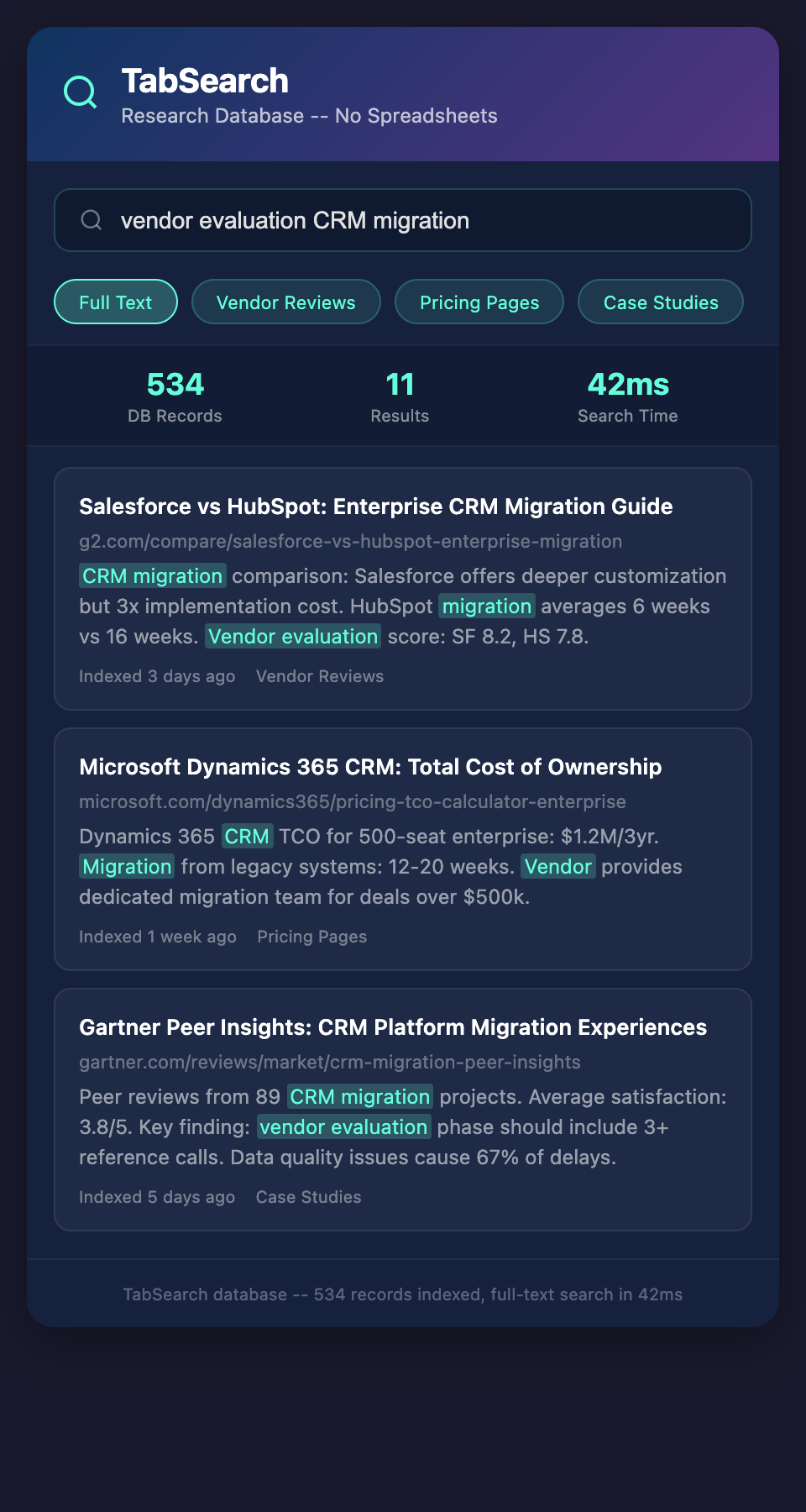
Why Competitive Intelligence Isn't Spreadsheet Data
Competitive intelligence isn't a list. It's a network of observations:
-
A competitor's pricing decision connects to their target market
-
Their product roadmap connects to their competitive positioning
-
Their hiring pattern indicates where they're investing
-
Their messaging connects to their market perception
-
Their customer wins indicate which market segments they're succeeding in
These connections matter. A fact in isolation is information; a fact connected to other facts is intelligence.
Spreadsheets flatten relationships. They turn a network into a table.
What You Lose With Spreadsheet-Only Intelligence
Traceability: Where did you find that pricing number? What date? Is it current?
- Spreadsheets store data but lose source context
Temporal analysis: How has competitor strategy evolved?
- Spreadsheets store snapshots but make temporal comparison manual
Confidence assessment: How certain are you of this data?
- Spreadsheets store facts but lose confidence levels
Related findings: What other research points to this conclusion?
- Spreadsheets store isolated cells, not connections
Qualitative nuance: A competitor's "aggressive" positioning can't be captured in a cell
- Spreadsheets force reductive categorization
The Database Alternative
A searchable research database:
-
Preserves full content
-
Store the complete earnings call transcript, not a summary
-
Store the full article, not key excerpts
-
Full-text search finds specific mentions you're looking for
-
-
Maintains context
-
Link findings to source documents
-
Include timestamps and publication dates
-
Note analyst, source credibility, and confidence level
-
-
Enables semantic search
-
Search "pricing strategy changes" and surface all relevant research
-
Search "market consolidation" and surface articles + pricing changes + M&A activity
-
Search "customer success emphasis" and surface messaging + hiring + case studies
-
-
Creates connections
-
Tag research by analytical question (Is there risk? Opportunity? Threat?)
-
Connect related findings automatically
-
See how pricing decision relates to positioning relates to market segment
-
-
Supports synthesis
-
Pull all research for a quarterly briefing in minutes
-
Generate reports with proper source attribution
-
Create timeline views of competitive evolution
-
-
Enables team collaboration
-
Multiple people can contribute and reference the same intelligence
-
Institutional knowledge persists beyond individual tenure
-
Analysts build on each other's work instead of re-researching
-
Building a Database Instead of Maintaining Spreadsheets
The obstacle isn't the database concept. It's the work of:
-
Manually transcribing content
-
Structuring data into schema
-
Maintaining consistency across entries
-
Keeping everything synchronized
The solution is automation: Your database should capture research automatically, not require manual data entry.
If you had to manually type each article into a spreadsheet, that would be prohibitive. If that same content is automatically indexed and searchable, databases become practical.
The Minimum Viable Research Database
You need:
-
Full-text index of all research (articles, pages, documents)
-
Metadata preservation (source, date, author, URL)
-
Search interface (find anything by keyword or concept)
-
Tagging system (mark research by category: feature, pricing, strategy, etc.)
-
Timeline view (see how competitive landscape evolved over time)
-
Report export (generate briefings with citations)
This is surprisingly achievable when content capture is automatic.
Why Now Is the Right Time
Five years ago: Building a searchable research database required specialized databases (expensive) and manual data entry (impossible at scale).
Today: Automatic tab indexing + modern databases make knowledge capture frictionless. Your research feeds the database automatically. You search and synthesize instead of maintaining.
Real-World Example: Building Quarterly Competitive Brief
Old way (spreadsheets):
-
Create outline for brief (2 hours)
-
Search for existing data in 3+ spreadsheets (3 hours)
-
Copy/paste relevant rows into brief document (2 hours)
-
Reformat for presentation (2 hours)
-
Re-read source articles to add context (3 hours)
-
Total: 12 hours
New way (searchable database):
-
Search "competitive positioning Q1 2026" in research database
-
All articles, pricing data, announcements surface in one view
-
Export search results with citations
-
Write analysis referencing results
-
Total: 2 hours
The difference: 10 hours saved per brief × quarterly = 40 hours per year per analyst.
For a team of 3 competitive analysts, that's 120 hours/year—3 weeks of regained productivity.
Spreadsheets as Supplements, Not Foundations
Spreadsheets are useful for:
-
Competitive comparison matrices (summary of key metrics)
-
Deal pricing lookups (quick reference)
-
Feature checklists (what do we support vs. competitors)
But they should be generated from your database, not your source of truth.
Your source of truth should be the complete research—the articles, announcements, transcripts, and analysis. Spreadsheets are summaries and views of that core data.
Starting Today: Moving Beyond Spreadsheets
-
Stop adding to standalone spreadsheets for research you want to preserve
-
Capture research in a searchable system instead
-
Use spreadsheets for comparison matrices that reference the searchable database
-
Notice how quickly analysis becomes faster when retrieval is instant
The most effective competitive intelligence teams use databases to preserve research and spreadsheets to analyze it.
Join the waitlist to build a searchable research database that replaces spreadsheet hell with instant retrieval.