Avoiding Research Rabbit Holes with Content Indexing
The Rabbit Hole Problem
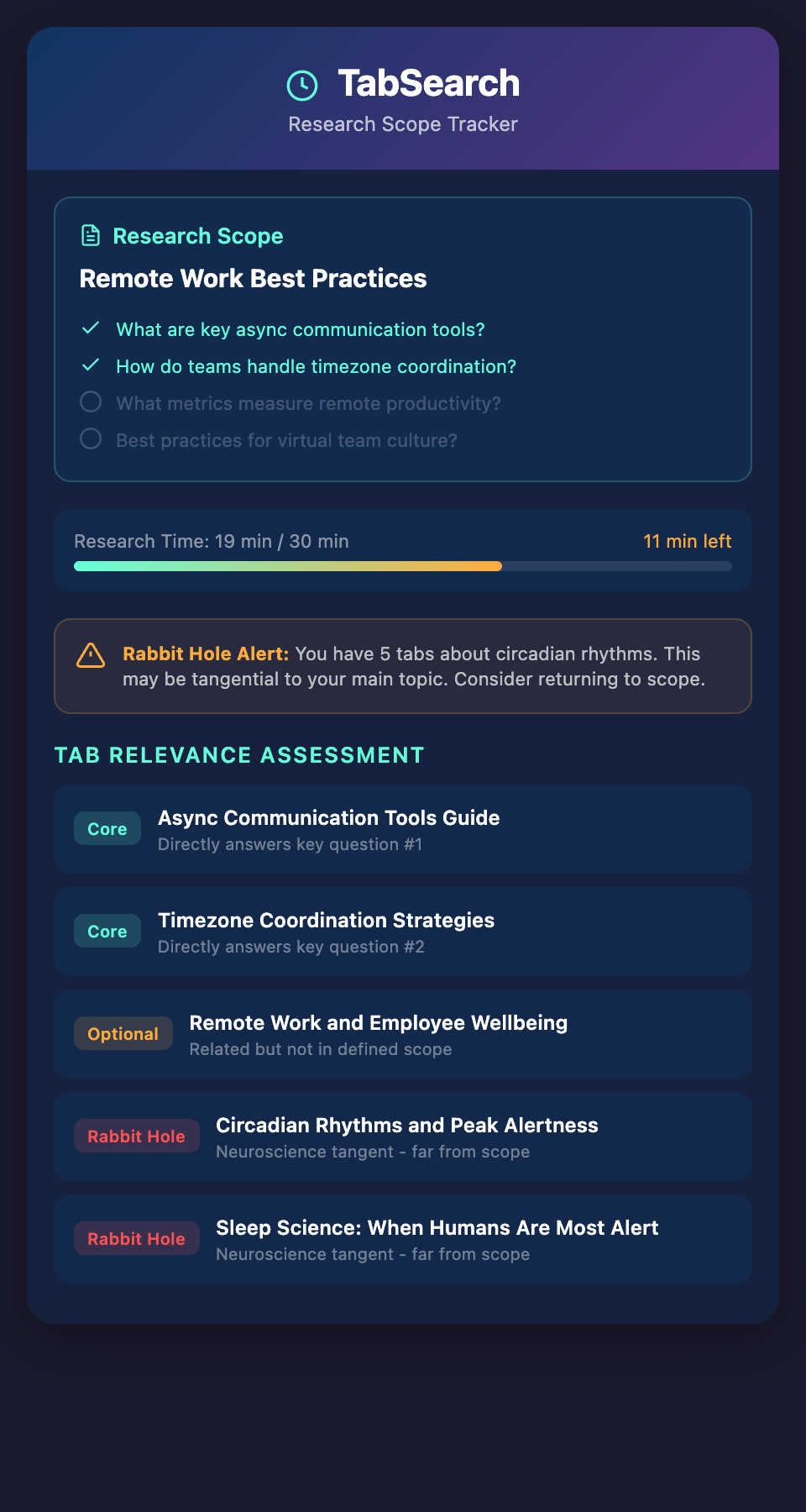
You're researching for an article about remote work best practices. You open an article about asynchronous communication. That article references a study about timezone coordination challenges. That study mentions research on circadian rhythms and productivity. Before you know it, you're deep in neuroscience research about when humans are most alert.
Two hours later, you've opened 35 tabs, learned interesting things about sleep science, and completely forgotten what you were researching in the first place.
This is the research rabbit hole. It's where writers and content creators lose hours to fascinating detours that, while intellectually engaging, contribute nothing to the piece they're writing.
Research rabbit holes aren't about lack of discipline. They're about how the internet works—each link leads somewhere interesting, and the friction of managing tabs encourages deeper exploration.
Why Rabbit Holes Happen
The structure of the internet practically guarantees rabbit holes:
Authority Through Links: Each article links to supporting sources. Following those sources feels legitimate—you're building understanding, not procrastinating.
Cognitive Engagement: Rabbit holes feel productive because you're learning and thinking actively. It feels like research, even when it's tangential.
Tab Friction: When switching between 30+ tabs is hard, you might as well keep digging deeper rather than try to organize what you have.
Open-Ended Research: Unlike writing, where the scope is clear, research has no inherent endpoint. You can always find one more source, one more perspective.
Curiosity: Writers are naturally curious. We follow interesting threads. That's partly why we're good at our jobs—and partly why we lose time.
The Cost of Rabbit Holes
The immediate cost is obvious: time. A two-hour research session intended to take 30 minutes is an hour and a half of lost writing time.
But the deeper cost is organizational. After a rabbit hole, your research is:
-
Unfocused: You have sources on five different subtopics
-
Hard to navigate: Finding the core research you needed among tangents is difficult
-
Mentally taxing: You can't remember the structure of what you researched
This makes writing harder. You have research material but no clear narrative through it.
Using Content Indexing to Manage Scope
Content indexing and full-text search provide unexpected tools for managing rabbit holes:
Clear Research Tracking: Instead of opening more tabs and hoping they're relevant, you can search to see if you've already researched something. Before diving into a rabbit hole, check if you have relevant research already indexed.
Quick Relevance Assessment: With full-text search, you can quickly assess whether a new source is actually relevant to your writing goal. Search your existing research for the topic. If you find good material, you don't need the new source.
Scope Documentation: Search your indexed research for your article's main topic. This shows you what you've already covered. New research can either strengthen existing material or introduce genuinely new angles.
Building a Rabbit Hole Prevention System
Define Your Research Scope
Before researching, write down:
-
What is this article/piece about? (1-2 sentences)
-
What questions must it answer? (3-5 key questions)
-
What sources or perspectives do I need? (broad categories, not specific sources)
Research, Then Index
Open tabs and research normally. Your natural curiosity and exploration is still valuable—you might discover important angles you hadn't considered.
But: Every 20-30 minutes, pause and search your indexed research against your scope.
Assess Relevance
Search your index for keywords from your research scope. Look at what you've found. Ask:
-
Does this material answer one of my key questions?
-
Is this a deeper perspective on something I've already covered?
-
Is this a tangential topic that's interesting but not essential?
Make Conscious Decisions
If a research direction is tangential, you can consciously decide: "This is interesting but not essential. I'll skip it and save time, or I'll pursue it knowing it's optional."
Most rabbit holes dissolve when explicitly acknowledged as optional. The problem comes from not realizing you've left your research scope.
Using Search History as a Rabbit Hole Indicator
Over time, your search history can reveal your research patterns:
If you notice you've searched for "circadian rhythm productivity" repeatedly, that's either:
-
A core topic you need to cover well, or
-
A rabbit hole you keep falling into
This visibility helps you make smarter research decisions.
Time-Boxing Research
Pair content indexing with time boxing:
Traditional approach: Research open-ended until you feel ready to write
Indexed approach: Research for a fixed time, then search your indexed material to assess what you have
If your indexed research adequately answers your scope questions, you're done researching. Write. The rabbit holes you didn't fall into are time preserved for actual writing.
Rabbit Holes Aren't All Bad
Worth noting: some rabbit holes produce your best writing. The unexpected connection, the deeper understanding that comes from following research threads, sometimes leads to better articles.
The goal isn't to eliminate rabbit holes entirely. It's to make them conscious choices, not accidental time-drains.
With content indexing and search, you have visibility into your research territory. You can choose: "This tangent is worth following for another 30 minutes because it strengthens my main point" versus "This is purely tangential and I'm skipping it."
Stay Focused on Your Writing
The ultimate goal is writing, not research. Content indexing systems that help you manage scope, assess relevance, and make conscious decisions about tangential research help you get back to the keyboard faster.
Join our waitlist to use a research tool that helps you stay focused on your writing while still capturing the full value of deep research exploration.