Backup Your Web Research Before It Disappears Forever
The Fragility of Web Research
You've spent weeks researching an article. You've collected 50+ sources. You have statistics, quotes, anecdotes, and perspectives from dozens of writers and experts.
Then one of the following happens:
Website Takes Content Offline: That brilliant guide you referenced? The author deleted it or the site went down. The URL returns a 404. Your reference is broken.
Content Gets Updated: You quoted a statistic, but the original source updated their data. Your citation now points to different information than what you originally read.
Your Browser Crashes: You lose 20 unsaved tabs, including research you hadn't processed yet.
Link Rot Happens: You save a bookmark. Two years later, when you need it for a followup article, the link is dead. The site changed their URL structure, or the page was deleted.
Archives Disappear: Services like Medium or Substack where many writers publish can take articles down. If you're relying on that source, it vanishes.
The web is fundamentally fragile. Every source exists at someone else's pleasure. At any moment, content can disappear.
Why This Matters for Your Writing
Credibility Requires Accessible Sources: When you cite a statistic or idea, readers might want to verify it. If your source is gone, your credibility suffers.
Fact-Checking Requires Original Sources: Six months after publishing, you need to verify a claim you made. If the source is gone, you can't verify it, and you can't explain your reasoning to critics.
Updates Require Knowing What Changed: If a source changed their data or conclusions, you need to know what the original said versus what it says now.
Long-Term Projects Require Stability: If you're writing a book that will be published and referenced for years, your sources need to remain accessible and unchanged during that process.
Knowledge Base Value Depends on Source Stability: Your personal research database is only valuable if the sources remain accessible and verifiable.
The Current State of Web Preservation
The Wayback Machine (archive.org) captures snapshots of websites, but:
-
Not everything is archived
-
Archiving is not guaranteed to happen or continue
-
Recent content isn't always captured
-
You can't rely on it capturing your specific pages
Bookmarking and Saving works until:
-
The original site changes
-
The site deletes content
-
You lose your bookmarks (device failure, account issues)
-
You need to share the source with others
Screenshots and PDFs require:
-
Manual effort for each source
-
Storage management
-
Retyping content to search it
-
Loss of interactivity and links
None of these approaches provide automated, comprehensive, searchable preservation of your web research.
An Intelligent Backup Approach
Automatic Capture:
As you research, every page you visit is not just indexed for search—it's also preserved as a snapshot. The content, formatting, and metadata are backed up locally.
Complete Preservation:
Not just a title and URL, but the full content of the page as you read it. Text, structure, even images and videos can be captured.
Searchability:
Your backups are full-text indexed. You can search across all your preserved research instantly.
Versioning:
If you revisit a page and it's changed, the new version is captured and you can see the difference. You know what the original said versus what it says now.
Portability:
Your research backups aren't stored with a third party. They're yours—on your device, in your control, portable if you ever need to move them.
Real-World Preservation Scenarios
The Disappearing Resource
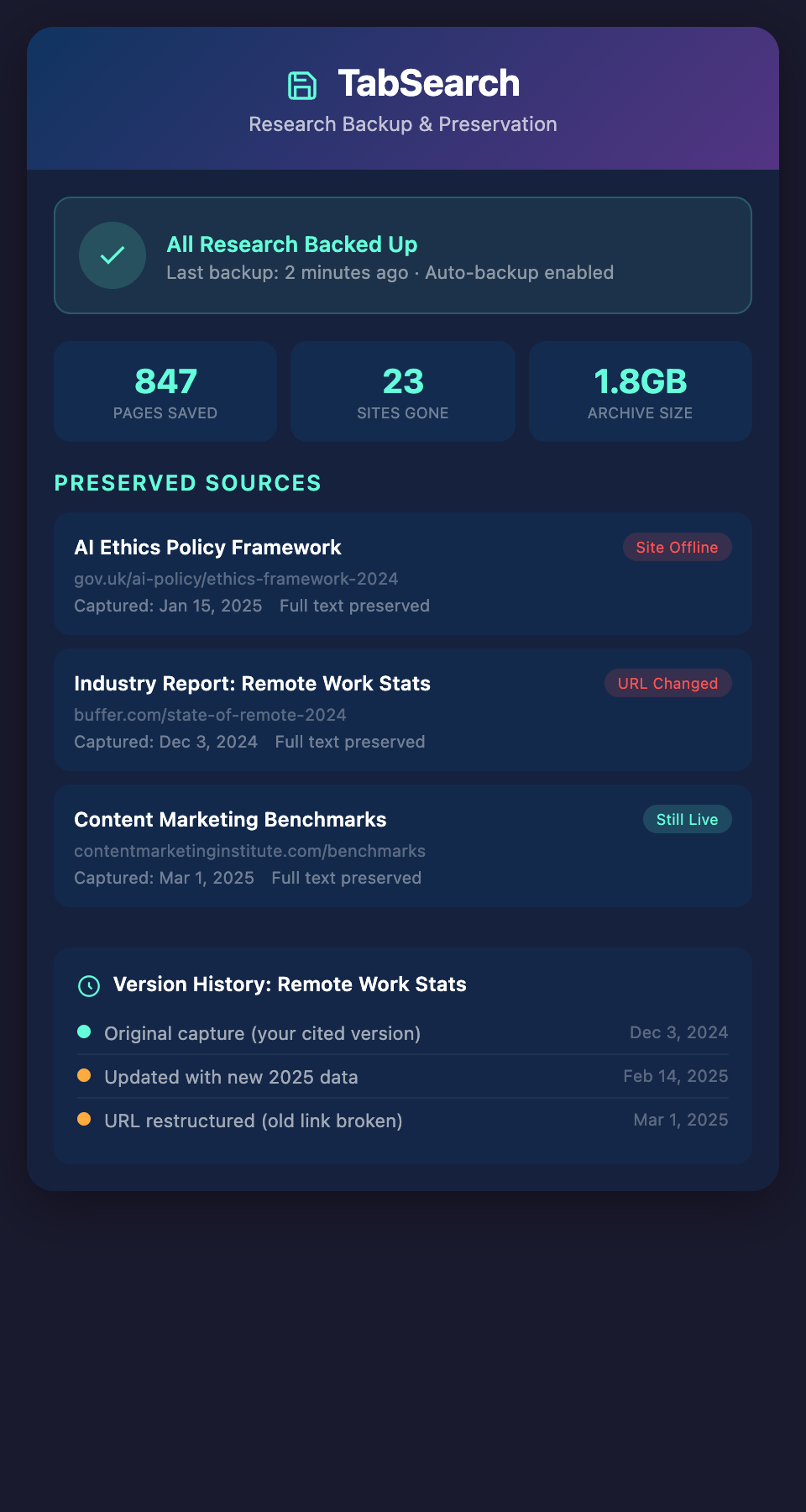
You're writing about AI ethics and save a government policy document. A year later, the government agency restructures their website and the document disappears from search. But you have the full text preserved in your research backup, and you can still cite it accurately.
The Statistical Source
You cite statistics from an industry report. Six months after your article publishes, the organization releases updated data. With your preserved backup, you can see exactly which data you originally cited. If a reader questions you, you can show the original versus the new data.
The Research Archive
Over five years, you write 100 articles in your niche. You've gathered thousands of sources. Your backed-up research becomes a personal archive of how your industry has evolved, what experts were saying at different times, and how thinking has shifted.
The Proof of Discovery
You claim to have read something first, or to have sourced an idea from a particular expert. With timestamped backups of the original content, you can prove when you discovered it and what it originally said.
Backup Formats and Accessibility
The Best Preservation:
Store full page content (HTML, text, and assets) in an accessible format. This means:
-
Readable without proprietary software
-
Full-text searchable
-
Portable across devices and systems
-
Backed up with version history
What This Enables:
-
Search across all preserved content
-
View original content as you read it
-
Export research in standard formats
-
Share sources with collaborators
-
Create personal archives of industry knowledge
Time-Shift Your Thinking
Instead of thinking "I'll remember where I found that," think "It's preserved and searchable."
Instead of "I hope that source doesn't disappear," think "I have a backup regardless."
Instead of "I need to manually save important sources," think "Everything is automatically preserved."
This time-shift in how you relate to web research reduces anxiety and increases confidence in your citations.
The Ethical Dimension
Preserving content you've researched is ethically sound:
-
You're not republishing content; you're keeping a personal copy
-
You're respecting original authors by maintaining access to their work
-
You're creating a personal archive for your own reference
Protect Your Research Investment
Your research is valuable. It's the foundation of your writing. It deserves protection.
Join our waitlist to get automatic backup and preservation of all your web research, ensuring that sources never disappear and your knowledge base remains stable and accessible forever.