Building a Personal Knowledge Base for Content Creators
The Knowledge Accumulation Advantage
Great writers and content creators don't just create content—they accumulate knowledge over time. Each article researched, each book read, each expert interviewed teaches them something. That knowledge compounds: the more you know, the faster you can research and create new content because you have context and existing mental models to build upon.
But knowledge dissipates. You read something insightful six months ago and forget you learned it. You've researched a topic thoroughly for one article, then start researching a different topic and can't cross-reference what you already know. You're constantly rebuilding knowledge you've already acquired.
A personal knowledge base prevents this loss. It's a system where every piece of information you encounter—articles you read, insights you have, connections you discover—is captured, organized, and connected. Over time, it becomes a searchable repository of your expertise.
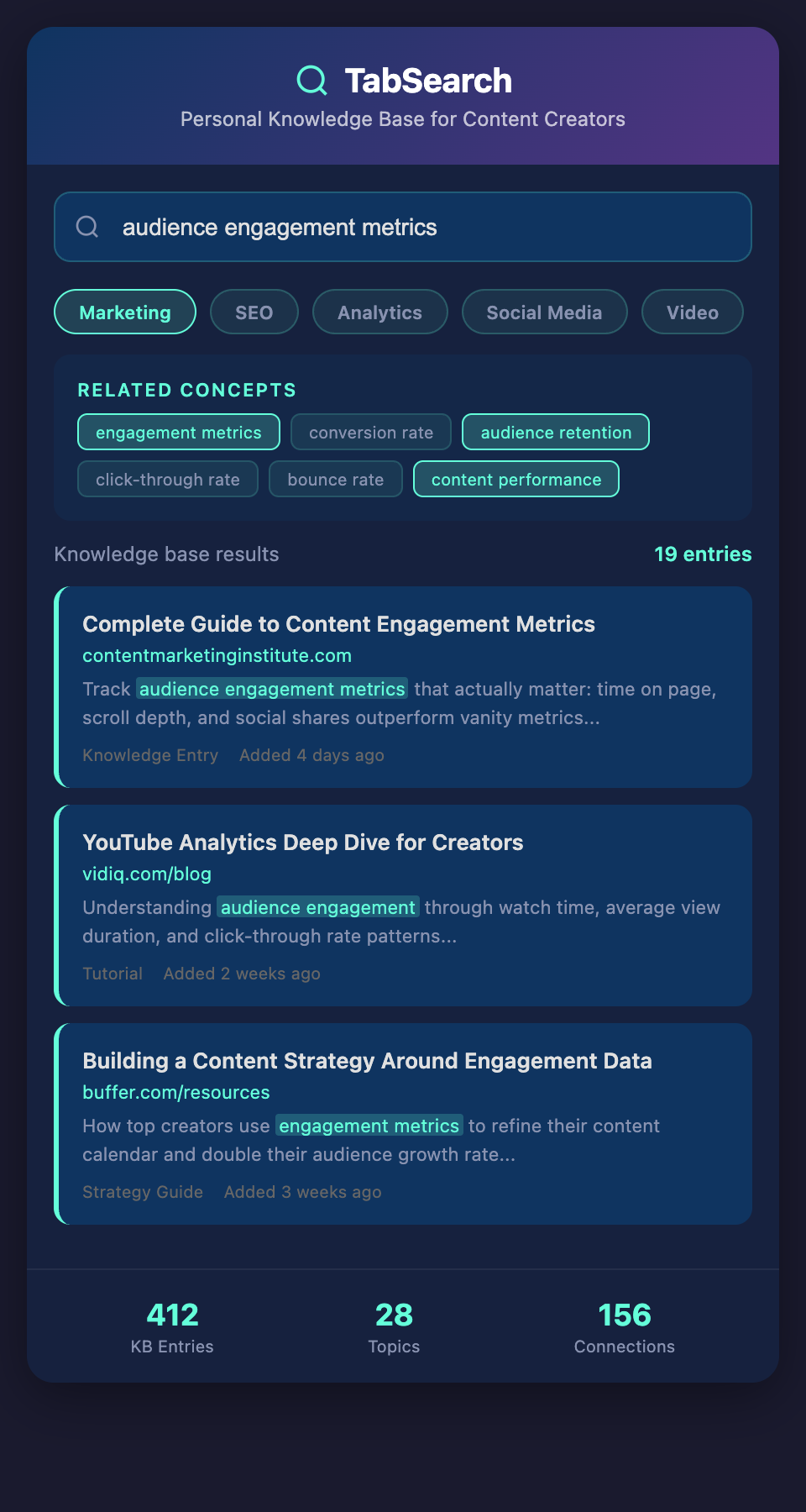
The Difference Between Knowledge Bases and Note-Taking Apps
Many writers use note-taking apps like Notion or Roam Research. These are better than nothing, but they're designed for general-purpose note-taking, not for the specific workflow of building expertise through research.
A knowledge base for content creators has distinct characteristics:
It's source-connected. Every piece of knowledge should link back to its source. When you capture "Remote workers report higher engagement," you should know which study that came from, be able to verify it, and cite it. General note-taking apps often lose this connection.
It supports full-text search across everything you know. You're not organizing knowledge into rigid categories; you're capturing it comprehensively and relying on search to retrieve it.
It enables connection-making. As you research across multiple topics, you should spot when a concept from Topic A is relevant to Topic B. A good knowledge base surfaces these connections—through tags, cross-references, or related notes.
It grows with you. Early in your content creation career, your knowledge base will be small. But over time, it becomes increasingly valuable. This means you should choose a system that scales: handles thousands of pages, remains fast, and doesn't require constant reorganization as it grows.
It's searchable and retrievable. Your knowledge only matters if you can access it. A chaotic note-taking app with thousands of unsearchable notes is actually a liability—you waste time searching.
Building Your Knowledge Base System
Start with a clear capture process. Everything you research should enter your knowledge base in a consistent format:
Capture at the Source
Don't manually transcribe information from articles to your note-taking app. That's slow and error-prone. Instead, capture the entire article or webpage. Full text enables full-text search later and prevents you from needing to return to the original source to reconstruct context.
Preserve Metadata
Every capture should include:
-
Source URL. So you (and your readers) can verify and cite it.
-
Author and publication. So you can assess credibility and build knowledge about who the experts are in a field.
-
Publication date. So you understand currency—research from 2024 might be outdated compared to 2025 findings.
-
Your capture date. So you know when you learned something.
Minimal, Consistent Tags
As you capture, assign 1-3 tags reflecting the topic area. Don't over-categorize; this doesn't scale. A few broad tags, applied consistently, enable filtering and discovery without requiring constant maintenance.
Annotation at Capture
Include a brief note about why you're capturing this: "Challenges to remote work productivity," "Contradicts common assumption," "Use in Q2 content series." These annotations are invaluable when reviewing your knowledge base months later.
Growing and Connecting Your Knowledge
Over months and years, your knowledge base accumulates hundreds or thousands of sources. The value isn't in the volume—it's in your ability to find connections.
Regular Review and Reflection
Schedule time to review what you've recently captured. As you read, ask: Have I encountered this concept before? Does this contradict something I learned earlier? Does this inspire a new content angle? Taking time to think deeply about new knowledge (rather than just capture-and-forget) builds real expertise.
Cross-Project Insights
When starting a new writing project, search your knowledge base for tangential topics. You might find research from an old project that intersects with your current topic in surprising ways. These unexpected connections often become the most interesting parts of your work.
Tracking Your Expertise Evolution
Your knowledge base is a record of your intellectual growth. Reviewing sources you captured a year ago reveals how your expertise has developed. You might notice you've become an expert in a topic you didn't consciously study—simply because you've captured and synthesized so much research on it.
The Compounding Returns
The first month of building a knowledge base requires discipline. You're capturing sources consistently, but the base is small, so search isn't remarkably faster than Google.
By month three, search becomes notably faster than re-Googling or re-reading articles.
By month six, your knowledge base contains enough interconnected information that you're spotting patterns and connections that inform your content strategy.
By year two, you have a searchable repository of your expertise. New projects start from a foundation of existing knowledge. Research that previously took weeks now takes days. And your content quality improves because you're writing from deeper, more integrated knowledge rather than surface-level research.
Building Your System Now
The best time to start building a knowledge base was years ago. The second-best time is today. Every article you don't capture is knowledge that will eventually dissipate.
Create Your Personal Knowledge Base
Ready to build a searchable knowledge base that preserves everything you learn and accelerates future content creation? Join our waitlist to be among the first to access a knowledge base system purpose-built for content creators.