Building a Personal Knowledge Base from Your Browser Tabs
Knowledge Management for Creators
Professional writers and content creators accumulate knowledge across decades. You read thousands of articles, interviews, and resources. You develop expertise across multiple domains. You have insights and connections that no search engine can replicate.
The tragedy is that most of this knowledge lives in scattered browser tabs, bookmarks, and personal notes—inaccessible and invisible until you happen to remember it.
A personal knowledge base changes this. Instead of knowledge existing in isolated tabs, it exists as an interconnected, searchable, organized system that you can leverage across all your creative work.
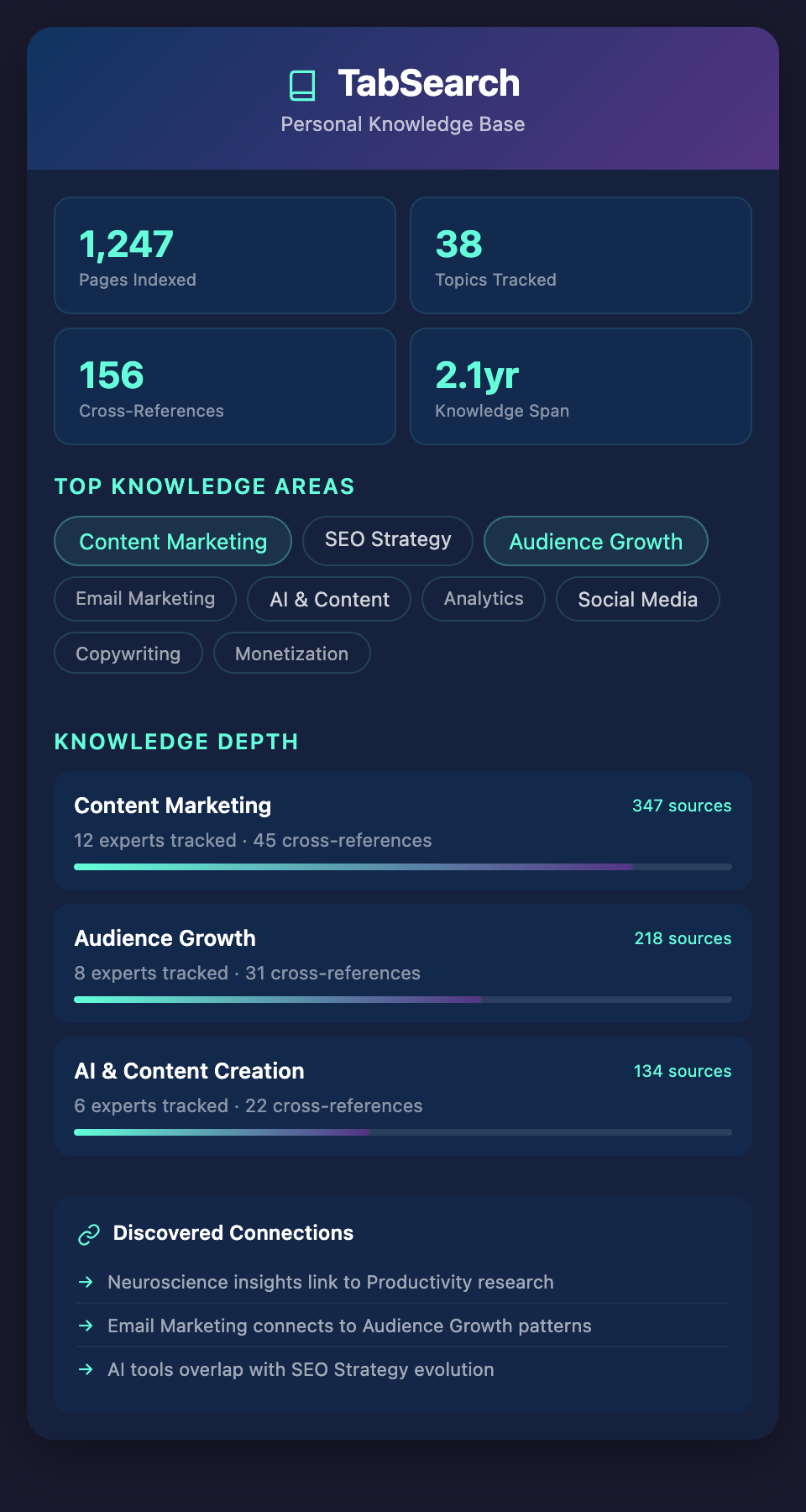
What Is a Personal Knowledge Base?
A personal knowledge base is a private, searchable collection of everything you've learned and researched. It's:
Comprehensive: Every article you've considered research-worthy is captured, not just the ones you remembered to save.
Interconnected: Ideas and sources are linked, showing relationships between concepts and themes.
Persistent: Unlike browser sessions, your knowledge base survives crashes, device changes, and time. It's there years later when you need it.
Searchable: You find information by content, not by remembering folder structures or file names.
Private: Everything stays on your device or your own infrastructure. No corporation analyzes your research or uses it for profit.
Why Browsers Fail as Knowledge Bases
Your browser is designed for browsing, not for knowledge retention. Every feature it has is optimized for finding new information, not retrieving old information.
Browser history is chaotic: It contains every site you've visited, including social media, email, shopping sites, and work applications. Finding research in that noise is impossible.
Bookmarks require discipline: You have to manually decide what's worth saving, where to file it, and maintain folder hierarchies. Most bookmarks systems become unusable within months.
Tabs disappear: Close the browser or lose power, and tabs vanish. The information is gone.
Search is limited: Browser history search works on titles and URLs, not content.
No cross-topic connections: Browser organization forces linear hierarchies. An article about remote work tools that's also relevant to team communication is isolated in one folder.
Building Your Knowledge Base
A personal knowledge base built on full-text indexing works differently:
Step 1: Automatic Capture
Everything you research is automatically indexed. No manual action required beyond normal browsing.
Step 2: Comprehensive Indexing
Every word on every page is indexed, including content that appears after scrolling. Paragraphs buried deep on a page are just as discoverable as the headline.
Step 3: Powerful Search
You search by content, by topic, by specific phrases or statistics. Results surface instantly.
Step 4: Cross-Topic Discovery
You can search across your entire knowledge base, discovering how different research areas interconnect. That article you read about neuroscience might be highly relevant to your article about productivity.
Step 5: Long-Term Retention
Your knowledge base is backed up and maintained, so knowledge never disappears. Articles you researched 5 years ago are still there when you need them.
Real-World Benefits
Faster Writing
When you're writing and need to reference something you read, finding it takes seconds instead of minutes or hours. This speed directly translates to more writing time.
Better Research
Instead of re-researching topics you've already explored, you can build on previous work. You spot gaps in your understanding based on previous research.
Deeper Insights
Searching your entire knowledge base reveals patterns and connections you wouldn't discover through dispersed bookmarks or vague memory. You see which topics you research repeatedly, which experts you consistently reference, which themes emerge across sources.
Improved Citations
You actually verify sources you remember reading because finding them is instant. Your writing quality improves because it's backed by concrete references.
Competitive Advantage
In content creation, having a deep personal knowledge base is a genuine advantage. You can draw connections others can't because you have instant access to a vast corpus of research.
The Mindset Shift
Building a knowledge base requires a mindset shift from "organize meticulously" to "capture everything and search later."
Many writers try to maintain perfectly organized systems. They create folders, they tag articles, they try to file everything in the right place. This works until it doesn't—usually within weeks.
A better approach: capture everything automatically and let search be your organization system.
Don't worry about filing that article about AI and content creation. Search for it later when you need it. Capture the research, trust the indexing, and rely on search.
Over Time, Your Knowledge Becomes Assets
After months or years of research, your personal knowledge base becomes a genuine competitive asset. You have:
-
Every article and resource in your industry
-
Complete research trails on topics you've written about
-
Collections of perspectives on debates and emerging trends
-
A library of citations for common claims in your field
-
Patterns and insights from your own research behavior
This knowledge is valuable. It accelerates future writing. It helps you write with authority because you're drawing from a deep, personally-verified research base.
Start Building Today
Your browser is capturing research every moment you browse. The only question is whether that research is lost or whether it becomes part of a searchable, persistent knowledge base you leverage for years.
Join our waitlist to build your personal knowledge base using a system designed specifically for writers and content creators. Turn your research into your competitive advantage.