Full-Text Search Tools for Writers and Journalists
Why Full-Text Search Matters for Writing
A writer's superpower is synthesis: pulling together disparate sources and weaving them into a coherent narrative. But synthesis demands the ability to find information quickly. You need to retrieve that specific quote you read last month, verify a statistic, find all your research on a particular subtopic, or discover connections across sources you forgot you had.
Google search works for finding information on the public web. But it doesn't help you search within your own research library—the accumulated sources, notes, and materials specific to your current project. That's where full-text search becomes critical.
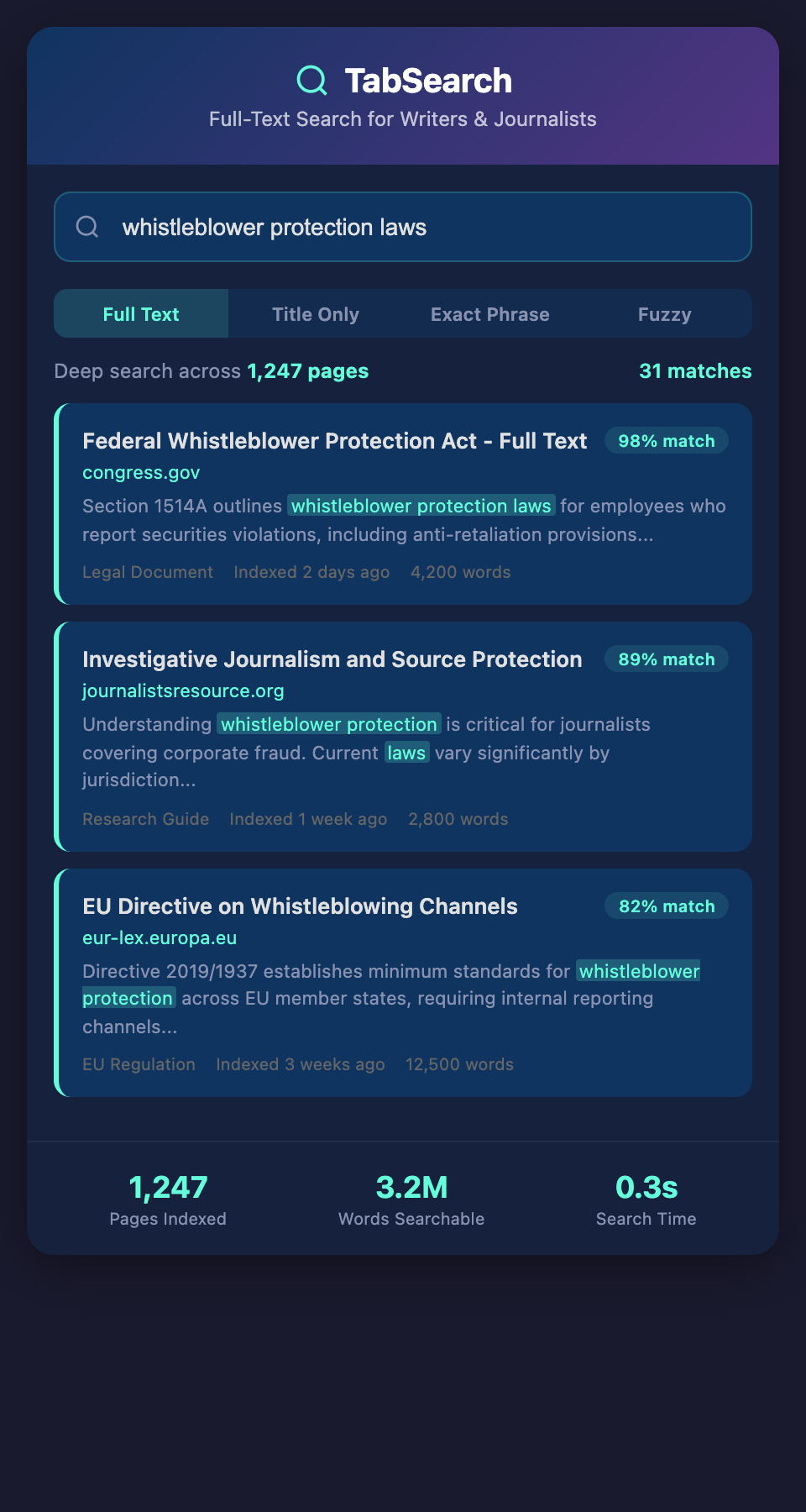
Full-text search means every word in every document you've captured is indexed and searchable. You're not limited to searching titles or tags; you're searching the complete content. This transforms research from a guessing game into a reliable retrieval system.
The Limitations of Existing Solutions
Many writers default to Notion, Google Docs, or Evernote for organizing research. These tools have search capabilities, but they were designed for general note-taking, not for the specific workflow of content creators.
Search results are often imprecise. Broad keyword searches return too many results or miss relevant documents. Boolean operators (AND, OR, NOT) aren't available or are difficult to use. You can't easily ask "show me all sources mentioning both X and Y but not Z."
Integration with browser research is weak. You're researching in your browser but taking notes in a separate app. This creates friction: switching applications disrupts flow, information gets lost in translation, and you spend cognitive energy on tool-switching instead of thinking.
Searching across multiple documents is cumbersome. If your research spans fifty web pages, a dozen PDFs, and some handwritten notes, no existing tool searches all of them equally well.
Context is lost during capture. When you copy a quote to Notion, you often lose metadata: who said it, when, in what context. You're left with fragmented information that's hard to verify or cite properly.
What Full-Text Search Should Enable
A proper full-text search system for writers should do the following:
Instant Retrieval of Any Information You've Encountered
If you remember a phrase, author name, publication, or date, you should be able to find every source containing that information in seconds. This sounds basic, but most systems are slow or return irrelevant results.
Boolean Search Capabilities
You need operators like AND, OR, and NOT to construct precise queries. "Show me sources about productivity AND remote work but NOT pandemic" is much more powerful than searching for a single keyword. For complex research, this capability is essential.
Phrase Search
Sometimes you remember an exact phrase. Phrase search (usually in quotation marks) should find that exact phrase and return results showing it in context. This is invaluable for fact-checking and locating quotes.
Filtering and Refinement
After a search returns results, you should be able to filter by publication date, source type, domain, or tags you've assigned. This narrows results to the most relevant subset.
Context Display
Search results should show matching text in context—not just the matching line, but surrounding text so you understand the idea fully. Many generic search tools show only the matching snippet, requiring you to open the full source to get context.
Search History and Saved Searches
You'll often run the same searches across multiple writing projects. The ability to save a search or review your search history prevents redundant work.
Designing Your Search Workflow
Full-text search is only useful if you actually use it. Integrate it into your drafting process intentionally.
Search Before You Write
When you're about to write a section, search your sources first. If you're writing about "the future of AI," search for "artificial intelligence," "machine learning," "AI trends." Skim the results. This jogs your memory about what you've researched, helps you remember sources you'd forgotten, and ensures your section will be well-sourced before you start drafting.
Verify Claims with Search
Mid-draft, when you want to assert something specific, search to verify. "Remote workers report 40% higher engagement" — does your research support this? Search, find the source, verify the exact statistic.
Build Arguments Incrementally
Rather than trying to recall all relevant sources from memory, use search iteratively. Write a paragraph, search to verify each claim, refine as you find additional supporting or contradicting evidence.
Create a Research Audit Trail
As you draft, note the searches you've done. This creates a semi-automatic source list: you know exactly which research informed each section because you can see your search history.
Evaluating Search Tools for Your Workflow
When choosing a full-text search system, test these capabilities:
Speed. Search should return results in under a second. Slow search discourages use.
Precision. Run test queries on your actual research. Do you get mostly relevant results, or is the signal-to-noise ratio poor?
Integration. Can you search without leaving your browser or writing app? Seamless integration increases adoption.
Scalability. Will it handle thousands of captured pages? Millions of words of content?
Offline access. Can you search when offline? Many writers prefer this for airplane work or unreliable internet.
The Research Advantage
Writers who can efficiently search their own research libraries have a structural advantage. They can write faster, with higher confidence in accuracy and source attribution. They can handle more complex topics because they can reliably find supporting evidence. They can revise more effectively because they can quickly verify whether a rewritten section still accurately reflects their sources.
The investment in a proper full-text search system pays dividends across every writing project you undertake.
Unlock Full-Text Search for Your Research
Ready to search your research library like a pro? Join our waitlist to get early access to a full-text search system built specifically for writers and content creators.