Research Organization for Freelance Writers and Creators
The Freelance Writer's Unique Challenge
Freelance writers juggle multiple clients, multiple projects, and multiple research contexts simultaneously:
Monday: You're researching SaaS tools for Client A's blog post.
Tuesday: You switch to researching supply chain logistics for Client B's whitepaper.
Wednesday: You research personal finance trends for Client C's newsletter.
Thursday: Client A needs a revision, requiring you to find and reference your original research from Monday.
Friday: All three clients want revisions, each requiring you to navigate different research contexts.
This context-switching is unavoidable in freelance work. But context-switching should be fast and frictionless. If it's slow, you lose time and revenue.
Most freelancers try to manage this with project folders, tag systems, or complex note-taking hierarchies. These approaches fail because:
They're Manual: You have to decide how to organize each project, which becomes time-consuming and inconsistent.
They're Rigid: When a client asks for research across two projects, your filing system doesn't help—research is siloed.
They're Context-Heavy: Switching projects requires remembering where research is filed, what's been saved, what's still to research.
They Don't Scale: What works for 2 concurrent projects breaks at 5+ projects.
The Freelancer's Research Reality
As a freelancer, you're essentially running a small research business. You gather information on behalf of clients. Your efficiency directly affects your income and workload capacity.
Key metrics for freelance writers:
-
Time from assignment to delivery
-
Research time vs. writing time ratio
-
Ability to reuse research across clients (without plagiarism)
-
Speed of context-switching between projects
-
Ability to find previous research for revisions or follow-ups
All of these are impacted by research organization.
The Traditional Approach: Project Folders
Most freelancers organize research by project:
Client A/
Project 1/
Research/

  article-1-sources/

  article-2-sources/
Client B/
Project 1/
Research/
Client C/
...
This works until:
-
You need research across projects: Client D asks for an article about marketing automation. You've researched this for Client A and Client B in different folders. You need to search both.
-
You need to remember what you've researched: Starting a new project, you vaguely remember researching this topic for a different client months ago. You either re-research or try to dig up old files.
-
File management becomes overhead: Time spent organizing files is time not spent writing or earning.
-
Revision requests require research archaeology: Client asks for a revision 3 months later. Finding the original research and context takes time.
A Better Model: Unified Research Database
Instead of organizing by project, maintain a unified research database and tag research by project:
All research lives in one searchable place:
-
Every article you've read for any client
-
Every source you've considered
-
Every statistic or insight you've gathered
But tagged and searchable by project:
-
Search your entire research: "content marketing"
-
Narrow results by project: "content marketing for Client A"
-
Switch projects: "content marketing for Client B" instantly shows related research
This approach is more flexible because:
No Redundant Research: If you've researched a topic, you can find and reuse it across clients (checking for conflicts of interest or confidentiality first).
Fast Context Switching: Switching from Client A to Client B means searching for "Client B" to surface all relevant research.
Efficient Onboarding: New project? Search your database for any related research you've already gathered.
Revision Management: Months later when a client asks for revisions, find their original research instantly.
Preventing Conflicts and Maintaining Ethics
With a unified database, you need safeguards:
Confidentiality Tagging: Tag sensitive or confidential research so you don't accidentally reference it for other clients.
Competing Clients: Tag research related to competing clients so you don't accidentally reuse it.
Client Privacy: Mark which research is client-specific vs. general knowledge you can reuse.
A well-designed research system allows you to:
-
Keep research organized for easy access
-
Ensure client confidentiality
-
Reuse general knowledge across projects ethically
-
Quickly identify what research is available for a new project
Project Velocity and Revenue
The time saved through efficient research organization directly impacts income:
Without efficient research organization:
-
Project timeline: 2 weeks (2 days research, 5 days writing, 5 days revision)
-
Research overhead: 2+ days of project time per project
With efficient research organization:
-
Project timeline: 10-12 days (1 day research, 5 days writing, 3-4 days revision)
-
Research overhead: 1 day or less per project
For a freelancer doing 6 projects per month:
-
Traditional: 12 days/month lost to research overhead
-
Optimized: 6 days/month saved
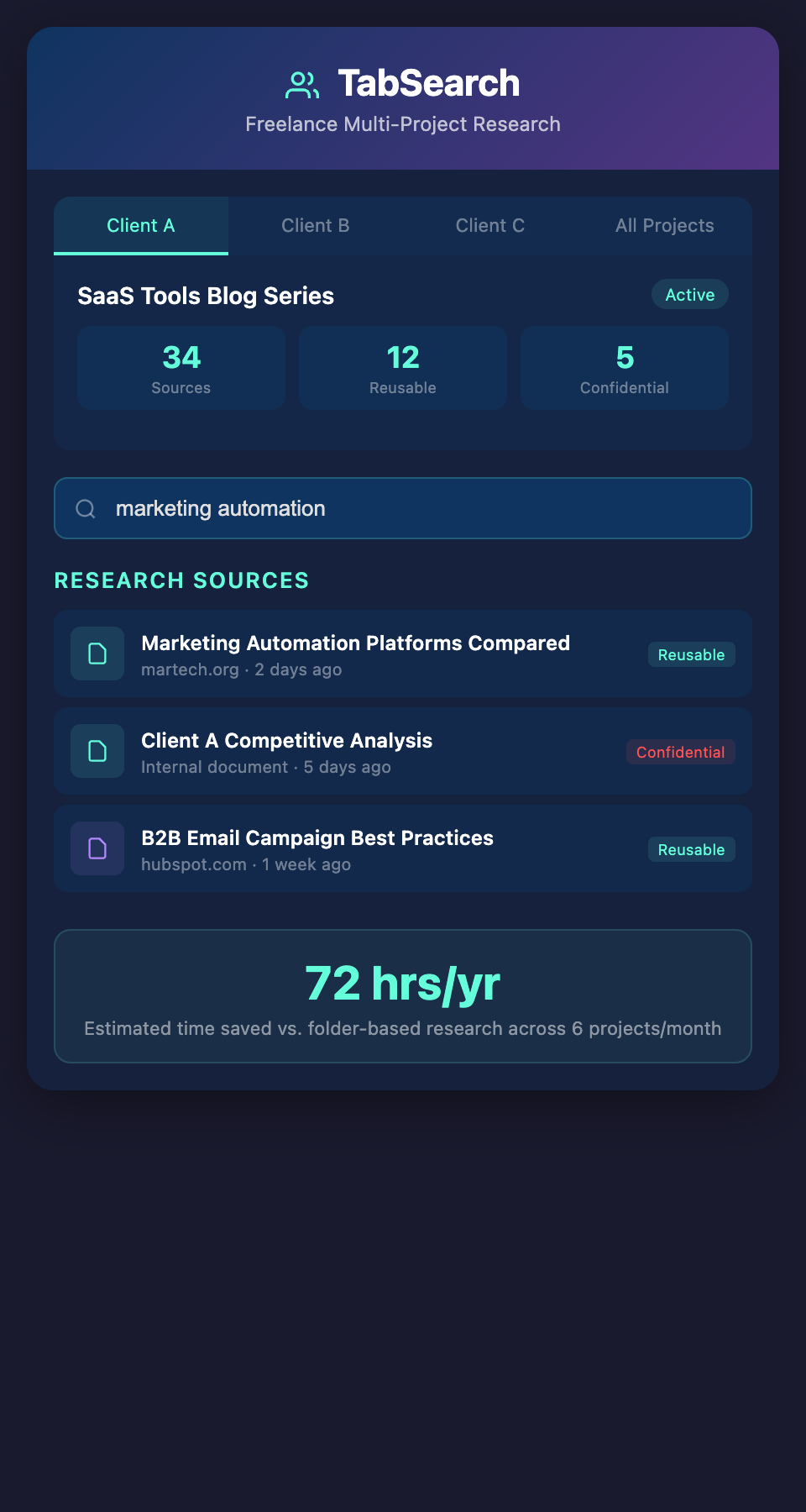
Over a year, that's 72 hours of saved time—hours you can spend on additional projects or deepening your expertise.
Building Expertise Across Topics
The unified research database has a secondary benefit: you become a better researcher.
When you can search your entire research history, you notice:
-
Which topics you've researched multiple times (these are your expertise areas)
-
Which sources keep reappearing (these are authoritative sources you trust)
-
How thinking on topics has evolved over time
-
Which angles are overused vs. underexplored
This meta-knowledge makes you a better writer and more valuable to clients.
Managing Volume
Successful freelancers scale to multiple concurrent projects. Each project has research. Total research accumulation can be substantial.
A unified, searchable research database scales better than project-folder organization:
With 2 projects: Both systems work fine.
With 5 projects: Folder systems become harder to navigate. A searchable database excels.
With 10 projects: Folder systems are painful. Searchable database is essential.
With 20+ projects: Folder systems are unusable. A searchable database is non-negotiable.
The better your research system scales with your business, the more projects you can handle profitably.
Building Your Professional Library
Over years of freelancing, your research database becomes a professional library:
-
Knowledge of your niche(s)
-
Relationships with sources and experts
-
Understanding of trends and evolution
-
Expertise in research itself
This library becomes your competitive advantage. You research faster, write faster, and deliver better work because you're building on years of accumulated research.
Invest in Yourself
Freelancing income is directly proportional to speed and quality. Anything that improves either of these is worth investing in.
A research system designed for freelancers—handling multiple projects, providing fast context-switching, enabling ethical research reuse, and building over time—is an investment in your business.
Join our waitlist to get a research system built specifically for freelance writers: manage multiple projects, switch contexts instantly, maintain ethics and confidentiality, and build your professional knowledge library.