Collaborative Research Organization for Distributed Academic Teams
The Unique Challenges of Distributed Research Teams
Research collaboration has transformed over the past decade. Teams that were once physically co-located in the same lab now span continents. A PhD student in Berlin collaborates with advisors in Toronto and colleagues in Singapore. Postdocs work across institutions. Grant-funded research teams bring together specialists from different universities.
This distributed model brings tremendous benefits: access to world-class expertise, diverse perspectives, and ability to tackle larger problems. But it creates unique challenges for research organization that traditional in-person collaboration never faced.
When everyone worked in the same physical space, you could casually ask, "Did anyone already find papers on X?" Now that same conversation requires structured communication across time zones and asynchronous workflows.
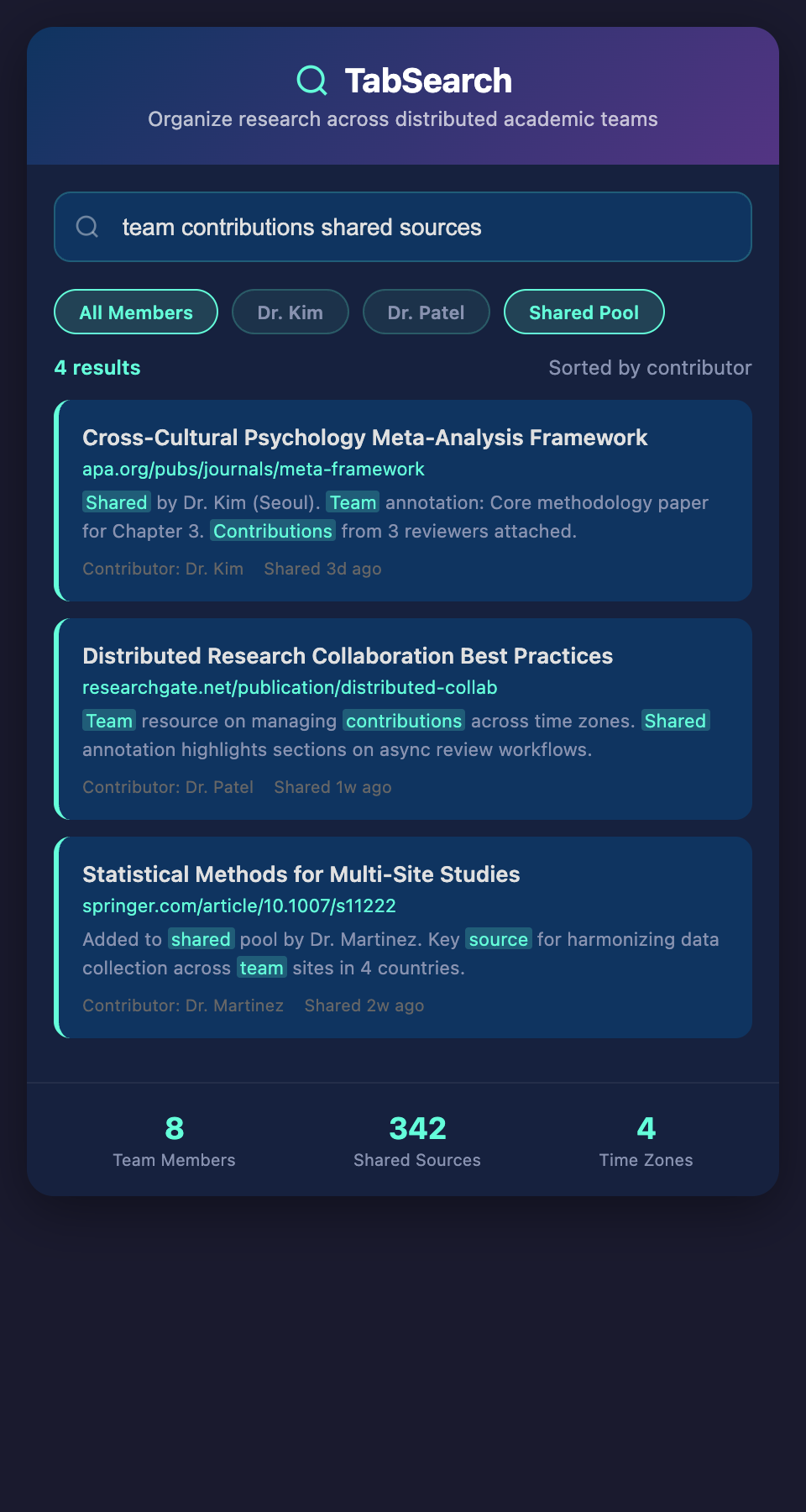
The Problems Distributed Teams Face
Invisible Duplicate Effort
Without visibility into what colleagues are researching, team members invest effort in the same topics independently. Researcher A spends a week finding papers on "reinforcement learning in robotics," while Researcher B simultaneously spends a week on the same topic. They don't realize the duplication until they compare notes weeks later.
Asynchronous Communication Gaps
A team member in Asia finds a critical paper and adds it to the team's shared folder on Monday morning (Asia time). By the time a European teammate logs in Monday afternoon (Europe time), they're already starting their own research on the same topic and miss the notification.
Fragmented Tool Ecosystems
Distributed teams often use different tools. One person maintains sources in Zotero, another uses Mendeley, another just bookmarks in the browser. Even when trying to share sources, different tools create friction and compatibility issues.
Attribution and Motivation
In-person teams naturally know who found what sources. In distributed teams, this attribution becomes invisible. A person who found 20 critical sources might not receive recognition because others don't see the contribution.
Version Control Confusion
"Who has the latest version of our source list?" becomes a serious question. Multiple copies of shared documents exist in different places, in different states. Team members accidentally work from outdated versions.
Time Zone Synchronization
Synchronous collaboration is difficult across distributed teams. Scheduling a meeting where everyone can attend is nearly impossible for teams spanning more than three time zones. Most collaboration must be asynchronous, requiring clear documentation and communication.
Building a Distributed Team Research System
The most effective distributed research teams implement a centralized system that works across time zones and tool preferences.
Core Principle: Single Source of Truth
All team research—sources, notes, citations—lives in one place. Not "sources in Zotero, notes in Google Docs, citations in a separate spreadsheet." One system that everyone uses, sees, and contributes to.
This single source of truth eliminates the confusion about "what's the latest version?" and ensures team members benefit from each other's work.
Real-Time Visibility
Every team member should see what sources have been found, who found them, and when. This doesn't require synchronous meetings—just visibility into each other's work.
Implementation:
-
Activity feed showing newly added sources with contributor name
-
Search bar where you check "did we already have this?" before adding
-
Notifications for sources added to topics you're researching
-
Contributor profiles showing each person's research focus and contributions
When team members have visibility into each other's work, duplication drops dramatically.
Clear Research Scope Definition
At the project's start, the team should explicitly divide research topics. Rather than everyone researching "climate science," assignments might be:
-
Person A: Climate modeling and prediction
-
Person B: Policy and economic impacts
-
Person C: Agricultural adaptation
-
Person D: Extreme weather events
Clear scope boundaries don't prevent people from helping each other—they ensure that someone owns each area and is responsible for comprehensive coverage.
Unified Search and Discovery
All sources should be searchable together, and that search should work across dimensions:
-
Author: "Show me everything by William Nordhaus on climate economics"
-
Topic: "Show me papers on carbon pricing that Person A added"
-
Type: "Show me only peer-reviewed papers, not blog posts"
-
Date: "Show me papers on this topic published in 2024"
-
Status: "Show me sources I haven't read yet"
Unified search surfaces others' work to everyone on the team, creating natural cross-pollination of research ideas.
Asynchronous Annotation
Team members should be able to add notes to shared sources without overwriting each other's work. If Person A annotates, "This paper uses a novel methodology," and Person B annotates, "Their results contradict Smith et al.," both annotations should coexist.
Implementation:
-
Each person's annotations linked to their name and timestamp
-
Ability to reply to others' annotations (creating discussion threads)
-
Distinction between personal notes (visible only to annotator) and team notes (shared with everyone)
This lets distributed teams have ongoing written conversations about sources rather than trying to align in synchronous meetings.
Contribution Tracking
The system should track who found each source, who's added notes, who cited it in their writing. This serves multiple purposes:
For team dynamics:
-
Recognizing and thanking people who contributed critical sources
-
Identifying research gaps where no one has taken ownership
-
Understanding each person's role and contribution
For accountability:
-
Knowing that Person A is responsible for comprehensive coverage of Topic X
-
Seeing who last updated each source or annotation (useful if something seems wrong)
For workflow:
- Knowing who to ask about a particular source: "Hey, I see you added this paper—what did you think of their methodology?"
Time Zone Strategies
Distributed teams across many time zones face genuine scheduling challenges. The research system should minimize the need for synchronous coordination:
Asynchronous Decision-Making
Rather than meetings to decide what sources to include, use the shared system to propose, discuss, and decide asynchronously. A proposal gets posted with reasoning, people comment over the next 1-2 days, and decisions are made without everyone being online simultaneously.
Automated Notifications
When someone adds a source to a topic you're researching, you should be notified. You don't need synchronous alerts—just awareness that someone added something new to areas you care about.
Recorded Discussions
When synchronous meetings do happen, record and transcribe them so people across time zones can catch up later. This creates an asynchronous version of synchronous discussion.
Handoff Communication
Establish clear handoff points: "The Asia/Pacific team finishes their day and documents what they found. The European team wakes up to a summary and can continue the work. The Americas team receives handoff notes and continues again."
Case Study: A Global Climate Research Consortium
A consortium of 15 researchers across 8 countries conducting a meta-analysis on climate adaptation needs established the following system:
Organization:
-
4 research teams by geography: Africa, South Asia, Southeast Asia/Pacific, Latin America
-
Each team owns sources for their region plus cross-cutting topics
-
One coordinator (distributed with 2-week rotating shifts across time zones)
Workflow:
-
Team members continuously add sources as they find them (no batch additions)
-
Coordinator reviews weekly for duplicates, missing metadata, potential gaps
-
Coordinator posts weekly summary: "This week we added 47 sources on water resources, 23 on agriculture adaptation, 12 on policy"
-
Research teams use search to check each other's work: "Asia team found 8 sources on small-farm irrigation—did Africa teams add their equivalents?"
Results after 6 months:
-
1,247 sources collected, fully indexed and searchable
-
0 known duplicates (automated detection caught and merged potential duplicates)
-
60% of sources tagged with multiple applicable regions (showing cross-regional relevance)
-
Clear attribution: each person's contributions visible
-
Each researcher could describe the state of their field: "We have strong coverage on coastal adaptation but gaps on mountain agricultural adaptation"
Without centralized organization, the same team would have been duplicating effort, losing sources, and spending hours trying to reconcile different collection formats.
Integration With Your Writing and Citation
The team research system should flow directly into the writing process. When you're drafting the methodology section, you should:
-
Search the team sources for all papers describing similar methodologies
-
See who on your team found each source
-
Export citations in the required format
-
Link directly from the paper to the original source
This integration means the team's months of research organization directly accelerates the writing process.
Managing Contribution Conflicts
Distributed teams sometimes face contribution conflicts: Who owns the decision about what sources to include? What if someone wants to exclude a source that others found valuable?
Healthy protocols:
-
Inclusion default: Sources are included unless there's a clear reason to exclude them
-
Discussion before exclusion: If someone wants to remove a source, the team discusses why
-
Separate tiers: Create "primary sources" (consensus picks) and "secondary sources" (found but less central)
-
Documentation: Record reasoning behind inclusion/exclusion decisions
These protocols prevent decision paralysis while maintaining research quality.
Scaling to Large Teams
As teams grow beyond 8-10 people, coordination becomes more complex. The system should scale through:
Subgroups: Dividing into smaller teams (3-4 people each) with one person on each subgroup participating in overall team coordination.
Hierarchical organization: Creating topic hierarchies so sources can be organized at multiple levels of specificity.
Delegation: Designating topic owners who are responsible for comprehensive coverage and quality.
Tools and Platforms
The most effective distributed research teams use platforms that provide:
-
Centralized source repository
-
Full-text search across all content
-
Real-time collaboration and attribution
-
Asynchronous notification and discussion
-
Integration with citation management
-
Mobile access (so researchers can add sources while reading on the go)
Building Your Distributed Research Practice
If you're part of a distributed research team, audit your current practices:
-
How many different tools does your team use for sources?
-
How much time is spent coordinating and deduplicating?
-
Do all team members have visibility into what others have found?
-
Could you clearly describe the research contributions of each team member?
Most distributed teams discover they're spending 15-20% of research time on coordination rather than actual research.
Ready to eliminate coordination overhead from distributed research? Join our waitlist for a collaborative research system that keeps global teams synchronized and prevents duplication across time zones.