Cross-Referencing Academic Sources Quickly and Accurately
The Citation Network Problem
You're building your argument, synthesizing findings from twelve papers. Paper A cites Paper B, which references Paper C. You recognize the pattern: these papers form an intellectual lineage, each building on the previous. But connecting these dots manually is tedious.
You search for Paper C to understand the foundation. Then you search back to see who else has cited Paper C since then. You're trying to map a citation network by hand, following breadcrumb trails, hoping you don't miss an important connection.
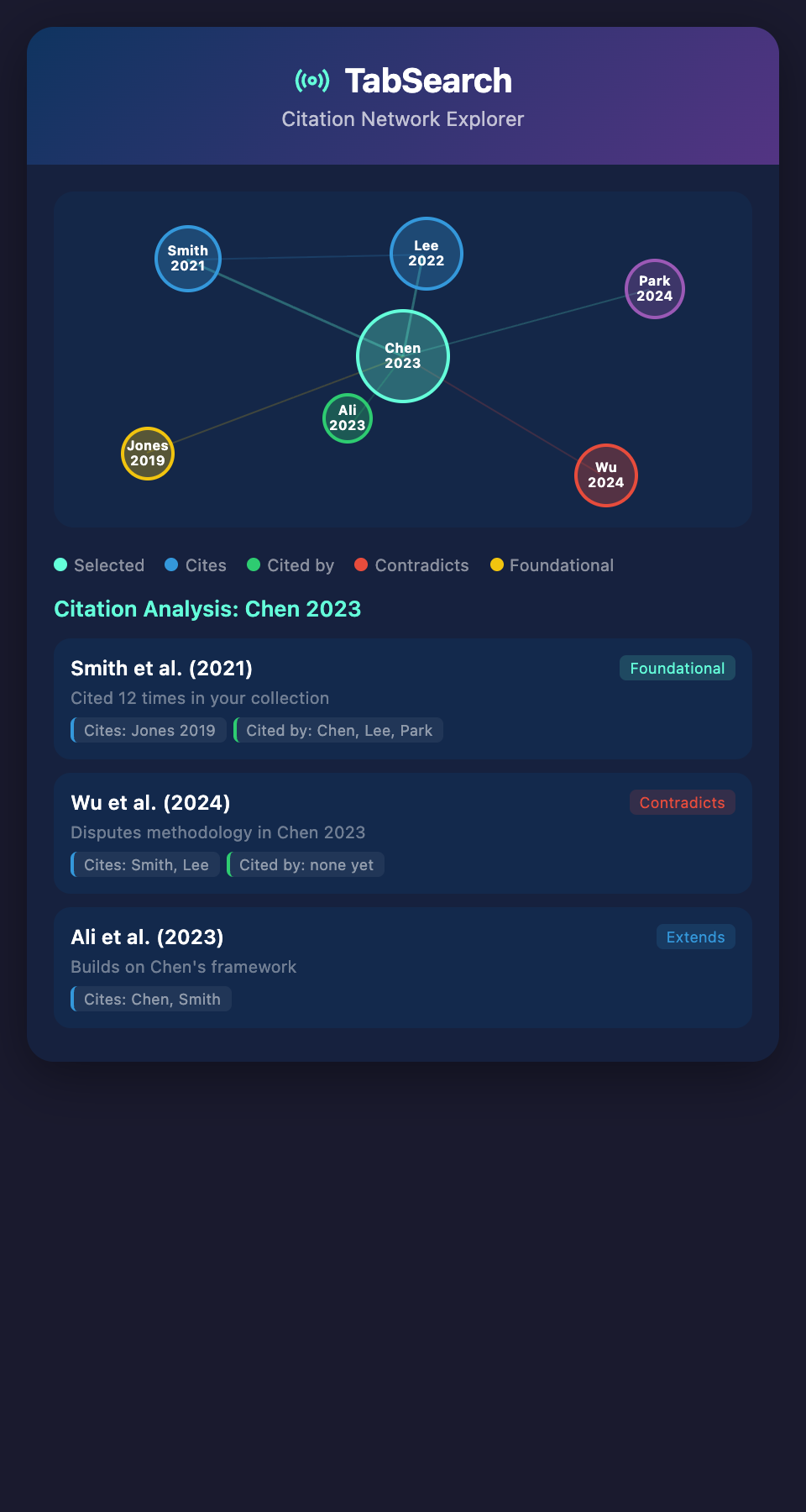
The most rigorous researchers understand that sources don't exist in isolation. Every paper references others, and every paper is cited by subsequent work. The pattern of citations and connections—the citation network—reveals the intellectual structure of your field. Papers that heavily cite each other form clusters. Those citation clusters represent research themes and paradigms.
But seeing this structure requires efficient cross-referencing, and manual cross-referencing is slow.
Why Cross-Referencing Matters
Consider two research synthesis approaches:
Approach 1: Linear Synthesis
You read Paper A, extract findings, take notes. You read Paper B independently, extract findings, take notes. After reading all papers, you try to connect them mentally. The connections form late, often after you've already drafted your argument.
Approach 2: Network Synthesis
You identify the key papers first. You map citations between them. You see which papers are central (cited by many others) and which are peripheral. You understand debates within the field by seeing which camps of papers cite each other vs. ignore each other. Then you read papers strategically, starting with foundational works and building toward recent findings. You synthsize as you go.
Research synthesis is faster, more accurate, and more insightful using the network approach. You spend less time searching for papers and more time on actual integration.
Tools for Citation Mapping
Several tools visualize citation networks:
Connected Papers
-
Input: A paper URL or identifier
-
Output: A visual map showing the paper's relationships
-
Shows which papers the input paper cites (backward citations) and which papers cite it (forward citations)
-
Useful for one paper, but creating a map of your entire literature base is tedious
Semantic Scholar
-
Offers citation network features
-
Better search and relevance scoring than Google Scholar
-
Shows related papers and citation context
Web of Science and Scopus
-
Institutional databases designed partly around citation analysis
-
Powerful but expensive and require institutional access
-
Overkill for most researchers unless you're doing comprehensive reviews
Zotero with Plugins
-
Zotero alone doesn't map networks, but plugins exist
-
Zotero-Teletype and similar community plugins try to add features, but they're limited
-
This is a major weakness in existing reference management software
Building Your Own Cross-Reference Map
Don't wait for tools to improve. Create a working cross-reference system today:
Method 1: Manual Citation Matrix (Works for Small Networks)
For a focused literature review of 15-30 papers:
-
Create a spreadsheet with these columns:
-
Paper Title
-
Author
-
Year
-
Key Finding
-
Papers It Cites (from within your collection)
-
Cited By Papers (from within your collection)
-
Your Assessment (foundational, builds on, extends, contradicts, etc.)
-
-
Fill the spreadsheet as you read. When you encounter a paper that cites another paper in your collection, note it.
-
Analyze the patterns:
-
Which papers are cited most frequently? These are foundational.
-
Which papers cite each other repeatedly? These form a research team or school.
-
Which papers are only cited once or never cited? These are peripheral.
-
Which papers cite nobody else in your collection? These are recent additions to the field.
-
The spreadsheet becomes a visual map of your literature base. Even without fancy visualization, you begin seeing structure.
Time investment: 15-30 minutes to create; 1-2 minutes per paper to populate.
Method 2: Reference Diagram in Notion
For larger reviews (30-100 papers):
-
Create a Notion database with each paper as a record
-
Create a relation property linking each paper to other papers it cites
-
Create a second relation property for papers that cite it
-
View the database as a graph: Notion's graph view shows visual connections
Now you have an interactive map. Click any paper and see what it cites and what cites it. Drag papers around to understand the network spatially.
Benefit: This scales better than spreadsheets and feels more visual. The cost is initial setup time.
Method 3: Automated Citation Tracking
For comprehensive reviews or ongoing research:
-
Export your bibliography from your reference manager as BibTeX
-
Use citation matching tools (like CrossRef API or Unpaywall) to automatically match papers you've cited against papers in your collection
-
Parse and visualize using Python or Node.js scripts to create a citation graph
This requires technical skill but scales to hundreds of papers and updates automatically as you add sources.
Reading Strategically Using Citation Networks
Once you've mapped your citations, reading strategy changes:
Start with High-Citation Papers
Papers cited frequently by other papers in your collection are typically foundational. Read these first. They establish context and terminology that later papers assume you know.
Follow Citation Chains
If Paper A cites Paper B, and you find Paper B relevant, read Paper A next to see how it built on B. This ensures you understand intellectual lineage and builds your knowledge cumulatively.
Identify and Read Debates
Papers that cite each other but reach different conclusions represent active debates in your field. Prioritize reading both sides of these debates to understand nuance and contested questions.
Note Citation Gaps
If Paper A cites paper X, Y, and Z, but not paper W (which seems relevant), that's information. Either W came after A, or A's authors disagreed with W's findings, or they were unaware of W. This helps you understand where papers position themselves theoretically.
Synthesizing Across Your Network
Cross-referencing isn't just organization—it's synthesis:
Identify Consensus: When multiple papers cite the same foundational work, and none contradict each other, you've found consensus. This is safe ground to build arguments on.
Find Disagreement: When papers cite similar foundational works but reach different conclusions, you've found active debate. These disagreements often indicate:
-
Different methodologies revealing different aspects of reality
-
Different theoretical frameworks
-
Emerging evidence revising older understanding
Spot Lineage: When Paper A leads to B leads to C, you've found a research lineage. Following it backward reveals the history of your field; following it forward shows where recent thinking is headed.
Discover Gaps: Maps often reveal papers that aren't cited by anything else in your collection, or papers that cite little else. These might be emerging work or peripheral to your specific question, but they often reveal gaps you should investigate.
Building a Personal Citation Network
The most sophisticated approach: maintain a personal database of how papers relate to each other, independent of the citation network within papers themselves.
Create your own "citations":
-
When you read Paper A and it reminds you of Paper B (without explicitly citing it), note that connection
-
When Paper A provides methodology that Paper C uses, note that relationship
-
When papers address the same research question but differently, flag that
These personal annotations create a citation network based on your research question, not on what the papers themselves cite. This network often reveals patterns the official citation network misses.
The Strategic Advantage
Researchers who efficiently cross-reference sources typically report:
-
Better argument quality: They synthesize findings across papers instead of citing papers independently
-
Faster writing: They understand the literature structure before writing, so they draft more efficiently
-
Reduced redundancy: They're less likely to make claims already made or miss important nuance
-
More novel insights: They spot patterns and gaps that less organized researchers miss
The cross-referencing work feels like overhead but actually accelerates synthesis and writing.
What's Missing in Current Tools
Reference managers excel at storing and organizing papers, but they're weak at revealing relationships. Citation mapping tools show official citations but not custom relationships. Most researchers either ignore citation structure entirely (losing the advantage) or manually track it (wasting time).
The ideal tool would automatically map citation networks, let you add custom relationships, and help you read strategically through the network.
Ready to map your research literature and uncover connections others miss? Join our waitlist for early access to tools that automatically visualize citation networks and help you synthesize research faster.