Preventing Duplicate Research Work in Collaborative Academic Projects
The Hidden Cost of Research Duplication
Collaborative research should make work faster and more comprehensive. Instead, many teams discover they've wasted weeks of effort researching the same topics independently. Researcher A found seven papers on machine learning in medical imaging while Researcher B independently found five of the same papers plus two different ones.
The duplication problem multiplies with team size. A team of four conducting literature reviews for a grant proposal might accumulate 200 sources total, with 60-80 being duplicates that could have been discovered months earlier.
The costs of duplicate research:
-
Wasted person-hours: Each person re-finding the same sources
-
Inconsistent analysis: Different team members form different conclusions about the same source
-
Citation errors: Multiple versions of the same source formatted differently
-
Team inefficiency: Resources directed at redundant work instead of novel analysis
-
Missed opportunities: Not discovering all sources because effort was duplicated
Why Teams Duplicate Research
Understanding the root causes reveals solutions:
Knowledge Silos
Team members work independently without visibility into what others have already found. Everyone maintains their own bookmarks, note-taking system, and source list. When teams operate this way, duplication is inevitable.
Asynchronous Work Patterns
In distributed teams, researchers work across time zones and irregular schedules. A researcher in Singapore finds a source on Monday, but a researcher in San Francisco doesn't know about it until Thursday—and might search for similar content independently.
Vague Scope Definition
When research topics aren't clearly delineated, team members might cover overlapping areas. "Research authentication methods" might mean cryptography to one person and user experience to another—they find completely different sources, or they both research the same subtopic.
Tool Fragmentation
Different team members use different research tools, citation managers, and note-taking systems. Even if sources exist in the system, a team member using Zotero might not see sources collected in Notion.
Building a Deduplication System
The most effective collaborative research teams use a centralized, transparent source management system where every team member contributes to and benefits from a shared pool of sources.
Real-Time Source Visibility
Everyone on the team should see what sources have been collected, when, and by whom. This single fact prevents 80% of duplication.
Implementation requirements:
-
Centralized source repository, not individual collections
-
Immediate visibility when sources are added
-
Clear attribution (who found this source and when)
-
Search before adding new sources
When your team knows "someone already collected this source," they focus on finding new material instead of re-researching.
Automated Duplicate Detection
Even with centralized systems, duplicates slip through: different URLs pointing to the same content, papers with slightly different titles, preprint vs. published versions.
Robust duplicate detection works by comparing:
-
DOI numbers: Most academic papers have unique Digital Object Identifiers
-
ISBN/ISSN: Books and journals have standardized identifiers
-
Citation metadata: Author names, publication year, and title can match even if URLs differ
-
Content fingerprints: Hash-based matching finds identical content even with formatting differences
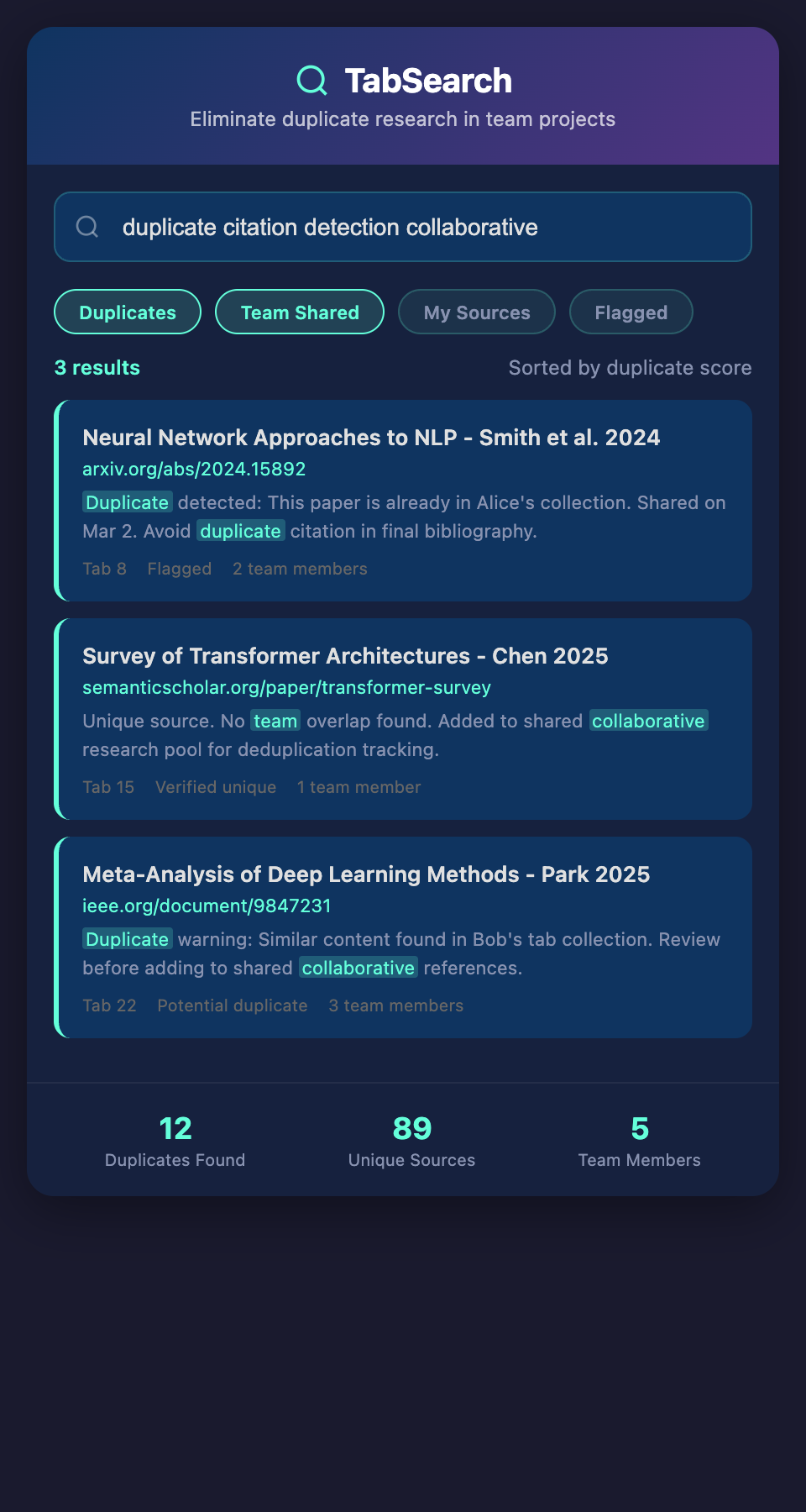
When a team member attempts to add a source that's already in the system, they're notified immediately and can review why the original was added.
Clear Role Definition
Duplicate research often stems from unclear responsibility. If no one explicitly owns "find sources on natural language processing," three people might all search independently.
Effective role definition for collaborative research:
-
Primary researcher: Owns a specific topic area and leads source discovery
-
Secondary reviewers: Add complementary sources and verify thoroughness
-
Quality assurance: Audits the source list for gaps and duplicates
-
Citation manager: Ensures consistent formatting and export
These roles can rotate or be shared, but clarity prevents overlap.
Cross-Team Source Sharing
For organizations conducting multiple concurrent research projects, larger duplication problems emerge. The renewable energy team might find sources on battery technology that the electrical grid team also needs.
Solving this requires:
-
Organization-wide source visibility: Researchers can search all sources across all projects, not just their current project
-
Tagging systems: Sources tagged with relevant keywords so they're discoverable across projects
-
Citation tracking: Knowing which projects cite which sources
-
Import/export mechanisms: Moving sources between projects without duplication
A university research office that implements this approach discovers that 25-40% of sources collected on one project are also relevant to other projects—often being researched simultaneously.
The Reference Tracking Problem
Duplication extends beyond finding sources—it appears in how teams track references. Researcher A cites "Smith et al. (2019)" while Researcher B cites the same paper as "Smith, J., Johnson, K., Williams, R. (2019)." When merging bibliographies, are these the same source?
Solving reference tracking:
-
Store complete citation metadata for every source (authors, date, journal, volume, pages)
-
Auto-generate citations in required formats from this metadata
-
Compare citations programmatically before merging documents
-
Flag citation inconsistencies for review
This prevents the final paper from containing duplicate references under slightly different names.
Case Study: A 12-Person Research Team
A university lab of 12 researchers conducts an interdisciplinary study on sustainable agriculture. Without coordination, this is what happened:
-
Three people researched "soil carbon sequestration"
-
Two independently found the same 8 papers
-
One found 4 unique papers; another found 6 unique papers
-
Total: 18 papers on this topic, with 8 duplicates
-
Time wasted: approximately 60 person-hours across searches, reading, and citation management
With a shared, deduplication-enabled system:
-
First researcher completes comprehensive search: finds 14 papers, adds to team database
-
Second researcher searches topic: sees all 14 papers already collected, but identifies 3 additional ones not yet found
-
Third researcher verifies completeness: confirms 17 papers represent comprehensive coverage
-
Total: 17 papers, zero wasted effort on duplicate searches
-
Time saved: 40+ person-hours
The team could redirect that 40 hours to analyzing sources, synthesizing findings, and advancing novel research—actual value-added work.
Implementing Collaborative Source Management
Start with these steps:
Week 1: Establish a centralized source repository. Migrate existing sources from individual tools.
Week 2: Define research scope clearly for each team member—what topics does each person own?
Week 3: Set up automated duplicate detection. Find and merge duplicates in your existing collection.
Week 4: Establish team protocols—how sources are added, tagged, and searched.
Week 5: Integrate with your citation tool to ensure consistent formatting.
Ongoing: Weekly team check-ins on source discovery progress and any gaps identified.
When Duplication is Intentional
Occasionally, team members should duplicate research independently—for verification purposes. If one researcher concludes "the literature strongly supports X" while independently collecting sources, another researcher might find "actually, the most recent sources contradict that conclusion." This intentional duplication catches errors and ensures research quality.
But this should be explicit and planned, not the default mode of operation.
Building Research Velocity
Collaborative research moves fastest when team members spend time synthesizing and analyzing sources, not searching and re-finding them. Preventing duplication isn't about control or efficiency metrics—it's about letting your team do their best work.
Ready to eliminate duplicate research and accelerate your team's progress? Join our waitlist for a collaborative source management system that automatically deduplicates and tracks research across your entire team.