Building Your Internal Developer Reference System: Centralize Technical Knowledge
The Silent Knowledge Leak
Your team is brilliant. Different developers have solved every major problem your system encounters. One engineer knows the optimal database query pattern. Another has expertise in your deployment pipeline. A third understands the authentication architecture inside and out.
But this knowledge lives inside individual heads. It's not captured. It's not shared. When someone new joins the team, they spend weeks re-learning what your senior developers already know. When you onboard a new service, multiple engineers research the same patterns separately. When a bug emerges, junior developers struggle with problems that senior developers solved months ago.
This is a knowledge leak—valuable expertise isn't being preserved or shared. Every time a developer leaves, or every time a problem is re-solved, you're losing productivity and efficiency.
Smart teams recognize this and try to build internal documentation. But traditional wiki-based approaches fail because they're high-friction. Documentation requires active maintenance. It gets outdated. People forget to update it. Knowledge that lives in everyone's head never gets documented until someone is frustrated enough to write it down.
What you need is a system that captures your team's collective knowledge automatically as you work, organizing it searchably without requiring active maintenance.
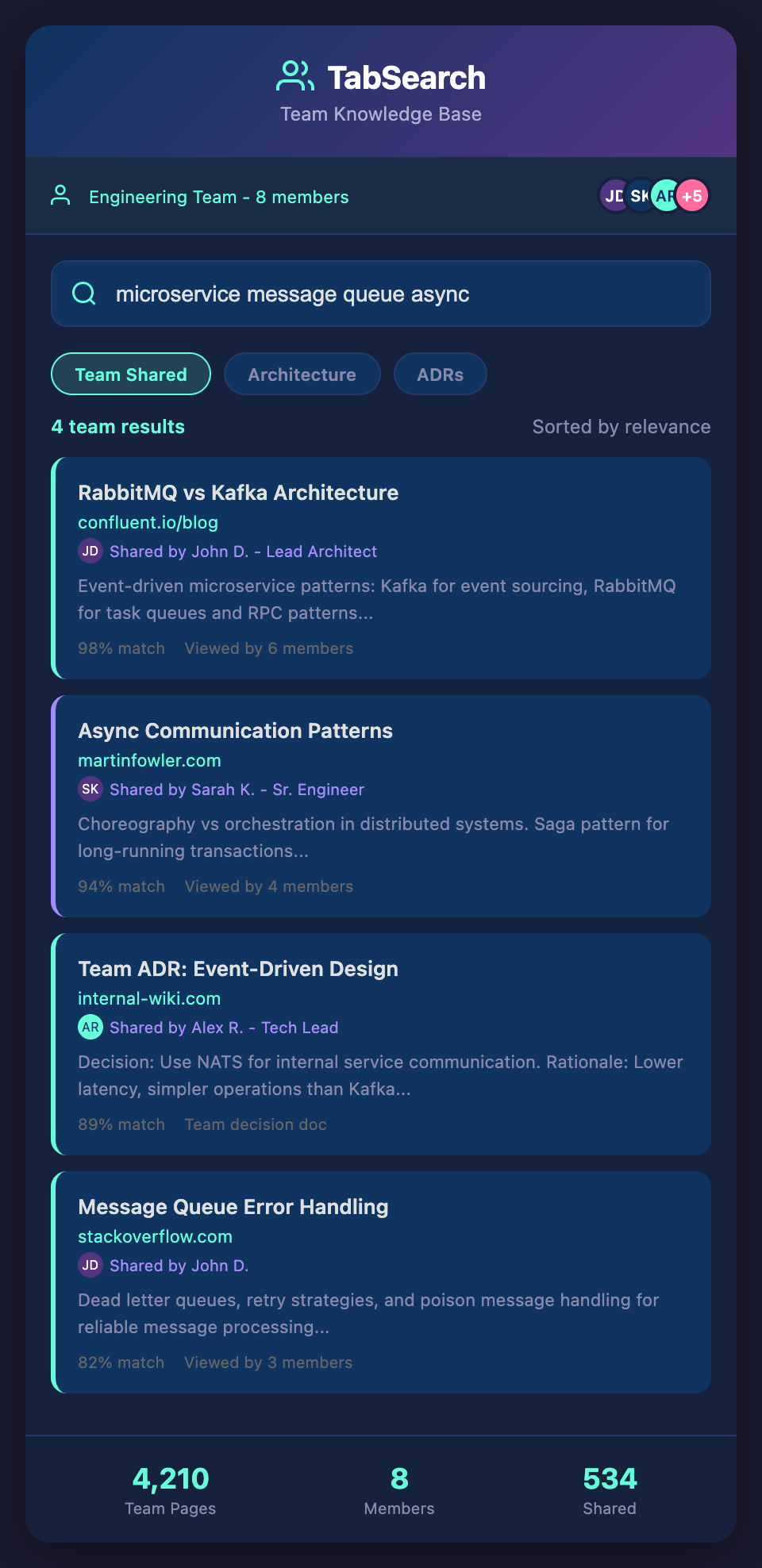
The Searchable Knowledge System Approach
Imagine your team has a shared, searchable index of everything you've learned as a team. When someone needs to understand your database architecture, they search "database schema design multi-tenancy", and immediately see:
-
The blog posts your architects read when designing the system
-
The architectural decision documents (if they exist)
-
The Stack Overflow discussions about your specific tradeoffs
-
Previous GitHub discussions where you debated approaches
-
The deployment documentation you wrote
Instead of asking colleagues or hunting through documentation that doesn't exist, they find the knowledge they need instantly.
This works because your team's research, decisions, and implementations are preserved in searchable form. You're not maintaining documentation—you're capturing the research and thought process that led to your current system.
Real Team Knowledge Scenarios
Scenario 1: Onboarding New Team Members
New engineer joins. Instead of spending a week asking colleagues about system architecture, they can search their way to knowledge. They search "API rate limiting strategy authentication", and they see the architecture blog posts and Stack Overflow discussions your team referenced when building the system. They understand not just what the system does, but why it was designed that way.
This reduces onboarding time from weeks to days, and the new engineer gains context that traditional documentation rarely provides.
Scenario 2: Architectural Decision Continuity
Your team is building a new service. Before implementing, you want to understand how your existing services handle similar problems. You search "microservice communication message queue asynchronous", and you find:
-
The blog posts that influenced your current architecture
-
The technical discussions where your team debated approaches
-
The documentation about your current system
-
Possibly, discussions about tradeoffs you made when building the first service
This shared knowledge prevents inconsistent architecture and lets new systems benefit from previous decisions.
Scenario 3: Debugging Together
A critical bug emerges in production. The original author isn't available. Junior developers are investigating. Instead of starting from zero, they search "production deployment error handling monitoring logging", and they see:
-
The debugging guides your senior engineers have researched
-
The monitoring setup documentation
-
Previous Stack Overflow solutions your team saved
-
The architectural discussions that explain the system's error-handling approach
They can debug more effectively because they have access to the team's collective expertise.
Building the Knowledge System
The mechanism requires minimal effort:
-
Share Research: Your team uses a shared development browser with the extension enabled. As individuals research and solve problems, everything is indexed.
-
Automatic Organization: The system understands context—what project people were working on, what problems they were researching, what tools they were learning.
-
Team Access: The shared index becomes accessible to everyone on the team. When someone needs knowledge, they search instead of asking.
-
No Maintenance: There's no documentation tool to maintain, no wikis to update, no knowledge base to keep current. The system captures research in real-time.
The Team Efficiency Multiplier
Consider the time saved:
-
Reduced onboarding: New team members become productive weeks faster
-
Faster problem-solving: Engineers reference team knowledge instead of researching from scratch
-
Better decisions: New architectural decisions benefit from documented tradeoff analysis
-
Preserved expertise: When engineers leave, their research stays with the team
Across a team, this compounds rapidly. If five engineers each save five hours per month through better knowledge access, that's 25 hours monthly. Across a year, that's 300 hours—the equivalent of a full-time engineer.
But the gains go beyond hours. Your team's decisions improve because they're informed by the team's cumulative expertise. Your architecture becomes more consistent because new services reference previous decisions. Your code quality improves because you're implementing proven patterns.
Stop Losing Institutional Knowledge
Great teams capture and share knowledge. They don't rely on individuals remembering everything. They build systems that preserve expertise and make it accessible.
Join our waitlist to build your team's searchable knowledge system. Automatically capture team research. Share expertise across your organization. Onboard faster. Decide better. Preserve institutional knowledge.