Building Episode Recap Systems for Actual Play Shows
Why Recaps Are Essential for Actual Play
Actual play shows have a unique recap challenge: each episode is a segment of a continuous, improvised narrative. Unlike scripted shows where the writers control exactly what information matters, actual play episodes contain a mix of plot-critical developments, character moments, combat details, and table banter. Your recap system must distill this mix into the information listeners actually need.
Recaps serve three audiences:
- Returning listeners who listened last week but have forgotten details
- Binge listeners who are catching up and need orientation between episodes
- New listeners who started mid-series and need context
Each audience has different needs, and the best recap systems serve all three.
Recap Formats Compared
The GM Narrated Recap
The GM provides a brief "previously on" narration at the start of each episode.
Length: 60-90 seconds.
Content: Summary of the most plot-relevant events from the previous episode, delivered in the GM's narrative voice.
Strengths:
- Sets the tone for the episode
- The GM controls what is emphasized, reinforcing important details
- Feels natural as part of the show's format
Weaknesses:
- Can feel formulaic if every recap follows the same pattern
- The GM's perspective on what matters may differ from the audience's
- Does not capture player-driven moments well
Best for: Story-heavy shows where the GM controls the narrative tightly.
The Player Recap
A player (rotating or designated) recaps the previous episode in character.
Length: 2-4 minutes.
Content: Whatever the player remembers and considers important, delivered from their character's perspective.
Strengths:
- Reveals character perspective — what matters to this character may differ from what the GM emphasized
- Creates entertaining moments when characters misremember or omit details
- Engages players actively at the start of each session
Weaknesses:
- Can miss plot-critical details that the recapping player did not consider important
- Quality varies between players
- In-character recaps may confuse new listeners about what actually happened versus character interpretation
Best for: Character-driven shows where personality and perspective are central to the appeal.
The Produced Recap
A separate, edited audio segment that combines clips from the previous episode with narration.
Length: 1-3 minutes.
Content: Curated highlights from the previous episode — key dialogue clips, critical dice rolls, dramatic moments.
Strengths:
- Highest production quality
- Can include actual audio from the previous episode, reinforcing exact wording
- Creates a professional, polished feel
Weaknesses:
- Time-intensive to produce
- Requires editing skills and additional production time
- Can feel disconnected from the live recording if overdone
Best for: Highly produced shows with dedicated editors and production schedules.
The Show Notes Recap
A written recap published alongside the episode rather than as audio content.
Content: Detailed summary of the previous episode with key facts, NPC appearances, and unresolved questions.
Strengths:
- Can be more detailed than audio recaps
- Searchable and referenceable
- Does not consume episode runtime
- Can include supplementary information (maps, character art, timelines)
Weaknesses:
- Requires listeners to actively seek it out
- Does not benefit listeners who only consume the audio
- Requires consistent publication discipline
Best for: Shows with engaged online communities who read show notes.
Designing Recap Content
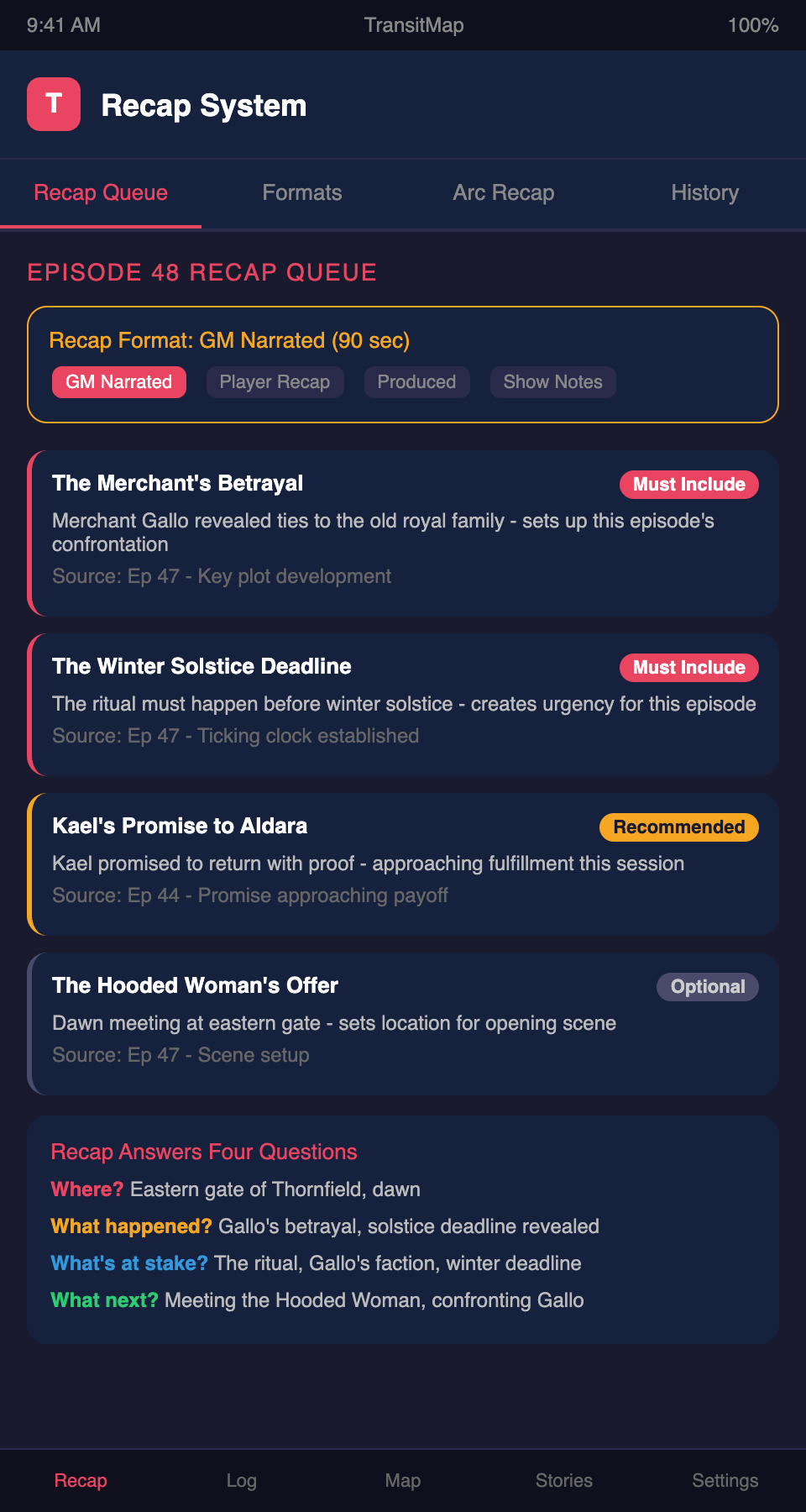
Regardless of format, your recap should answer four questions:
- Where are the characters? Physical location and narrative context.
- What just happened? The key events of the previous episode.
- What is at stake? The active threats, goals, and tensions.
- What are the characters about to do? The immediate plan or direction.
The Arc Recap
At the start of a new story arc or season, provide an extended recap that covers the relevant history:
- What the audience needs to know from previous arcs to understand this one
- Which characters are central to the upcoming arc and their current states
- What the unresolved threads from previous arcs will affect this one
Arc recaps should be three to five minutes and should be treated as standalone content that orients both returning and new listeners.
Recaps as Narrative Tools
Beyond audience orientation, recaps can serve narrative functions:
Emphasis control. By choosing what to include in the recap, you signal to the audience what matters. Including a minor detail from last episode in this episode's recap tells the audience that detail is about to become significant.
Foreshadowing. A recap that mentions a seemingly minor detail primes the audience for its payoff in the upcoming episode.
Emotional priming. Starting the recap with "last time, the party suffered a devastating loss" sets the emotional tone for an episode that deals with the aftermath.
Tension maintenance. For cliffhanger episodes, the recap should build tension: "when we left off, the party was surrounded, outnumbered, and the ritual clock was counting down."
Tracking What to Recap
Maintain a "recap queue" — a running list of details that should be mentioned in upcoming recaps:
- Plot developments that are about to become relevant again
- Character moments that set up upcoming payoffs
- Promises or commitments that are approaching their fulfillment
- Details the audience needs to remember for the next episode to make sense
Review the recap queue before writing each episode's recap. This ensures you are recapping strategically, not just summarizing.
Want a system that tells you exactly what to recap for each episode? Join the TransitMap waitlist — track active storylines and upcoming payoffs on a visual map, so your recap always covers the threads that matter most for the next episode.