Foreshadowing and Payoff Tracking for Actual Play Shows
Foreshadowing in an Improvised Medium
Foreshadowing in scripted media is straightforward — the writer knows the ending and plants clues pointing toward it. Foreshadowing in actual play is complicated because you do not always know where the story is going. Player choices alter the trajectory. Improvised details create unexpected connections. The ending you planned in Episode 1 may not be the ending you deliver in Episode 100.
This makes foreshadowing in actual play a bidirectional activity:
- Forward foreshadowing — Deliberately planting seeds that point toward planned developments. This is traditional foreshadowing and requires knowing what is coming.
- Retroactive foreshadowing — Identifying past details that coincidentally align with current developments and treating them as intentional setups. This is unique to improvisational storytelling and is just as valid.
Both types require tracking to execute effectively.
Forward Foreshadowing: Planting Seeds
When you know a major development is coming, plant seeds that point toward it:
The rule of subtle escalation. Start with barely noticeable hints and escalate gradually:
-
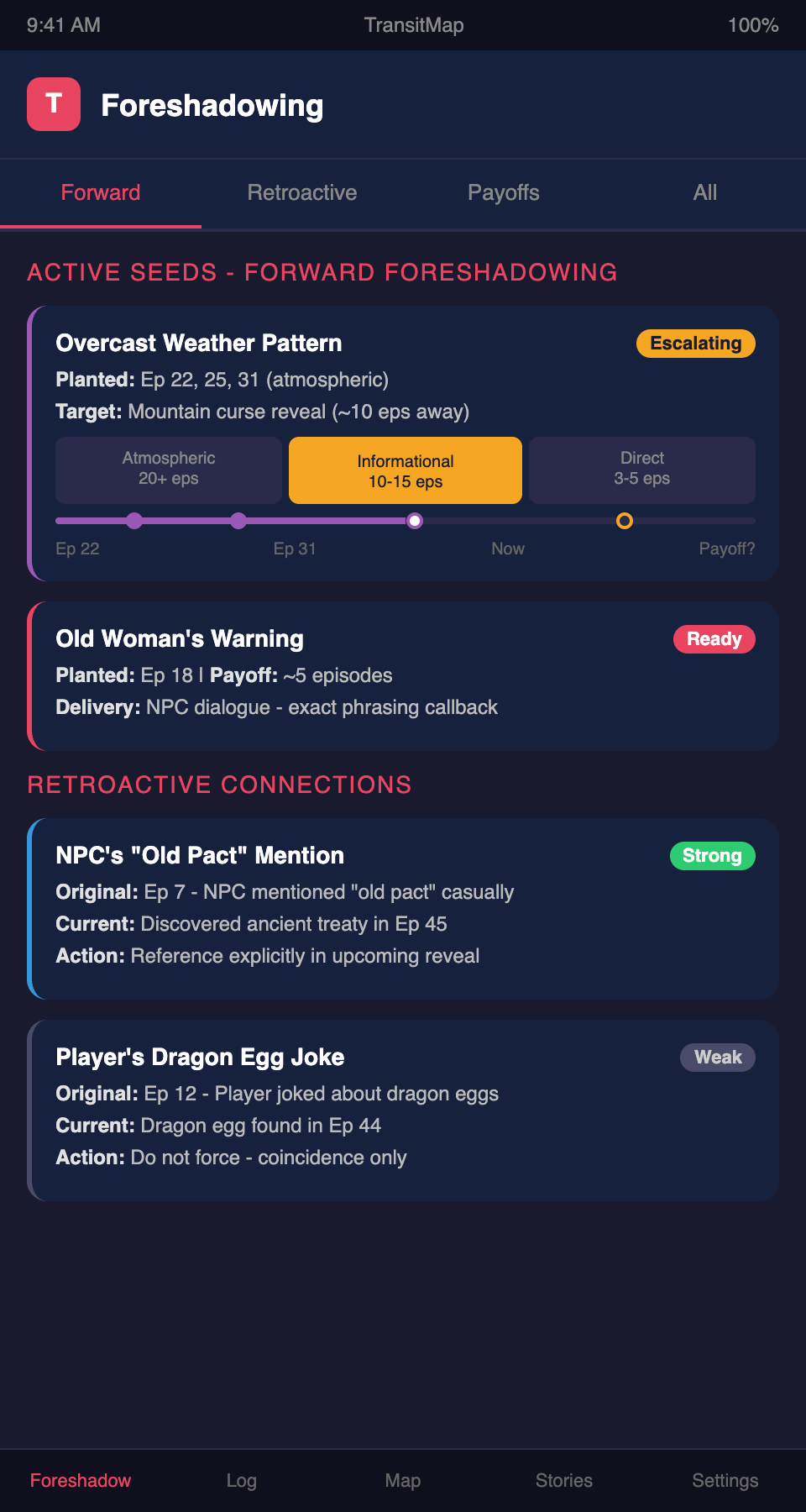
Atmospheric foreshadowing (20+ episodes before payoff) — Environmental details that create a mood. The weather is always overcast near the cursed mountain. Animals avoid the river south of town. These are felt but not analyzed by the audience.
-
Informational foreshadowing (10-15 episodes before payoff) — Details that provide partial information. An NPC mentions a historical event that parallels the coming development. A book in a library contains a relevant passage. These reward attentive listeners.
-
Direct foreshadowing (3-5 episodes before payoff) — Clear signals that something is coming. An NPC warns the party. A dream sequence previews the development. The signs are unmistakable. These build anticipation.
Retroactive Foreshadowing: Mining Your History
When a new development emerges from play that you did not plan, search your episode logs for past details that could serve as retroactive foreshadowing:
- Did an NPC say something that now seems prophetic?
- Did the players visit a location that is connected to the new development?
- Did someone improvise a detail that accidentally aligns?
- Did a player make a joke that is now eerily relevant?
When you find these connections, reference them in the payoff. Have an NPC say "Remember what the old woman told you in the marketplace?" Have the players return to the location where the detail was established. Explicitly connect the past detail to the current development.
The audience will believe you planned it all along. They will re-listen to the original episode and find the "planted" detail. This creates the impression of masterful long-term planning, even when the connection was discovered retroactively.
The Foreshadowing Tracker
Maintain a tracker with two sections:
Active Seeds (Forward Foreshadowing):
| Seed | Planted In | Target Payoff | Current Distance | Status |
|---|---|---|---|---|
| Overcast weather near mountain | Ep 22, 25, 31 | Mountain curse reveal | ~10 episodes | Escalating |
| Old woman's warning | Ep 18 | Villain identity reveal | ~5 episodes | Ready for payoff |
| Recurring dream imagery | Ep 30, 35, 38 | Prophecy activation | ~15 episodes | Building |
Retroactive Connections (Mining History):
| Past Detail | Original Episode | Current Development | Connection Quality |
|---|---|---|---|
| NPC mentioned "old pact" | Ep 7 | Discovered ancient treaty | Strong — reference explicitly |
| Player joked about dragon eggs | Ep 12 | Dragon egg actually found | Weak — do not force |
| Tavern painting description | Ep 3 | Painting is actually a map | Strong — revisit location |
Delivering Payoffs Effectively
The payoff is the moment when the foreshadowed element is revealed, resolved, or recontextualized. Delivery matters as much as planning:
Signal the connection. Do not assume the audience remembers the foreshadowing. Provide enough context to trigger recognition: "The symbol — it's the same one carved into the dungeon wall in Thornfield. You saw it months ago."
Let the table react. When a payoff lands, give the players time to react. Their genuine surprise and excitement is some of the best content your show produces. Do not rush past the moment to continue the plot.
Layer the payoff. The best payoffs operate on multiple levels:
- Plot level — The reveal advances the story
- Character level — The reveal affects a character personally
- Thematic level — The reveal deepens the story's central theme
- Audience level — The reveal rewards listeners who caught the foreshadowing
Vary the scale. Not every foreshadowed element needs a dramatic reveal. Some payoffs are quiet — a detail that clicks into place without fanfare. Varying the scale keeps your audience attentive to both major and minor details.
Common Foreshadowing Mistakes
- Over-planting — So many seeds that the early episodes feel like a setup factory. Plant sparingly and make each seed count.
- Forgotten seeds — Seeds that are never paid off become plot holes. Your tracker prevents this.
- Obvious foreshadowing — Seeds that are so blatant the audience knows the payoff before it arrives. Subtlety is key.
- Forced retroactive connections — Not every past detail needs to become foreshadowing. Forced connections feel artificial. Only retroactively connect details that genuinely align.
- Delayed payoffs without maintenance — A seed planted in Episode 10 that is not paid off until Episode 80 needs periodic reinforcement (soft returns, additional hints) to keep it in audience memory.
Want to track every piece of foreshadowing across your show? Join the TransitMap waitlist — map seeds and payoffs as connected nodes on your show's narrative timeline, with status tracking that ensures no seed goes unharvested.