Multi-Season Arc Design for Actual Play Podcasts
The Multi-Season Design Challenge
Most actual play shows start with a single campaign and a vague hope that it will last a while. If it succeeds, the show continues — and the creators face a structural question they did not plan for: how do you tell a story across multiple seasons without the narrative becoming formless?
Television solved this problem decades ago with multi-season arc design — a framework where each season tells a complete story while contributing to a larger narrative that spans the entire series. Actual play shows can adapt this framework, but with a crucial difference: your "writers' room" includes players who make unpredictable choices.
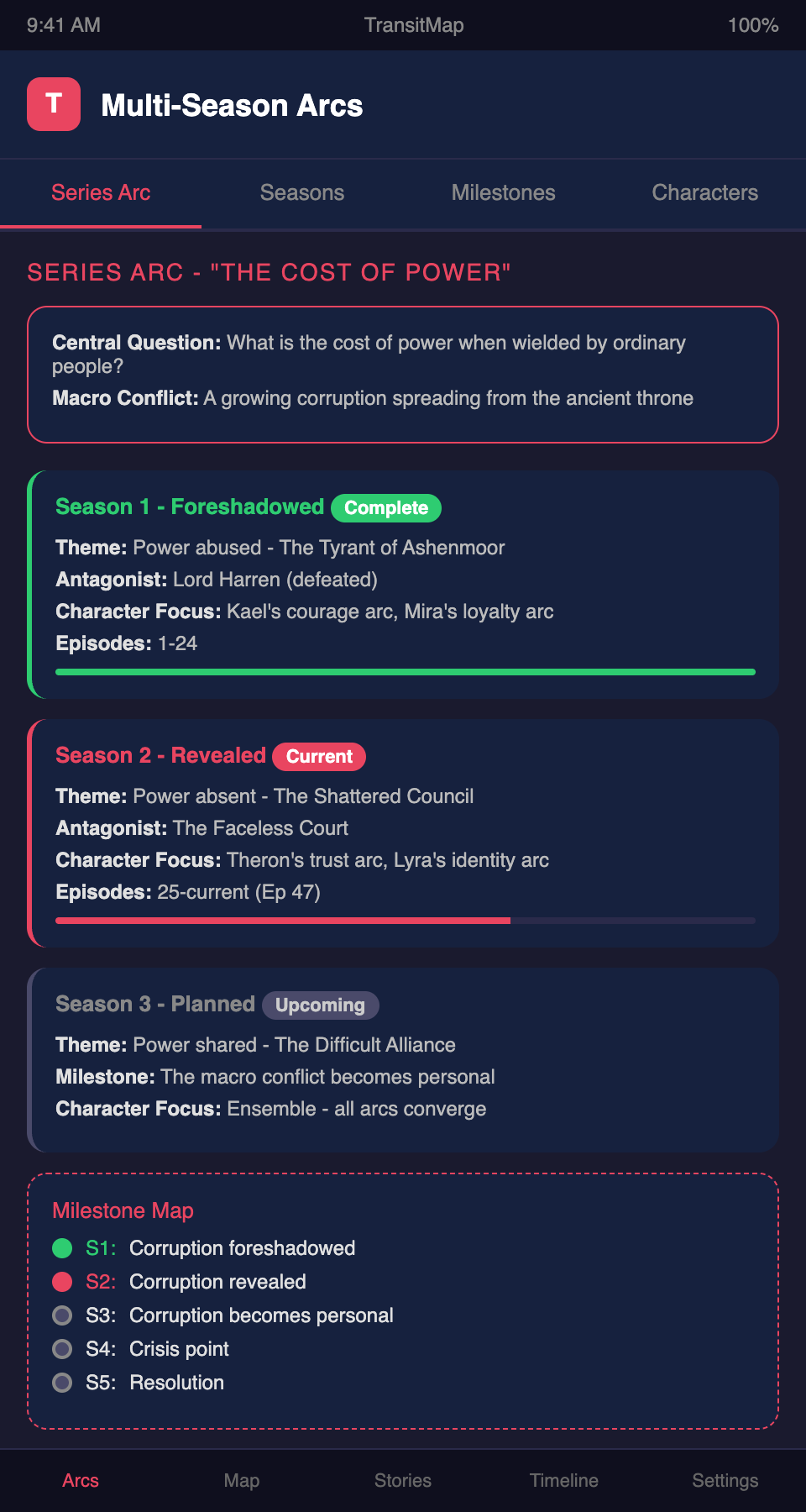
The Two-Layer Structure
Multi-season actual play design operates on two layers:
The Season Layer. Each season has its own arc — a central conflict that is introduced, escalated, and resolved within the season. A listener who starts with Season 3 should be able to follow the season's story without having heard Seasons 1 and 2 (even if they would enjoy them more with context).
The Series Layer. Across all seasons, a larger narrative develops. This is the overarching story — the grand conflict, the deepening mystery, the evolving theme that connects everything. A listener who has been with the show from Season 1 experiences the full series arc.
Each season serves both layers: it tells its own story AND advances the series-level narrative.
Designing the Series Arc
The series arc is your show's longest-term narrative commitment. Define it in broad strokes:
The central question. What is the fundamental question your series explores? "Can ordinary people stand against cosmic forces?" "What is the cost of power?" "Can broken people build something good?" This question should resonate through every season without being explicitly stated.
The macro conflict. What is the series-level threat or challenge? This can be an entity (a world-threatening villain who operates across seasons), a condition (a growing corruption that worsens each season), or a mystery (a truth about the world that is gradually revealed).
The milestone map. Plan three to five major milestones for the series arc — moments that dramatically advance the series-level narrative. Assign each milestone to a season (roughly):
- Season 1 milestone: The macro conflict is foreshadowed
- Season 2 milestone: The macro conflict is revealed
- Season 3 milestone: The macro conflict becomes personal
- Season 4 milestone: The macro conflict reaches its crisis point
- Season 5 milestone: The macro conflict is resolved
These milestones are flexible — they can shift between seasons based on how the campaign develops. But having them gives you a long-term trajectory.
Designing Individual Season Arcs
Each season arc needs the same structural elements as any complete story:
The season's central conflict. What specific problem must the characters face this season? This should be distinct from the series-level conflict but thematically connected. If the series is about the cost of power, one season might focus on a tyrant (power abused), another on a power vacuum (power absent), another on a difficult alliance (power shared).
The season's antagonist. Each season should have its own primary antagonist, even if the series has an overarching villain. Season-level antagonists provide immediate dramatic stakes and can be fully resolved within the season.
The season's character development focus. Which player characters will experience the most growth this season? Rotate the spotlight across seasons so every player has a season where their character's arc is central.
The season's resolution. How does this season's central conflict resolve? The resolution should be satisfying on its own while setting up the next season's conflict. The best season endings both conclude and launch.
Managing the Player Variable
Television series are scripted. Your show is not. Players will make choices that affect your multi-season arc in ways you cannot predict. Build flexibility:
Plan milestones, not moments. Define what needs to happen at the series level, not when or how. "The players learn the truth about the world's creation" is a milestone. "In Season 3, Episode 12, the NPC reveals the truth during a dream sequence" is a script. Plan the milestone; let the players determine the moment.
Adaptive season boundaries. Be willing to adjust where seasons end based on narrative momentum. If the natural climax of your planned Season 2 arc arrives three episodes early, end the season there. Do not pad to fill a predetermined episode count.
Player-driven series development. Let player choices influence the series arc. If the players unexpectedly ally with a faction you planned as antagonists for Season 4, adapt your series arc. The best long-running actual play shows feel collaborative because they are — the GM provides the structure but the players shape the story within it.
Cross-Season Continuity
Multi-season shows face enhanced continuity challenges:
Character development tracking. Track how each PC has changed across seasons, not just within a season. The character who started as a naive farm kid in Season 1 should be visibly different by Season 4 — in behavior, capabilities, and worldview.
World evolution. The game world should change between seasons. Cities grow or decline. Political landscapes shift. Technology advances. The world the players return to in Season 3 should not be the same world they left in Season 2.
NPC lifecycle management. NPCs who recur across seasons need careful tracking. An NPC introduced in Season 1 who reappears in Season 4 must be consistent but should have evolved in the intervening time.
Callback infrastructure. Multi-season shows generate massive callback potential. Maintain your seed log across seasons. The most powerful callbacks in long-running shows are the ones that reach back multiple seasons.
Season Transitions
The transition between seasons is a critical design moment:
Time skip. Most actual play shows benefit from a time skip between seasons — weeks, months, or years of in-game time. This allows the world to change, characters to develop offscreen, and new dynamics to establish.
Transition content. Between seasons, consider publishing supplementary content: epilogue episodes, character journals, world update documents, or "between seasons" vignettes that bridge the narrative gap.
Audience onboarding. Each new season should be an entry point for new listeners. The season premiere should provide enough context for the series-level narrative that a new listener can follow along, while rewarding returning listeners with callbacks and continuity.
Ready to design multi-season arcs for your actual play show? Join the TransitMap waitlist — map your series-level narrative and season-level arcs as nested transit routes, with milestones, callbacks, and character arcs tracked across your show's entire run.