Tracking Dormant Storylines in Your Actual Play Show
The Dormant Thread Danger
Every actual play show accumulates dormant storylines — threads that were introduced, developed to a point, and then set aside while the narrative focus shifted elsewhere. In a home game, dormant threads are minor annoyances. In a published show, they are ticking bombs.
Your audience is tracking every thread you introduce. They have wikis, episode guides, and community discussions that catalog every unresolved element. When a thread stays dormant for too long, the audience shifts from "I wonder when that will come back" to "they forgot about it" to "this show doesn't follow through on its setups."
Dormant threads are not a problem in themselves — they are a narrative resource. The problem is dormant threads that are untracked and therefore unmanageable.
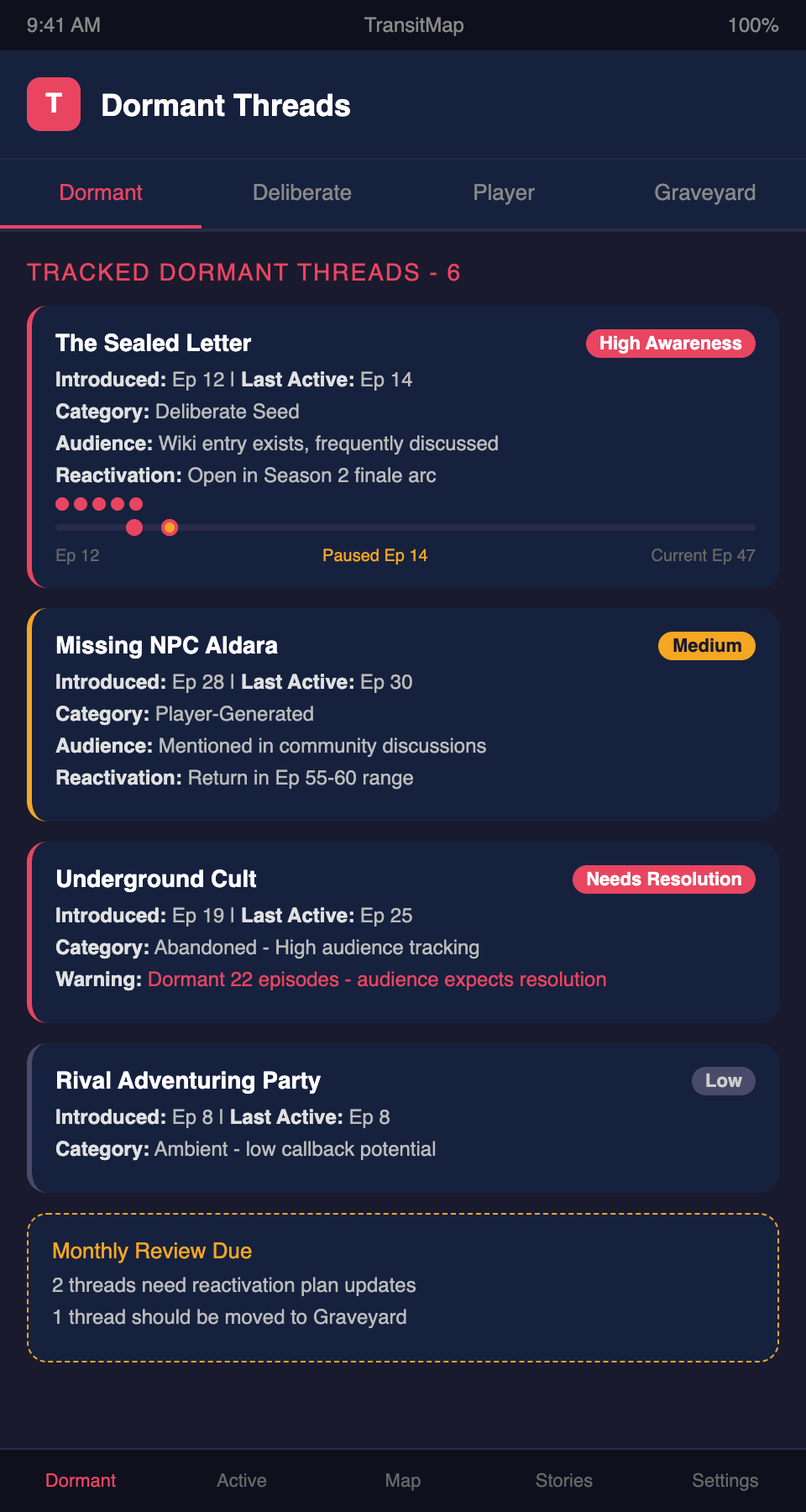
Categorizing Dormant Threads
Not all dormant threads are equal. Categorize them to determine management priority:
Deliberate seeds. Threads you intentionally planted for future payoff. The mysterious stranger in Episode 15 who will return in Season 3. The cryptic dream that foreshadows the finale. These are planned and under control — they just need tracking so you do not forget them.
Player-generated threads. Threads created by player actions or declarations that you did not plan for. "I'm going to find out who my real parents are." "We should investigate that abandoned tower someday." These are promises the show has made to the audience, even if the GM did not intend them.
Ambient threads. Worldbuilding details that could become storylines but have not been developed. The rival adventuring party mentioned once. The political tension in a distant kingdom. These are potential threads that the audience may or may not remember.
Abandoned threads. Threads that you started developing and then decided to drop. The subplot that was not working. The NPC whose storyline no longer served the campaign. These need to be either quietly resolved or consciously acknowledged.
The Dormant Thread Tracker
Maintain a dedicated tracker for dormant threads:
| Thread | Introduced | Last Active | Category | Audience Awareness | Reactivation Plan |
|---|---|---|---|---|---|
| The sealed letter | Ep 12 | Ep 14 | Deliberate seed | High (wiki entry) | Open in Season 2 arc |
| Missing NPC Aldara | Ep 28 | Ep 30 | Player-generated | Medium | Return in Ep 55-60 |
| Rival adventuring party | Ep 8 | Ep 8 | Ambient | Low | No current plan |
| Underground cult | Ep 19 | Ep 25 | Abandoned | High | Needs resolution |
Review this tracker monthly. The critical metric is audience awareness — if your audience is actively tracking a dormant thread, it needs a plan. If they have forgotten about it, the pressure is lower (but the callback potential is higher).
When to Reactivate Dormant Threads
Narrative opportunity. The active storyline naturally intersects with the dormant thread. The players are visiting a location connected to the dormant NPC. The current villain is connected to the dormant conspiracy. These organic connections are the best reactivation triggers.
Pacing need. The current storyline needs a complication or a twist. A dormant thread provides a ready-made complication that carries extra weight because the audience has been waiting for it.
Player interest. A player mentions a dormant thread in character: "Whatever happened to Aldara?" This signals that the player (and by extension, the audience) wants that thread addressed. Respond within two to three episodes.
Arc transition. Between major arcs, reactivate dormant threads to bridge the transition. The old arc concludes; a dormant thread from early in the show provides the seed for the new arc. This creates narrative continuity across the show's structure.
Reactivation Techniques
The soft return. Mention the dormant thread in passing — a rumor, a news item, a character's offhand comment. This reminds the audience the thread exists without committing to full reactivation.
The escalation return. The dormant thread returns with higher stakes than when it went dormant. The missing NPC is found — but in unexpected circumstances. The sealed letter is finally opened — and its contents change everything. Escalation justifies the wait.
The convergence return. The dormant thread merges with an active storyline, enriching both. The conspiracy from Episode 19 turns out to be connected to the current antagonist. The dormant thread adds depth to the active plot and the active plot provides the energy to revive the dormant thread.
The callback return. The dormant thread is referenced in a way that rewards long-term listeners. The exact phrasing from the original episode is echoed. A visual detail from the original scene recurs. Listeners who remember the original feel rewarded; those who do not still enjoy the current content.
Managing Audience Expectations
Do not let dormant threads stay dormant for more than one season without at least a soft return. An entire season without any mention of a thread the audience is tracking creates the impression that you have forgotten it.
Acknowledge the wait. When a thread returns after a long dormancy, acknowledge the passage of time in-narrative: "It's been months since anyone mentioned Aldara. Everyone assumed she was gone." This validates the audience's patience.
Not every thread needs a massive payoff. Some dormant threads can be resolved quietly. The rival adventuring party is mentioned as having moved to a different continent. The political tension is noted as having been resolved by a treaty. Quick resolution is better than eternal dormancy.
The Thread Graveyard
Some dormant threads will never be reactivated. When you decide to permanently abandon a thread:
- Resolve it offscreen in the simplest way possible
- If the audience is tracking it, acknowledge the resolution in-show or in supplementary content
- Remove it from your active dormant thread tracker and move it to an archive
- Do not leave it in limbo — conscious resolution is always better than silent abandonment
Tracking dormant storylines across your show's entire run? Join the TransitMap waitlist — visualize every dormant thread as a paused transit line, with reactivation triggers and audience awareness levels mapped alongside your active storylines.