Campaign Pacing: How to Control the Rhythm of Your D&D Game
What Pacing Actually Means for a GM
Pacing is not about speed. A slow session can be perfectly paced. A fast session can feel rushed. Pacing is about the rhythm of tension and release — the pattern of escalation and rest that keeps players emotionally engaged without exhausting them.
Good pacing means:
- Players feel urgency during critical moments
- Players have breathing room between crises
- Plot revelations land with impact instead of getting lost in noise
- The campaign builds toward climactic moments rather than plateauing
Bad pacing means:
- Every session feels the same intensity (whether that is relentlessly high or flatly low)
- Major revelations happen in the middle of combat or during routine travel
- Players feel like the plot is either dragging or sprinting past them
- The climax arrives before the stakes feel real, or long after the players have stopped caring
The Tension Curve
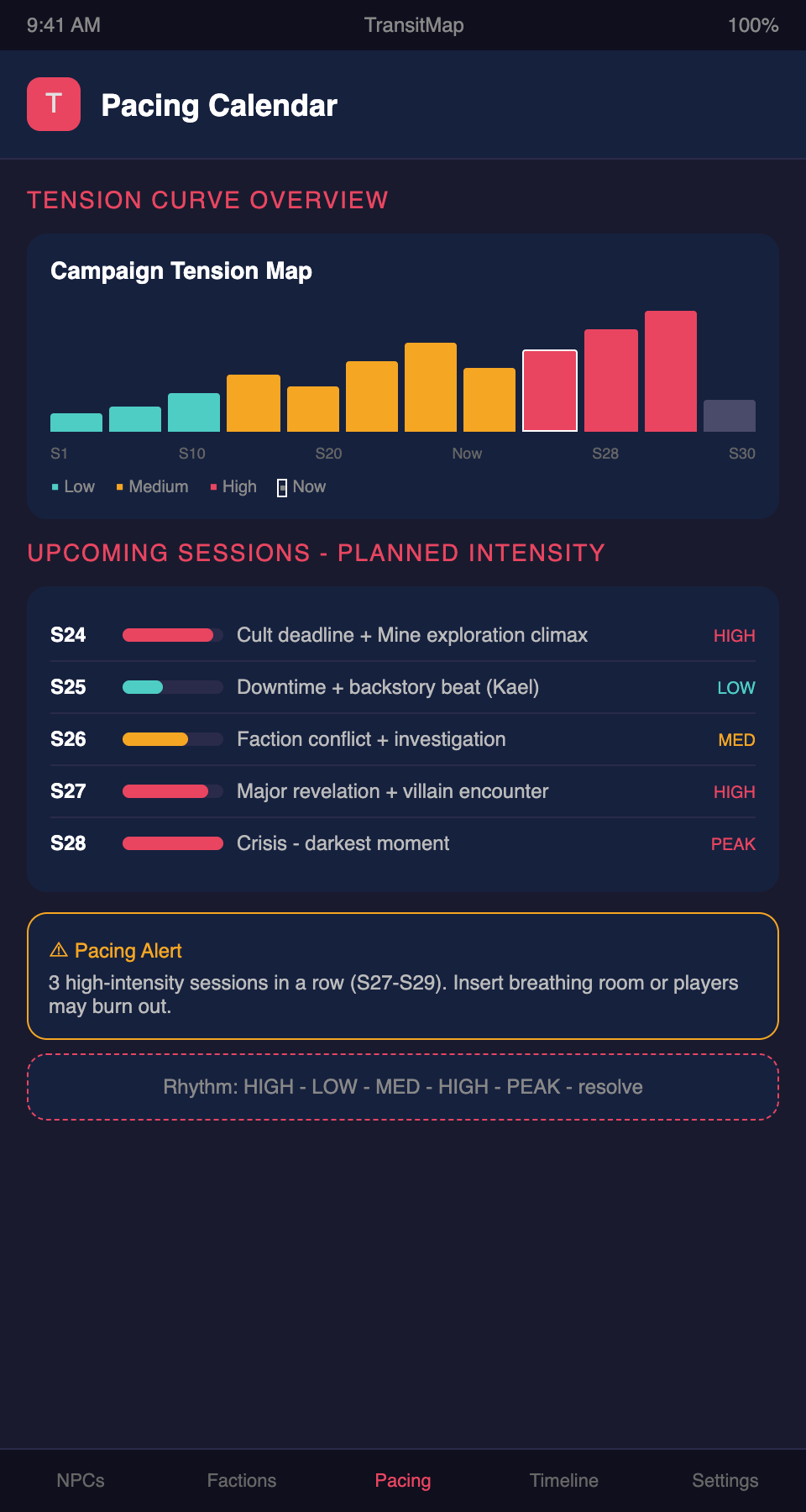
Think of your campaign's pacing as a tension curve — a line that rises and falls over time. The overall trajectory should climb from the opening to the climax, but within that upward trend, there should be regular dips and peaks.
A healthy tension curve for a campaign arc looks like this:
- Low tension — Introduction. Players explore, meet NPCs, learn the world. Tension is minimal but curiosity is building.
- Rising tension — The central conflict becomes apparent. The stakes are established. Each session raises the pressure slightly.
- First peak — A significant confrontation, revelation, or setback. Tension spikes. The players feel the weight of the conflict.
- Dip — A period of regrouping. The players process what happened, make plans, handle personal business. Tension drops but does not return to baseline.
- Escalating peaks — Multiple cycles of rising tension and partial resolution, each peak higher than the last.
- Crisis — The darkest moment. Everything seems lost. Tension is at maximum.
- Climax — The final confrontation. The accumulated tension resolves in a dramatic conclusion.
- Denouement — The aftermath. Tension drops to zero. The players reflect on what happened.
Session-Level Pacing
Within each individual session, you also need pacing control. A well-paced session typically follows this pattern:
Opening hook (first 15 minutes) — Start with something that grabs attention. A problem, a revelation, a consequence of last session's actions. Do not start with shopping or travel unless that shopping or travel contains a hook.
Rising action (middle 2-3 hours) — The meat of the session. Exploration, encounters, roleplay, problem-solving. Vary the type of activity — do not run three combat encounters back to back or three social scenes in a row.
Climactic moment (last 30-45 minutes) — Build toward one moment of maximum tension or significance. A boss fight. A betrayal. A difficult choice. A major revelation.
Cliffhanger or resolution (last 5-10 minutes) — Either resolve the climactic moment satisfyingly or cut to a cliffhanger that makes players count the days until next session.
Controlling Pacing With Scene Transitions
The most powerful pacing tool available to a GM is the scene transition — the moment where you jump from one situation to another. Transitions control pacing because they control what the players experience and what gets skipped.
To increase pace: Cut scenes short. "You travel for three days without incident. You arrive at the fortress gates." Skip the parts that do not contribute to tension.
To decrease pace: Linger on scenes. Let conversations play out fully. Describe environments in detail. Give players time to discuss plans in character.
To spike tension: Cut from a calm scene to an urgent one without warning. "You're halfway through dinner when the alarm bells ring."
To release tension: After a high-intensity scene, transition to something mundane. "The battle is over. The next morning is quiet. Birdsong. Smoke from the campfire."
The mistake most GMs make is passive pacing — letting scenes run until they end naturally. This results in scenes that overstay their welcome and sessions that feel shapeless. Active pacing means you decide when each scene has served its purpose and transition deliberately.
Diagnosing Pacing Problems
Your campaign feels like it is dragging.
Possible causes:
- Too many sessions between major plot developments
- Side quests that do not connect to the main storyline
- Players spending excessive time on logistics (shopping, planning, debating)
- Not enough consequences for player actions — choices feel weightless
Fixes:
- Advance the villain's plan. Create urgency by having the threat escalate visibly.
- Skip routine activities. "You buy supplies and head out" instead of roleplaying every purchase.
- Introduce a time pressure. A deadline forces decisions and prevents endless deliberation.
Your campaign feels like it is rushing.
Possible causes:
- Moving from crisis to crisis without breathing room
- Resolving storylines too quickly — introducing and concluding a thread in the same session
- Not giving players time to react emotionally to major events
- Insufficient buildup before payoff moments
Fixes:
- Insert a downtime session. Let the players rest, craft, explore, and interact with NPCs without any urgent threat.
- Slow down your reveals. If you have three bombshell revelations planned, space them across three sessions instead of dropping all three at once.
- After a major event, give the world time to react. Show NPCs grieving, celebrating, panicking, or debating. Let the significance sink in.
The Pacing Calendar
A practical tool for managing campaign pacing is a pacing calendar — a visual overview of your upcoming sessions with planned intensity levels:
- High intensity — Major plot advancement, boss battles, revelations, crises
- Medium intensity — Exploration, investigation, moderate encounters, faction interactions
- Low intensity — Downtime, character moments, shopping, travel, worldbuilding
Plot these across your next five to eight sessions. If you see three high-intensity sessions in a row, insert a low-intensity session between them. If you see four medium-intensity sessions without a high, plan a spike.
The calendar does not lock you into specific content — it locks you into a rhythm. The actual content of each session can adapt to player actions, but the overall pattern of tension and release stays intentional.
Pacing and Player Energy
Remember that pacing is not just about your narrative — it is about your players' energy at the table. A session that runs from 7 PM to 11 PM has different energy dynamics than an afternoon session:
- Early in the session, players have energy for complex decisions and emotional roleplay
- Mid-session, players are in their groove and can handle combat or exploration
- Late in the session, players are tiring and may not absorb a complex revelation properly
Schedule your most important narrative moments for when player energy is highest. Save the climactic reveal for the first half of the session, not the last fifteen minutes when everyone is looking at their phones.
Want to visualize your campaign's pacing across sessions and arcs? Join the TransitMap waitlist — see tension peaks and valleys mapped across your campaign timeline like express and local stops on a transit line.