How to Keep Player Backstories Relevant Throughout Your D&D Campaign
The Backstory Graveyard Problem
Players invest real creative energy into their backstories. The rogue with the murdered family. The cleric on a pilgrimage of atonement. The wizard searching for a lost mentor. These stories are gifts to the GM — pre-built narrative hooks attached to characters the players already care about.
And most GMs waste them.
Not intentionally. The campaign starts, the main plot takes over, sessions fill up with dungeon crawls and faction politics, and those carefully written backstories slowly sink into irrelevance. The rogue's murdered family never comes up again. The cleric's pilgrimage becomes decorative flavor text. The wizard's lost mentor remains lost, forever.
This is a missed opportunity on two levels. First, backstory integration is the easiest way to make players feel like their characters matter to the world. Second, backstory elements are pre-tested plot hooks — the player has already told you what they care about.
Step 1: Mine Every Backstory for Usable Elements
Before you can integrate backstories, you need to break them down into their component parts. Read each backstory and extract:
- NPCs mentioned — Family members, mentors, rivals, enemies, old friends. These are characters the player has pre-approved as important.
- Locations — Hometowns, schools, temples, battlefields. These are places that carry emotional weight for the character.
- Unresolved conflicts — Murdered families, stolen inheritances, broken oaths, missing persons. These are built-in quest hooks.
- Relationships — Debts owed, loyalties sworn, grudges held. These create obligations and complications.
- Secrets — Things the character knows that others do not, or things about the character that have not been revealed to the party.
Create a master list of these elements across all player backstories. You will be drawing from this list for the entire campaign.
Step 2: Connect Backstory Elements to Your Main Plot
The most powerful technique for backstory integration is connecting backstory elements to the central conflict of your campaign. This does not mean every backstory has to be about the main villain. It means finding organic connections between personal histories and the larger story.
Examples:
- The rogue's family was murdered — what if the cult responsible is connected to the campaign's antagonist?
- The cleric is on a pilgrimage — what if one of the sacred sites is built on a location the villain needs?
- The wizard's lost mentor — what if the mentor discovered something about the central threat and disappeared because of it?
These connections should feel discovered, not forced. The key is plausibility. If a connection feels like a coincidence, it will feel contrived. If it feels like the world is interconnected and everything is related, it will feel like good storytelling.
Not every backstory element needs to connect to the main plot. Some should remain personal side stories. But at least one thread from each backstory should intersect with the campaign arc.
Step 3: Schedule Backstory Beats
Backstory elements should not appear randomly. They should be scheduled across the campaign arc to provide regular personal stakes alongside the main plot.
A practical scheduling approach:
- Each character should have a backstory moment every 8-12 sessions. This ensures no one goes too long without their personal story being relevant.
- Rotate the spotlight. If the rogue's backstory was the focus of sessions 5-7, the cleric's backstory should feature in sessions 9-11.
- Escalate backstory stakes alongside campaign stakes. Early backstory beats should be discoveries and reunions. Mid-campaign beats should be complications and betrayals. Late-campaign beats should be confrontations and resolutions.
- Tie backstory climaxes to the campaign climax. The most satisfying endings resolve personal arcs and campaign arcs simultaneously.
Step 4: Create Backstory Ripples
A backstory element should never appear once and vanish. When a backstory NPC shows up, that appearance should create ripples that affect future sessions:
- The rogue's sister appears, reveals she is alive, and asks for help — but helping her will compromise the party's relationship with an allied faction
- The cleric meets a fellow pilgrim who has already completed the pilgrimage and is disillusioned — forcing the cleric to question their faith
- The wizard finds a letter from the lost mentor that reveals the mentor did something morally questionable
Each ripple creates a new decision point. Each decision point creates consequences. Each consequence creates more story. This is how a single backstory element generates sessions of content.
Step 5: Let Players Drive Backstory Timing
While you should schedule backstory beats, you should also respond to player signals. When a player starts talking about their backstory in character, asking questions about their homeland, or making choices that reference their past, they are signaling that they want their backstory to be relevant.
Respond to these signals quickly. If the wizard asks "is there a library here where I could research my mentor's last known location," do not say "you don't find anything." Say "you find a reference to a scholar matching your mentor's description who passed through this city three years ago." Reward engagement with content.
Conversely, if a player seems uninterested in their backstory, do not force it. Some players wrote a backstory because the GM required it but are more interested in the present-tense campaign. Read the table.
Common Backstory Integration Mistakes
The Backstory Dump — Resolving a character's entire backstory in a single session. This is unsatisfying because it reduces a campaign-long thread to a one-shot. Spread backstory content across multiple sessions with escalating stakes.
The Backstory Railroad — Forcing the entire party to stop the main quest and deal with one character's personal story. Instead, weave backstory elements into locations and situations the party is already engaging with. The rogue's sister happens to be in the city they are visiting for the main quest.
The Backstory Contradiction — Introducing a backstory NPC or event that contradicts something the player established. Always check with the player before revealing new information about their past. "Your backstory mentions your mentor disappeared — would it work for you if we discover she was captured rather than killed?"
Ignoring Collaborative Potential — Players sometimes write backstories that reference each other, or that have obvious connections the players did not intend. The cleric's temple and the wizard's academy might be rivals. The rogue's murdered family might have been killed by the same organization the fighter used to work for. Ask players if these connections are intentional, and if not, whether they would like them to be.
Tracking Backstory Threads Across the Campaign
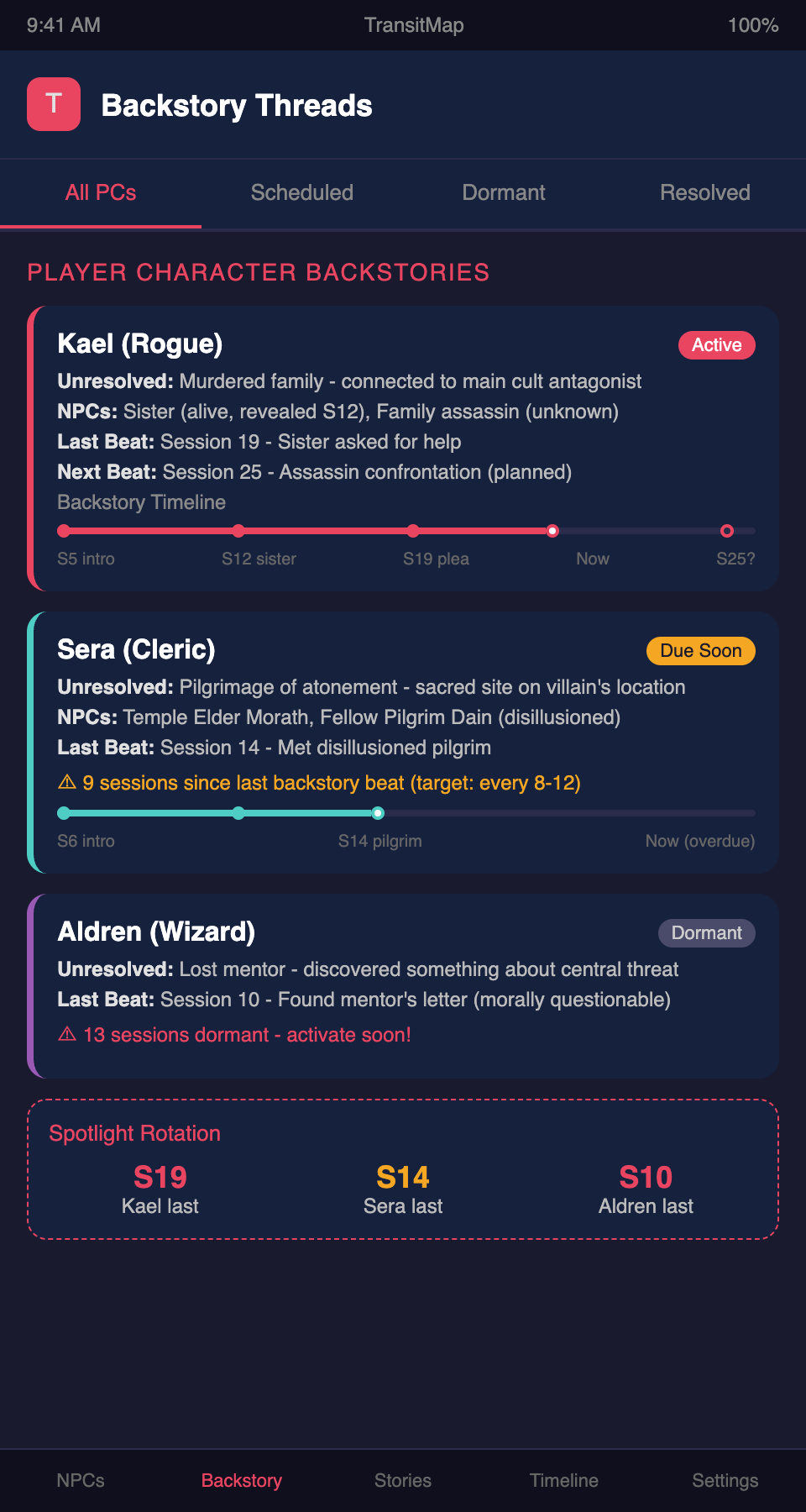
The practical challenge is remembering which backstory elements you have introduced, which are still dormant, and which are ready for their next beat. A visual system helps enormously:
For each player character, maintain a backstory thread tracker that shows:
- Which elements have been introduced and when
- Which elements are still waiting to be revealed
- When the last backstory beat for this character occurred
- What the next planned backstory beat is and when it should trigger
When you can see all backstory threads running in parallel alongside your main campaign arc, you can make informed decisions about pacing, spotlight distribution, and when to escalate personal stakes.
Want to track every backstory thread alongside your main campaign arc? Join the TransitMap waitlist — visualize personal storylines as transit lines running parallel to your campaign, and never let a player's backstory fall into the graveyard again.