Managing a Large Cast of NPCs Without Overwhelming Yourself or Your Players
When Your NPC Cast Outgrows Your Brain
It happens gradually. You introduce a quest giver. A shopkeeper. A faction leader. A mysterious stranger. Each one felt necessary in the moment. Now, thirty sessions in, you have a cast of characters that would rival a Russian novel, and neither you nor your players can keep them straight.
The problem is not that you have too many NPCs. A living world needs people in it. The problem is that most GMs treat all NPCs with equal narrative weight, which means every new character competes for the same limited mental real estate — yours and your players'.
The Cast Hierarchy System
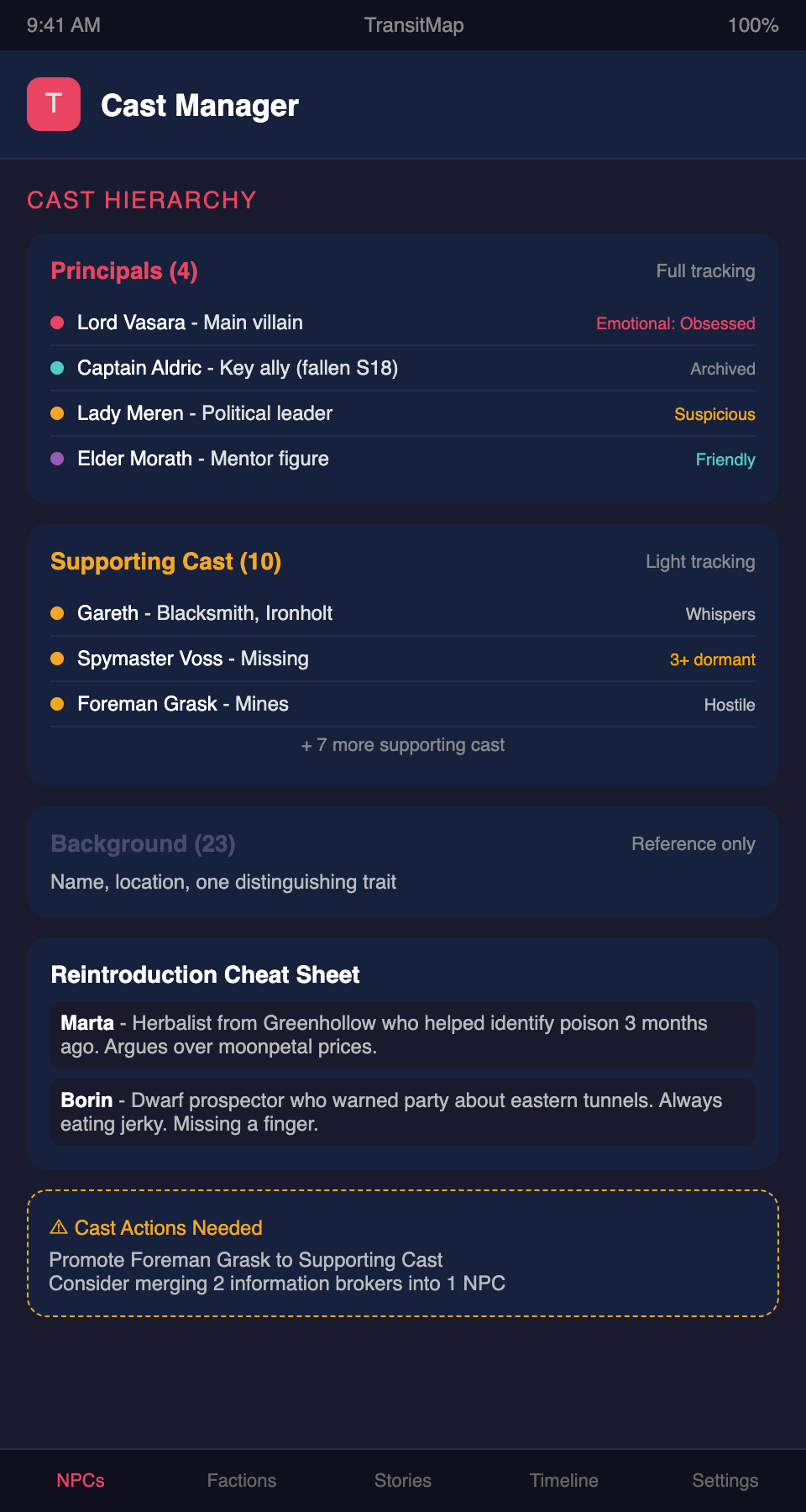
Professional fiction writers manage large casts by assigning clear roles. You should do the same. Every NPC in your campaign falls into one of four categories:
Principals (3-5 characters) — These are the NPCs who drive the main storyline. The main villain. The key ally. The mentor figure. The political leader whose decisions shape the campaign. Principals appear frequently, have complex motivations, and evolve over the campaign. You should be able to describe each principal's current emotional state without checking your notes.
Supporting Cast (8-12 characters) — These are the NPCs who recur regularly and have their own ongoing situations. Faction leaders, recurring quest givers, player backstory NPCs, and beloved allies. Supporting cast members appear every few sessions and have recognizable personalities and goals.
Recurring Background (15-25 characters) — These are the NPCs who populate the world and appear when relevant. Shopkeepers, guards, tavern owners, local officials. They have names and basic personalities but no ongoing storylines. They exist to make locations feel inhabited.
One-Shot Characters (unlimited) — NPCs who appear once for a specific purpose and may never return. The messenger who delivers the quest. The prisoner who shares information. The merchant in the one-time market scene. These characters need a name and a distinguishing trait, nothing more.
Making NPCs Memorable With Minimal Effort
You cannot give every NPC a detailed personality. But you can make any NPC instantly memorable with the three-trait method:
- A voice or speech pattern — Not a full accent, just a tendency. Speaks in questions. Never uses contractions. Whispers everything. Repeats the last word of every sentence.
- A physical detail — One visible characteristic the players will remember. A scar across the nose. Always eating something. Constantly fidgeting with a coin. Missing a finger.
- A want — Something this NPC wants right now, in this conversation. Not their life goal — their immediate desire. Wants to close the shop early. Wants the players to leave. Wants to impress someone.
These three traits take ten seconds to establish and make an NPC more memorable than a page of backstory. When the NPC reappears sessions later, repeat the same traits and the players will instantly remember them.
The Reintroduction Problem
The biggest practical challenge with a large cast is reintroduction. An NPC appears after a ten-session absence, and the players stare blankly. "Who is this person? Have we met them?"
Solve this with contextual reintroduction. Do not just say the NPC's name. Reintroduce them with context:
- Instead of: "You see Marta at the market."
- Use: "You spot Marta — the herbalist from Greenhollow who helped you identify the poison three months ago. She's arguing with a merchant over dried moonpetal prices."
This gives the players three hooks to grab onto: the name, the past interaction, and a current activity. Most players will remember within seconds.
For principals and supporting cast, maintain a reintroduction cheat sheet — one line per NPC that summarizes who they are and their last significant interaction with the party. Glance at it before any session where that NPC might appear.
Consolidating Your Cast
Sometimes the best NPC management technique is having fewer NPCs. If your cast is unwieldy, look for opportunities to consolidate:
- Merge similar NPCs. If you have three different information brokers, make them the same person. If two faction lieutenants serve similar narrative functions, combine them.
- Retire resolved NPCs. When an NPC's storyline is complete, let them exit the stage gracefully. Not every NPC needs to stick around forever.
- Let NPCs die. Character death is permanent cast reduction. When dramatically appropriate, let an NPC die — it raises the stakes and reduces your tracking load.
- Promote minor NPCs instead of creating new ones. When you need a new ally, traitor, or informant, check your existing cast first. Elevating a background NPC the players already know is more satisfying than introducing someone new.
Delegation: NPCs Who Manage Other NPCs
In a large campaign, you can reduce your direct management burden by creating NPC hierarchies. Instead of tracking twelve individual guild members, track the guild leader and note that they have twelve members who follow their lead.
When the players interact with the guild, they primarily interact with the leader. If they need to deal with a specific member, you can improvise one on the spot — but you do not need to maintain twelve separate character sheets.
This mirrors how organizations actually work. You deal with the manager, not every employee. Apply the same principle to your campaign's factions, governments, and organizations.
Tracking Your Cast Effectively
Your cast tracking system should match your hierarchy:
Principals — Full character entries with current state, motivation, relationships, knowledge, and projected trajectory. Update after every session.
Supporting Cast — Brief entries with current state, primary motivation, and attitude toward the players. Update when they appear or are affected by events.
Recurring Background — A simple roster with name, location, role, and one distinguishing trait. Update rarely.
One-Shot Characters — A running list of names and one-line descriptions, primarily so you do not accidentally reuse a name or give two NPCs the same distinguishing trait.
The Cast Map
A visual representation of your NPC cast organized by relationships is invaluable. Plot your principals in the center, supporting cast around them, and draw lines showing who knows whom, who works for whom, and who opposes whom.
This map serves two purposes:
- During prep, it shows you which NPCs are connected and helps you plan scenes that naturally involve multiple characters
- At the table, it helps you answer the question "who would this NPC contact about this?" without pausing to think
Update the map when relationships change — alliances shift, betrayals happen, new connections form. The map should always reflect the current state of your NPC network.
Letting Players Help Track NPCs
Your players are a resource. Many groups designate a party chronicler who keeps notes on NPCs the party has met. Encourage this by:
- Giving the chronicler a small in-game benefit (a minor inspiration die, a narrative advantage)
- Occasionally asking "does anyone remember this person?" before providing the answer yourself
- Validating player notes when they are correct and gently correcting when they are not
Players who track NPCs themselves are more invested in those characters and more likely to seek them out for future interactions, which makes your large cast feel more alive.
Struggling to keep track of your campaign's growing NPC cast? Join the TransitMap waitlist — map every character as a node on your campaign's narrative transit network, with relationships and storyline connections visible at a glance.