Managing Multiple Factions in Your D&D Campaign Without a Spreadsheet Nightmare
Why Faction Management Gets Overwhelming
Factions are one of the most powerful tools in a GM's arsenal. A world with competing organizations — thieves' guilds, noble houses, religious orders, merchant cartels — feels dynamic and real. Players love navigating faction politics because their choices have consequences that ripple through the entire setting.
The problem is that every faction you add multiplies your bookkeeping geometrically. Two factions have one relationship to track. Four factions have six. Eight factions have twenty-eight. Add the players as their own quasi-faction and every relationship becomes a triangle with shifting loyalties.
Most GMs hit the wall somewhere around four to six active factions. That is the point where you start forgetting that the Merchant Guild is supposed to be secretly funding the rebels, or that the Temple of the Sun switched from hostile to cautious after the players returned the stolen relic three sessions ago.
The Core Information You Need Per Faction
Before building a tracking system, identify what you actually need to know in the moment. For each faction, track:
- Current goal — What is this faction actively trying to accomplish right now? Not their philosophical mission statement, but their concrete next move.
- Resources and leverage — What do they have that gives them power? Soldiers, money, information, political connections, magical artifacts?
- Attitude toward the players — A simple scale works: hostile, suspicious, neutral, cautious, friendly, allied. Update this after every significant interaction.
- Key NPCs — Who are the faces of this faction that the players interact with? Usually two to four per faction.
- Active operations — What is this faction doing right now that could intersect with the players' activities?
Notice what is not on this list: detailed history, organizational charts, membership rosters, or elaborate lore documents. Those are worldbuilding, not session-relevant tracking. Keep them in a separate reference document if you enjoy writing them, but do not clutter your active tracker.
Mapping Faction Relationships
The single most useful artifact you can create for faction management is a relationship map. This can be as simple as a diagram with faction names as nodes and labeled lines between them:
- Allied — These factions actively cooperate and share resources
- Friendly — These factions have compatible goals but do not coordinate
- Neutral — No significant relationship
- Tense — Competing interests but no open conflict
- Hostile — Active opposition, may include covert or overt warfare
The critical discipline is updating this map every time something changes. When the players broker a truce between the thieves' guild and the merchant cartel, that line changes from hostile to tense. When a faction leader is assassinated, every relationship that faction has needs to be re-evaluated.
Running Faction Turns
One of the most effective techniques for managing factions is the faction turn — a structured process you run between sessions to advance each faction's agenda independently of the players.
Here is a simple faction turn procedure:
- For each active faction, ask: what is their current operation, and did anything happen last session that affects it?
- Roll or decide on progress — Did the faction advance toward their goal, stall, or suffer a setback? Some GMs use dice for this; others just decide based on narrative logic.
- Check for collisions — Are any two factions' operations on a collision course? If the thieves' guild is trying to steal the same artifact the temple is trying to consecrate, that creates a conflict that will happen whether the players are involved or not.
- Generate hooks — Based on each faction's progress, identify one or two things the players might notice, hear about, or stumble into next session.
- Update the relationship map — Did any faction relationships change as a result of this turn?
This entire process should take fifteen to twenty minutes between sessions. It keeps factions feeling alive without requiring hours of prep.
The Transit Map Model for Faction Tracking
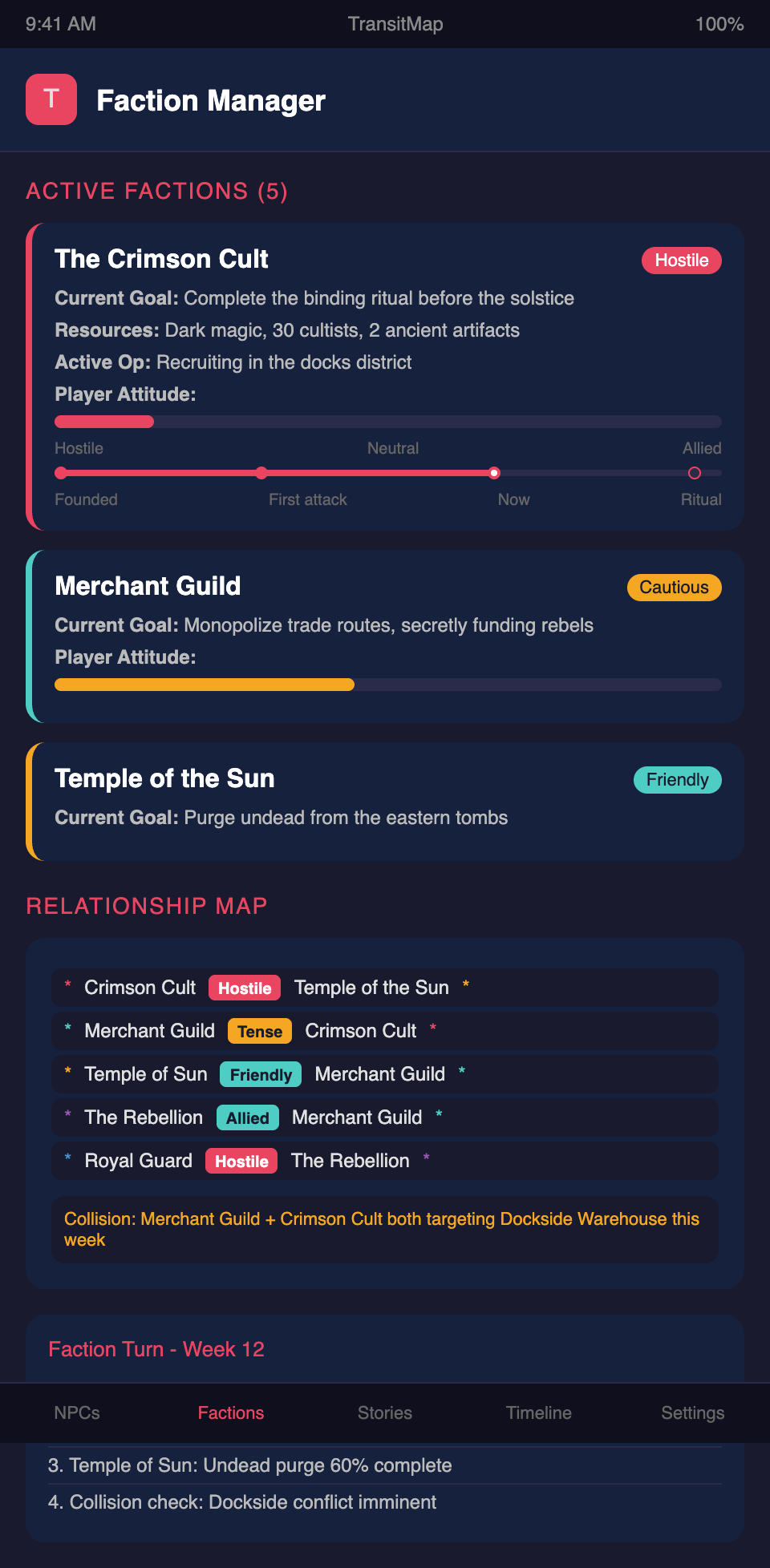
Think of each faction's agenda as a transit line. The line has a starting point (their initial goal), a destination (their desired outcome), and stations along the way (milestones they need to hit). Multiple faction lines running in parallel across your campaign timeline reveal:
- Where lines converge — Factions whose operations target the same location, resource, or NPC at the same time. These are natural conflict points.
- Where lines cross the player's path — Moments when the players will unavoidably encounter faction activity, whether they seek it out or not.
- Where lines dead-end — Factions that have stalled and need a new goal or a shake-up to stay relevant.
This visual approach is particularly powerful because it lets you see the pacing of your faction game. If three factions all reach critical milestones in the same session, that session will be overwhelming. If no faction has a milestone for four sessions, the political layer of your game goes dormant and players lose interest.
Handling Player Interactions With Factions
Players will do things you did not expect, and those actions will affect factions in ways you did not plan for. A few principles help you roll with it:
Every significant player action should affect at least one faction's attitude. If the players clear out a bandit camp, ask yourself: which faction benefits from that? Which faction was using those bandits? Which faction notices the power vacuum? Even a seemingly simple quest can ripple through your faction ecosystem.
Let players play factions against each other. This is some of the most engaging gameplay in a faction-heavy campaign. When the players figure out that they can use information from the thieves' guild to pressure the merchant cartel into supporting the rebellion, they feel like strategic geniuses. Your job is to make sure the consequences are real — the thieves' guild will eventually find out they were used.
Track faction patience. A faction that the players have promised to help but keep delaying will eventually give up on them and pursue their goal independently — possibly in ways the players will not like. Track how many sessions have passed since the players last advanced a faction's interests, and have consequences when patience runs out.
Common Faction Management Mistakes
- Making factions too simple — A faction that is purely evil or purely good is boring. Every faction should have a goal that is at least partially sympathetic, even if their methods are objectionable.
- Letting the players fully resolve faction conflicts — If the players completely defeat a faction, the political ecosystem loses complexity. Have remnants scatter, reform under new leadership, or get absorbed by other factions.
- Forgetting faction intelligence — Factions have spies, informants, and allies. When the players do something significant, at least one faction should find out about it and react. Players should feel watched.
- Running factions in isolation — Factions that only interact with the players and never with each other feel artificial. Faction-versus-faction conflict that happens offscreen makes the world feel larger than the player characters.
Scaling Factions Across Campaign Tiers
As your campaign progresses from local to regional to continental scope, your faction roster needs to evolve:
- Tiers 1-4 (local) — Two to three factions is plenty. The town guard, the local thieves, and one secret organization.
- Tiers 5-10 (regional) — Four to six factions. Add political powers, religious organizations, and merchant interests.
- Tiers 11-16 (national) — Six to eight factions. Kingdoms, military orders, arcane academies, and planar entities.
- Tiers 17-20 (cosmic) — Consolidate back to three or four factions with world-shaking power. At this scale, minor factions become irrelevant.
The key is to retire lower-tier factions as the scope expands. The local thieves' guild stops mattering when the players are negotiating treaties between empires. Archive them and focus your tracking energy on the factions that drive the current tier of play.
Tired of losing track of which faction is doing what in your campaign? Join the TransitMap waitlist and manage every faction's agenda as a visual transit line — see alliances, conflicts, and collision points at a glance.