Running a Multi-Party Campaign: How to Manage Parallel Storylines
Why Multi-Party Campaigns Are Worth the Complexity
A multi-party campaign is exactly what it sounds like: two or more groups of players operating in the same world, at the same time, with their actions affecting each other. Group A liberates a town; Group B arrives to find a newly free populace with their own agenda. Group A starts a war; Group B deals with the refugees.
The appeal is enormous. The world feels genuinely alive because it is being changed by multiple sets of actors. Players feel their choices matter even more when they see the ripple effects in another group's experience. And the narrative possibilities — convergence events, rival parties, shared villains — are unlike anything a single-group campaign can offer.
The challenge is equally enormous. You are now running two or more campaigns simultaneously, with a shared continuity layer that requires meticulous tracking.
Setting Up the Multi-Party Structure
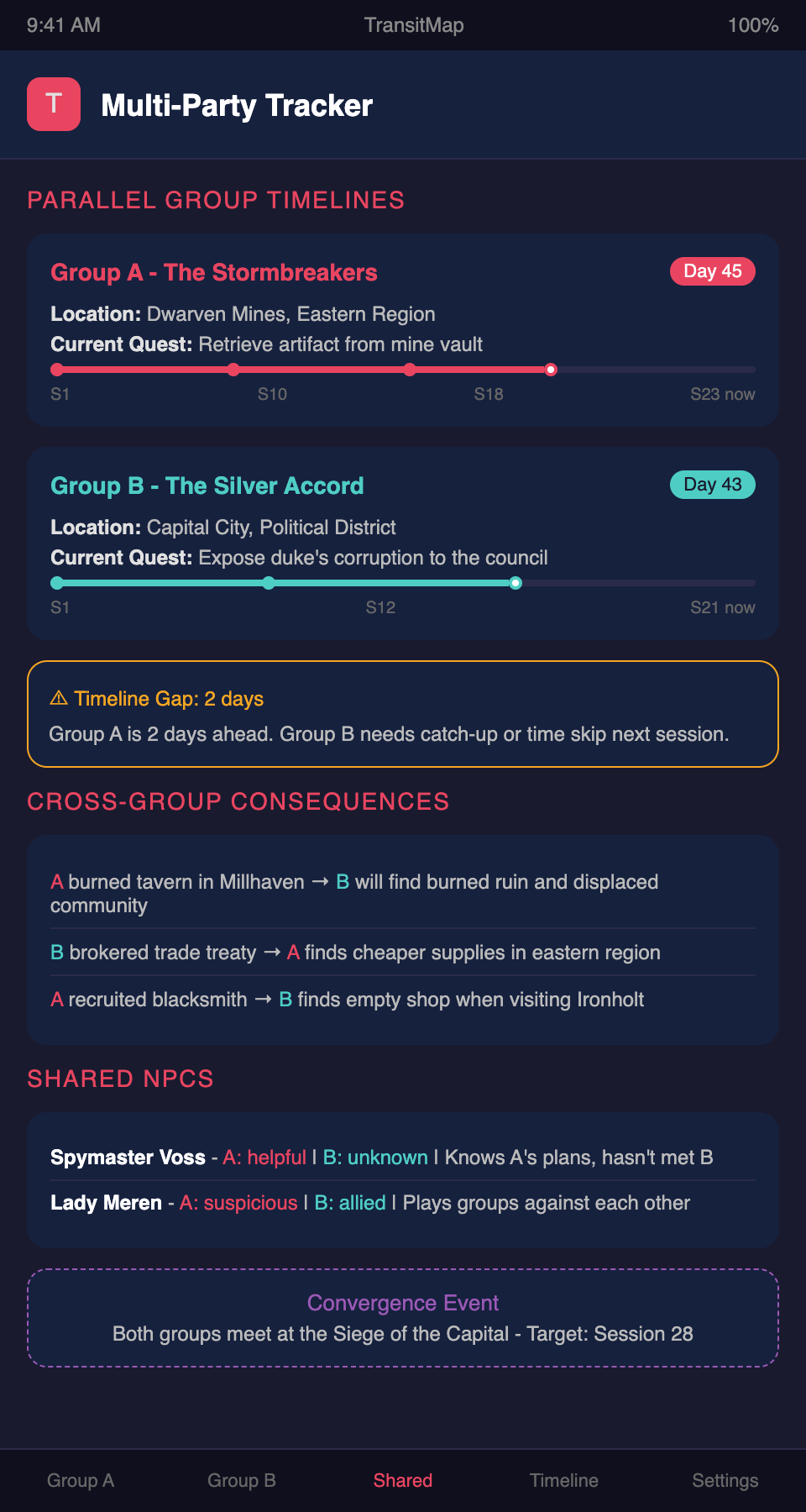
Before your first session, decide on the structural relationship between the parties:
Same world, different regions — The easiest to manage. Each group operates in their own area with occasional overlap. Consequences travel between regions through news, trade, and faction movements.
Same world, same region — More complex. The groups might visit the same locations, interact with the same NPCs, and work on different aspects of the same conflict. Continuity requirements are high.
Same world, opposing sides — The most dramatic. The groups are working toward conflicting goals, potentially as rivals or enemies. Requires careful balancing so neither group feels like the "bad guys" unless that is intentional.
Convergence campaign — Groups start separately and their storylines merge at a predetermined point for a combined session or arc. This is logistically challenging but produces extraordinary moments.
The Shared Timeline Problem
The most immediate practical challenge is timeline synchronization. If Group A plays on Tuesdays and Group B plays on Thursdays, their in-game timelines will advance at different rates. Group A might cover three in-game days on Tuesday while Group B covers two weeks on Thursday.
Solutions:
- Calendar sync — Maintain a master in-game calendar and advance both groups along it at roughly the same rate. If Group A is on day 45, Group B should be within a few days of day 45.
- Catch-up sessions — When one group gets ahead on the timeline, give the lagging group a time skip or a downtime period to synchronize.
- Parallel but offset — Accept that the groups are at different points on the timeline and manage contradictions as they arise. This is the simplest approach but requires tracking which events each group knows about relative to their current date.
Managing Shared NPCs
When both groups interact with the same NPC, you need to track that NPC's state relative to each group's interactions:
- What does the NPC know from Group A that they might share with Group B? An NPC who helped Group A might mention them to Group B, or might keep their involvement secret.
- How has Group A's interaction changed the NPC? If Group A threatened the innkeeper, the innkeeper will be nervous when Group B arrives.
- Is the NPC available? If Group A recruited the blacksmith for a quest, the blacksmith is not in the shop when Group B visits.
Create a shared NPC log that records every group's interactions with shared NPCs. Before each session, check which shared NPCs might appear and verify their current state accounts for all groups' actions.
Cross-Group Consequences
The magic of multi-party campaigns is cross-group consequences — moments when one group feels the impact of the other group's choices.
Types of cross-group consequences:
- Environmental changes — Group A burned down the tavern. Group B arrives to find a burned ruin and a displaced community.
- Political shifts — Group A brokered a peace treaty. Group B finds the political landscape has changed and their planned approach is no longer viable.
- Resource changes — Group A bought all the healing potions. Group B finds the market depleted.
- Reputation effects — Group A's actions have made adventurers popular (or hated) in the region. Group B benefits (or suffers) from that reputation.
- NPC disposition changes — Group A betrayed a faction. Group B, if associated with adventurers generally, faces suspicion from that faction.
The key to making cross-group consequences satisfying is visibility. The affected group should be able to trace the consequence back to its cause. "The tavern was burned by another group of adventurers" is more interesting than "the tavern burned down."
Running Convergence Events
The pinnacle of a multi-party campaign is the convergence event — a session where both groups play together. These are logistically complex but narratively unforgettable.
Planning a convergence event:
- Set the date far in advance. Finding a time that works for two full groups requires notice.
- Synchronize timelines. Both groups must reach the convergence point at the same in-game time.
- Design for the full group. With potentially 8-12 players, your encounter design changes. Large-scale battles, political summits, or heist scenarios work better than dungeon crawls.
- Give both groups meaningful roles. If one group is spectating while the other acts, the convergence fails. Each group should have critical responsibilities.
- Prepare for conflict between groups. If the groups have different goals, the convergence may involve PvP tension. Establish expectations beforehand.
Tracking Requirements for Multi-Party Campaigns
A multi-party campaign requires tracking infrastructure that goes beyond single-group needs:
- A master timeline that shows both groups' progress relative to in-game dates
- A shared world state document that records changes either group has made to the world
- A shared NPC roster with interaction history per group
- A cross-reference log that links events in one group's sessions to potential consequences for the other group
- A convergence tracker that monitors how close both groups are to shared story beats
This is a significant tracking burden. Without a robust system, the shared world degrades into two separate campaigns that occasionally mention each other.
Common Multi-Party Campaign Mistakes
- Favoritism — Giving one group more world-affecting agency than the other. Both groups should feel their choices matter equally.
- Information overflow — Spending session time telling Group B about everything Group A did. Keep cross-group updates brief and relevant.
- Timeline drift — Letting the groups get so far apart on the timeline that synchronization becomes impossible.
- Forced convergence — Railroading both groups toward a meeting point they have not earned through their choices. Convergence should feel natural.
- Shared villain imbalance — One group does most of the work against the shared antagonist. Ensure both groups contribute meaningfully to the campaign's central conflict.
Running a multi-party campaign and struggling to keep all the threads straight? Join the TransitMap waitlist — map parallel storylines as adjacent transit lines and track shared events, NPCs, and timeline synchronization in one visual system.