Preventing Plot Holes in Your Homebrew Campaign
What Counts as a Plot Hole in a TTRPG
In a movie, a plot hole is a gap in logic that the audience cannot explain. In a TTRPG, plot holes are worse because your audience is actively interrogating the logic in real time. Players ask questions. They test assumptions. They remember details you have forgotten. And when something does not add up, they will find it.
Common plot holes in homebrew campaigns include:
- Motivation gaps — The villain's plan does not actually make sense when examined closely. Why would they do this when an easier option is available?
- Knowledge paradoxes — An NPC acts on information they could not possibly have. Or the players are expected to know something they were never told.
- Timeline impossibilities — An event could not have happened in the time available. The messenger could not have traveled that far in one day.
- Forgotten consequences — The players did something dramatic and the world did not react. They killed the mayor and nobody cares.
- Contradicted facts — Something established as true earlier is violated later without explanation.
Why Plot Holes Are Harder to Prevent in TTRPGs
Novel authors can revise. Film editors can cut scenes. You are performing live, generating content in real time based on player choices you could not predict. Plot holes are not a sign of incompetence — they are a structural feature of improvised collaborative storytelling.
This means preventing plot holes requires systems, not just talent. You need processes that catch inconsistencies before they reach the table, and recovery techniques for when they slip through.
The Pre-Session Logic Check
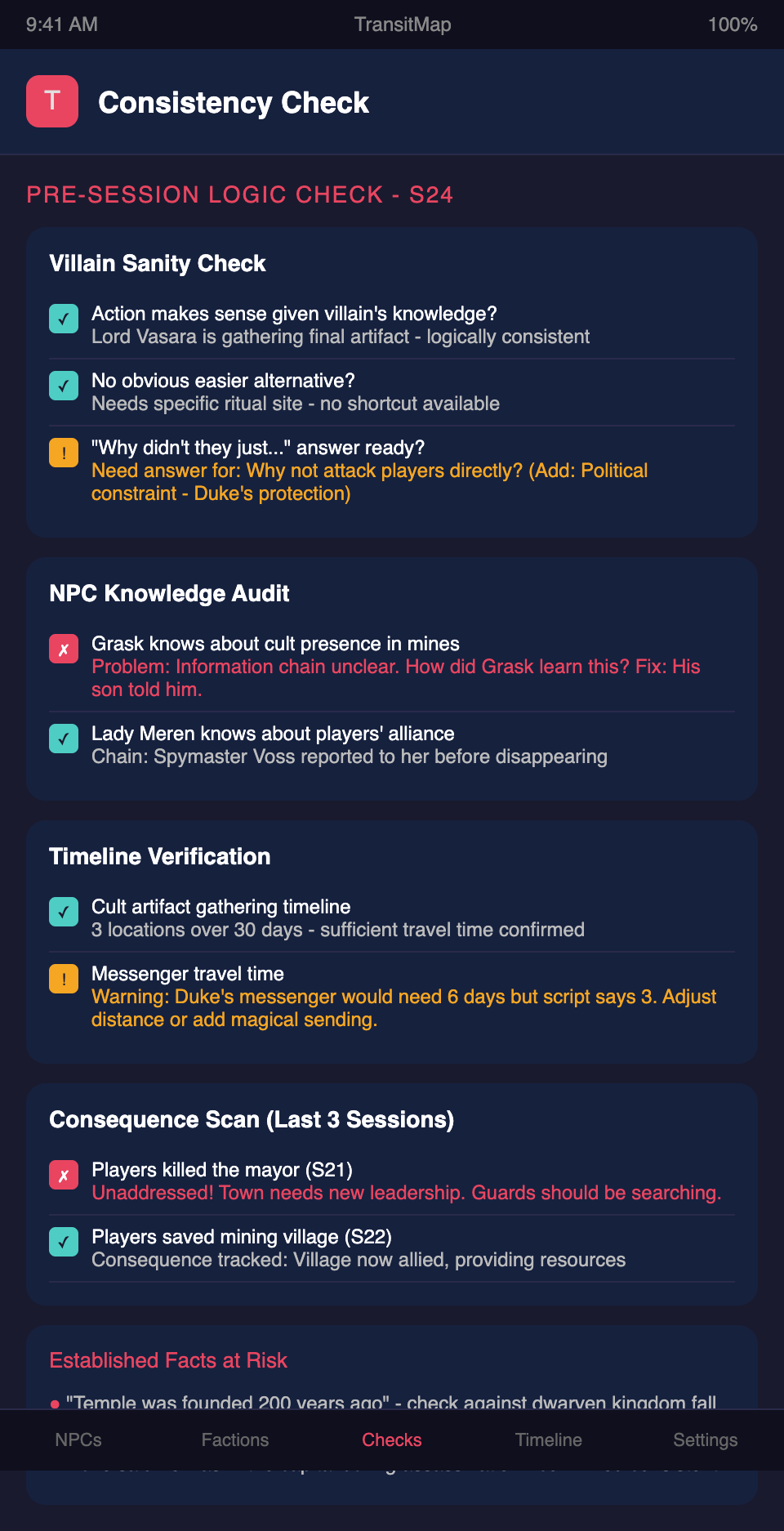
Before each session, spend five minutes running a logic check on your planned content:
The Villain Sanity Check. For any villain plan you are advancing: Does this action make sense given what the villain knows? Is there an obvious easier alternative the villain would logically pursue instead? If a player asks "why didn't they just...?" do you have an answer?
The NPC Knowledge Audit. For any NPC who will share information or act on information: How did they learn this? Can you trace the information chain from source to this NPC? If the chain has gaps, either fill them or change what the NPC knows.
The Timeline Verification. For any event that has occurred offscreen: Is there enough time for this to have happened? If the cult ritual requires gathering artifacts from three different locations, has enough in-game time passed for the cult members to have traveled to all three?
The Consequence Scan. Review the last two or three sessions and ask: Did anything happen that should have consequences I have not yet addressed? Did the players make a loud, public action that witnesses would report? Did they leave evidence? Did they make enemies?
This five-minute check catches the majority of plot holes before they reach the table.
Building Airtight Villain Plans
The most common source of plot holes is the villain's plan. You designed the plan to create drama, not to be logically airtight, and your players will find every logical weakness.
To build villain plans that hold up to scrutiny:
Start with the goal, then work backward. What does the villain want? What is the minimum they need to achieve that goal? What steps lead to acquiring those necessities? Each step should logically follow from the previous one.
Give the villain constraints. A villain who can do anything will raise the question "why haven't they already won?" Villains need limitations: limited resources, limited knowledge, political constraints, magical restrictions, personal flaws. These constraints explain why the plan is complex instead of simple.
Make the villain's plan respond to new information. A static plan creates plot holes when circumstances change. If the players disrupt one element, the villain should adapt. "The villain continues with the original plan despite knowing the players are aware of it" is a plot hole unless the villain has no alternative.
Write the villain's plan from the villain's perspective. Spend ten minutes writing a brief document as if you were the villain, explaining your plan and why each step is necessary. This exercise reveals logical gaps that are invisible when you are thinking as the GM.
The Player Memory Problem
Your players remember things you have forgotten. This is a consistent source of discovered plot holes: the GM introduces something that contradicts a detail from twenty sessions ago that the GM does not remember but a player does.
Defense strategies:
- Keep a fact log. Record every significant factual claim made during play. "The duke said he was in the capital during the assassination" is a fact that must remain consistent forever.
- Flag potential continuity risks. When you improvise a detail that connects to established canon, mark it for verification after the session. "I said the temple was founded 200 years ago — need to check if that aligns with the timeline."
- Encourage player note-taking. Players with notes will catch your errors, but they will catch them at the table rather than letting them fester. Better to be corrected immediately than to build a storyline on a contradicted fact.
Reactive Plot Hole Repair
When a plot hole is discovered during play, you have a narrow window to address it. Here are your options, in order of preference:
Acknowledge and correct. "Good catch — I misspoke. The duke was actually in Thornfield during the assassination, not the capital. That's consistent with what you learned from the spy." This is fast, honest, and players respect it.
Incorporate and explain. "Interesting — the duke told you he was in the capital, but the evidence suggests otherwise. It seems the duke lied to you." This turns the plot hole into a plot point. Only use this if the lie creates a genuinely interesting story beat, not just to cover your mistake.
Defer and research. "That's a good question — let me check my notes and we'll address it next session." This buys you time to figure out the best resolution without making a snap decision that creates more problems.
Never deny. Do not tell a player their notes are wrong when they are right. Do not insist that you never said something when you did. This destroys trust faster than any plot hole.
Structural Prevention: The Consistency Layer
Beyond session-by-session checking, you can build structural safeguards into your campaign:
Establish world rules and follow them. If teleportation requires a specific component, every instance of teleportation must use that component — including villain teleportation. If the dead cannot be raised without a specific ritual, no NPC should casually return from the dead.
Track cause and effect chains. When something happens in your campaign, trace the logical consequences forward. If the players destroyed the bridge, who is affected? If they spread a rumor, who hears it? Untraced consequences become plot holes when the affected parties do not react.
Maintain an "established facts" document. Separate from your session notes, keep a running list of things that are now canonically true in your world. Before introducing any new element, scan this list for potential contradictions.
The investment in consistency pays dividends in player trust. When your players believe the world is consistent, they engage more deeply, plan more ambitiously, and derive more satisfaction from their achievements.
Want a visual system that makes plot holes visible before your players find them? Join the TransitMap waitlist — see every storyline, fact, and cause-effect chain mapped out like a transit network where gaps and contradictions are immediately obvious.