Building a Recurring Villain Arc That Keeps Players Invested
Why Most Campaign Villains Fall Flat
The typical campaign villain appears in Act 1 as a name and a vague threat, disappears for twenty sessions while the players deal with minions and side quests, and then shows up at the end for a final boss fight. The players defeat someone they barely know and feel... nothing.
This happens because the GM designed the villain as a destination instead of a relationship. A great recurring villain is not the boss at the end of the dungeon. They are a character the players have history with — someone they have clashed against, been outsmarted by, grudgingly respected, or deeply hated across the length of the campaign.
Building that relationship requires a deliberate arc — a series of escalating encounters and interactions that develop the villain as a character alongside the heroes.
The Five-Phase Villain Arc
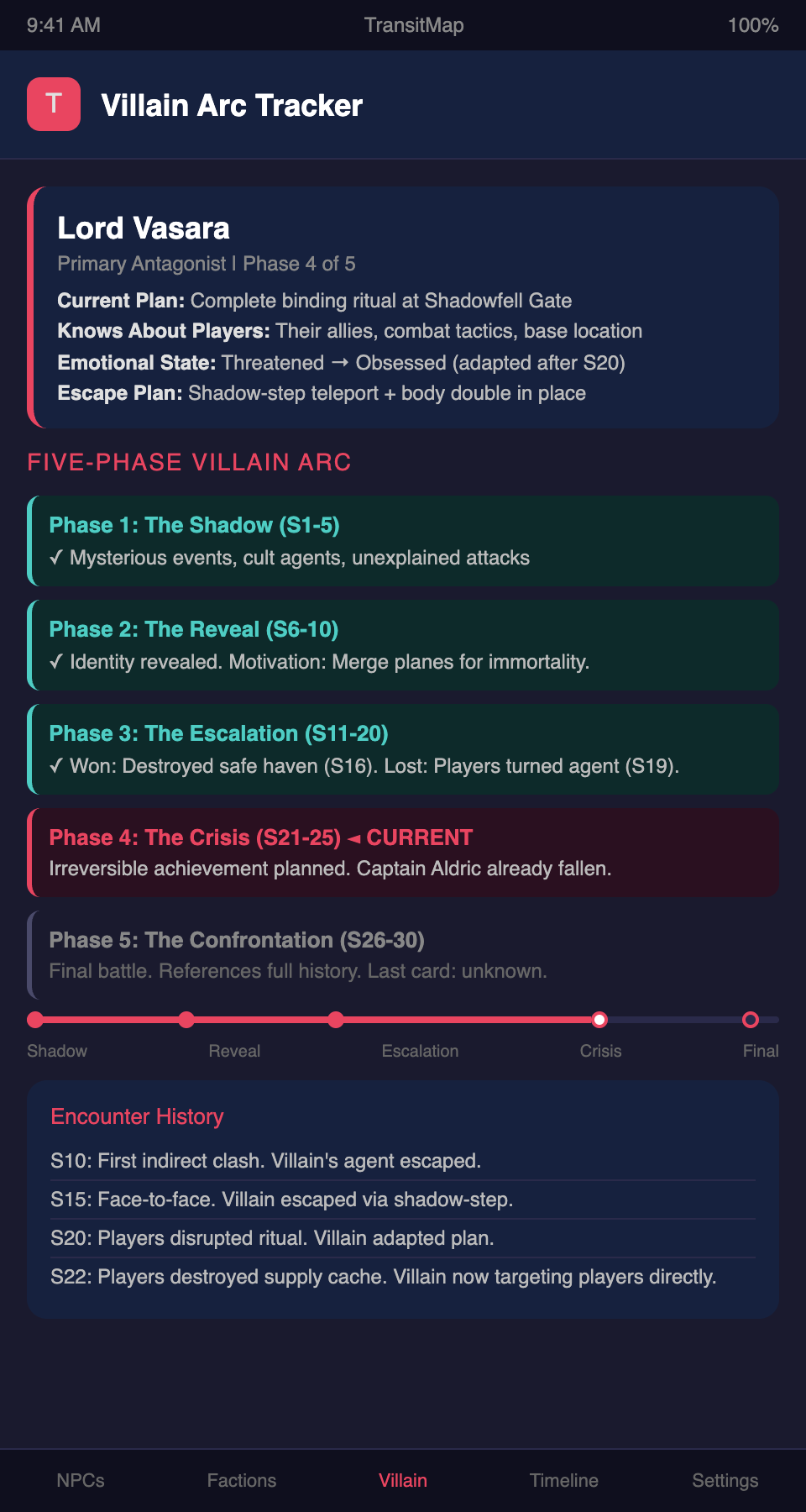
Phase 1: The Shadow (Sessions 1-5)
The villain is not seen directly. Their influence is visible in the world — consequences of their actions, agents carrying out their plans, evidence of their preparation. The players should feel that something is moving in the background before they know who or what it is.
What to do in this phase:
- Drop clues that connect seemingly unrelated events to a single cause
- Introduce minor antagonists who serve the villain, even if the players do not know it yet
- Establish the villain's effect on the world before establishing the villain themselves
What to avoid:
- Naming the villain too early. Mystery builds anticipation.
- Making the villain's influence too subtle. Players should notice that something is wrong, even if they cannot identify it.
Phase 2: The Reveal (Sessions 6-10)
The villain steps into the light. The players learn who they are, what they want, and why they are a threat. This does not need to be a face-to-face encounter — it can be learning the villain's identity through investigation, witnesses, or captured agents.
What to do in this phase:
- Give the villain a comprehensible motivation. The best villains want something the players can understand, even if they disagree with the methods.
- Show the villain's competence. Their plan should be clever. Their resources should be impressive. The players should realize this is not going to be easy.
- Create a personal connection. The villain should affect something the players care about — threaten an NPC ally, target a player's hometown, or share an unexpected history with a party member.
What to avoid:
- A villain who monologues about their plan. Show the plan through its effects, not through exposition.
- A villain who seems stupid or weak. First impressions set expectations for the entire campaign.
Phase 3: The Escalation (Sessions 11-20)
The players and the villain are in active conflict. Each side takes actions that affect the other. The stakes rise steadily.
What to do in this phase:
- Let the villain win sometimes. If the players thwart every move, the villain becomes a joke. The villain should succeed at things that hurt the players — destroying a safe haven, turning an ally, completing a phase of their plan despite the players' efforts.
- Have the villain adapt. When the players use a tactic successfully, the villain should counter it next time. This makes the villain feel intelligent and makes the players innovate.
- Create direct confrontations that the villain survives. The players should clash with the villain in person at least two or three times before the final battle. Each encounter should end with the villain escaping or withdrawing — not through plot armor, but through preparation and cunning.
- Make it personal. The villain should target the players specifically, not just their goals. Threaten their friends. Attack their reputation. Exploit their weaknesses.
What to avoid:
- Making the villain untouchable. The players should hurt the villain too — disrupt plans, turn agents, destroy resources. The conflict should feel like a real contest, not a predetermined outcome.
- Letting the escalation plateau. Each confrontation should be more intense than the last.
Phase 4: The Crisis (Sessions 21-25)
The villain's plan reaches a critical stage. The players face their darkest moment — a major setback, a devastating loss, or a moral dilemma with no good answer.
What to do in this phase:
- The villain should achieve something irreversible. A city falls. An ally dies. A weapon is completed. The players cannot undo it — they can only move forward.
- Reveal the villain's full depth. This is where the villain's backstory, motivations, and vulnerability become fully clear. The players should understand why this person became what they are.
- Create a moment of doubt. Can the players actually win? The uncertainty should be genuine. If the players feel certain of victory, the crisis is not working.
Phase 5: The Confrontation (Sessions 26-30)
The final battle. This should be the culmination of everything the players have experienced with this villain — every trick, every grudge, every unresolved moment.
What to do in this phase:
- Reference the history. The villain should mention specific things the players did. The battlefield should connect to earlier encounters. The stakes should be the cumulative weight of everything the players have fought for.
- Give the villain a last card. Something the players did not know about — a final transformation, a backup plan, a hostage. The climax should have a moment of "we thought we were ready, but..."
- Make the resolution matter. The players' specific choices throughout the campaign should affect how the final battle unfolds. The allies they made, the resources they gathered, the information they discovered — all of it should be relevant.
Villain Tracking Requirements
Running a recurring villain arc requires specific tracking:
- The villain's current plan — Updated after every session where the players or the villain take relevant action
- What the villain knows about the players — Their capabilities, their allies, their weaknesses. The villain should gather intelligence too.
- Encounter history — Every time the players and the villain have interacted, directly or indirectly. What happened? What did each side learn?
- Emotional trajectory — How does the villain feel about the players right now? Annoyed? Threatened? Obsessed? Respectful? This should evolve over the campaign.
- The escape plan — For every villain encounter before the finale, how does the villain get away? Plan this in advance so it does not feel like deus ex machina.
Common Villain Arc Mistakes
- The invincible villain — The players can never hurt them, which feels frustrating and unfair
- The incompetent villain — The players foil every plan effortlessly, which eliminates tension
- The absent villain — Too many sessions without the villain's presence, causing players to forget about them
- The sympathetic villain who commits atrocities — If you want the villain to be sympathetic, their actions need to match. A villain who massacres innocents cannot be redeemed with a sad backstory
- The pivot villain — Changing the villain's motivation or plan mid-campaign without narrative justification. Players feel cheated.
Want to track your villain's arc alongside your players' journey? Join the TransitMap waitlist — map antagonist and protagonist storylines as parallel transit lines and see exactly where they converge for maximum dramatic impact.