Tracking Your In-Game Timeline: Why It Matters and How to Do It
The Invisible Problem of Untracked Time
Most GMs track what happens in their campaigns. Far fewer track when it happens. Sessions blur together into a vague sequence of events with no clear temporal relationship. Did the journey take three days or three weeks? How long has the villain had to prepare since the players last disrupted their plans? Has the wizard had enough downtime to copy those spells?
When you do not track in-game time, three problems emerge:
Plot timing becomes nonsensical. An NPC says "I'll have the information in a week," but the players spend the next six sessions (representing maybe two days of game time) on other things, and you forget to follow up for three real-world months.
The world feels static. Without a timeline, nothing happens offscreen on a schedule. Seasons do not change. Construction projects do not finish. Pregnancies do not progress. The world waits for the players like a video game.
Rules that depend on time break down. Spell durations, crafting times, travel pace, exhaustion, lifestyle expenses, healing — many D&D mechanics reference specific time periods. Without tracking, these rules are applied inconsistently or ignored.
What to Track: The Minimum Viable Timeline
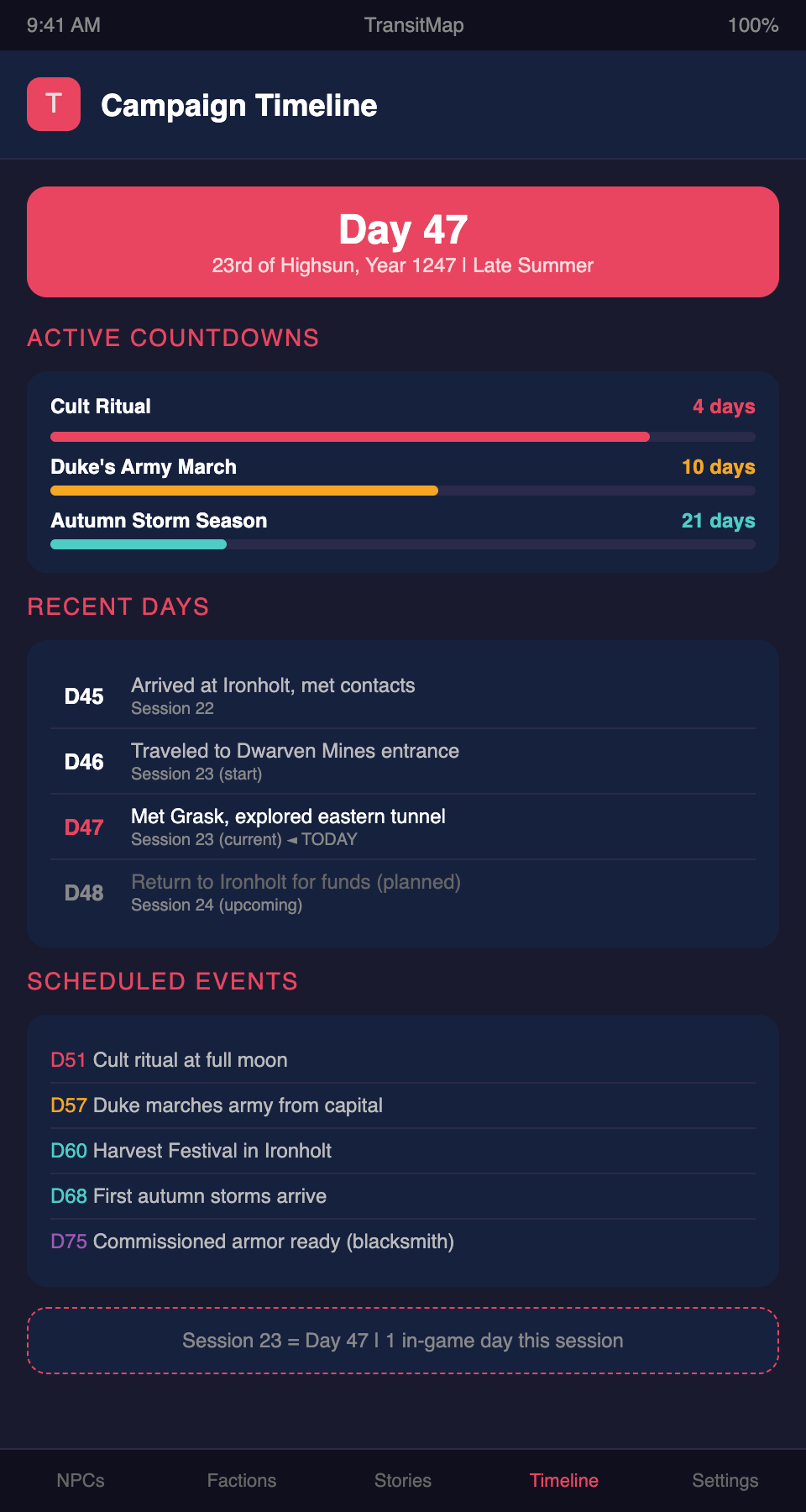
You do not need to track time to the hour. For most campaigns, day-level tracking is sufficient. Know what day it is, and everything else falls into place.
Your timeline needs:
- A calendar — Either the real-world calendar (easy but immersion-breaking) or a fantasy calendar. If you create a fantasy calendar, keep it simple. Twelve months of thirty days each is perfectly functional.
- A "today" marker — What day is it right now in game? Update this at the end of every session.
- Session date mapping — Which sessions correspond to which in-game days. This is your master reference when players ask "how long ago did we...?"
- Scheduled events — Things that will happen on specific future dates, regardless of what the players do. NPC deadlines, seasonal festivals, military movements, celestial events.
Setting Up Your Calendar
If you are starting a new campaign, establish the calendar in session zero. It does not need to be elaborate:
- Name the months and days — Or just use numbers. "It's the 15th of the 7th month" works fine if you do not want to invent names.
- Establish the current season — This affects weather, travel conditions, available food, and general atmosphere.
- Mark two or three upcoming events — A festival in two months, a solstice in six weeks, a tax collection day in three weeks. These create temporal landmarks that help players feel the passage of time.
- Decide on a year — Even if it never matters mechanically, knowing it is "the year 1247 of the Third Era" gives players a reference point.
Tracking Time During Sessions
The hardest part of timeline tracking is maintaining it during play. Here is a lightweight approach:
At the start of each session, announce the current in-game date and any relevant temporal context: "It's the morning of the 23rd of Highsun. You've been in Waterdeep for three days. The merchant guild's deadline is in four days."
During the session, track time at transition points:
- Travel — Mark the days of travel. "You travel for three days along the coast road. It's now the 26th."
- Long rests — Each long rest is a new day. "You camp for the night. When you wake, it's the 27th."
- Downtime activities — When players want to craft, research, or train, assign a time cost and advance the calendar accordingly.
At the end of each session, note the current in-game date in your session log. This takes five seconds and saves hours of reconstruction later.
Making Time Matter
Tracking time is pointless if time has no consequences. Here is how to make your timeline meaningful:
Give NPCs deadlines. "The duke will march his army in ten days, with or without your help." Now the players have a countdown that adds urgency to everything they do between now and then.
Make travel time real. If the dungeon is five days away, those five days of travel should include at least one meaningful event — an encounter, a discovery, or a decision point. Empty travel time feels like wasted time and makes players resent the distance.
Advance faction agendas on schedule. If you run faction turns, tie them to in-game time. The thieves' guild advances their plan every week. The cult performs their ritual on the full moon. The political election happens on a fixed date.
Change the world with the seasons. When autumn arrives, the harvest festival creates new social dynamics. When winter hits, travel becomes harder and supply lines strain. When spring comes, armies that were camped all winter start moving. Seasons are the easiest way to make time passage feel real.
Track NPC activities over time. If the players asked an NPC to research something, that research takes a specific number of days. If the players commissioned armor, it takes three weeks. Record the completion date and follow up when it arrives.
Handling Time Skips
Sometimes the campaign needs to jump forward — weeks of downtime, a season of rebuilding, a month of travel across a continent. Time skips are fine as long as you handle them deliberately:
- Announce the skip clearly. "Three weeks pass. It's now the 14th of Leaffall."
- Ask each player what their character does during the skip. This is an opportunity for downtime activities, personal projects, and character development.
- Advance your timeline events. What happened in the world during those three weeks? Check your scheduled events. Run faction turns for the skipped period. Update NPC statuses.
- Note the skip in your session log. Mark the before and after dates so you can reference the gap later.
Common Timeline Mistakes
- Ignoring travel time — Fast-traveling everywhere makes your world feel small. If two cities are supposed to be a week apart, enforce that week. Use the travel time for encounters and roleplay.
- Letting time freeze during dungeons — A dungeon that takes three sessions to clear might represent one day of in-game time. Meanwhile, three weeks of real time have passed and the players feel like the campaign has stalled. Remind them (and yourself) that only a day has passed in-world.
- Never giving players downtime — If the campaign is one crisis after another with no breaks, time tracking feels oppressive. Build in downtime periods where the calendar advances and nothing urgent is happening.
- Tracking time inconsistently — Half-tracked time is worse than untracked time because it creates false precision. If you commit to tracking, track consistently.
Visual Timeline Tools
A visual timeline — even a simple horizontal line with dates and events marked on it — transforms time tracking from abstract bookkeeping to intuitive reference. When you can see the entire campaign laid out temporally, you can spot pacing problems, identify gaps where nothing is scheduled, and plan future events with confidence.
The timeline should show:
- Sessions mapped to in-game dates
- Scheduled future events
- Active countdowns (NPC deadlines, ritual timers, army movements)
- Season and weather markers
When the timeline is visible alongside your storyline tracking, you can see not just what is happening in your campaign, but when — and that temporal awareness is what separates a living world from a static one.
Ready to track your campaign's timeline alongside every storyline and faction move? Join the TransitMap waitlist — a visual timeline tool where every event, deadline, and story beat maps to your campaign's temporal flow like stations on a transit schedule.