Large-Scale LARP Plot Logistics: Running Events With 50+ Players
The Scale Threshold
There is a threshold — usually around thirty to forty players — where LARP organization shifts from a creative exercise to a logistical operation. Below that threshold, a talented organizer can hold the entire event in their head, adjust on the fly, and personally interact with most players. Above it, no individual can maintain that level of control. The event becomes too large, too simultaneous, and too unpredictable for any one brain to manage.
This is not a problem to solve. It is a reality to design for. Large-scale LARP requires systems, structures, and delegation that small-scale LARP does not. The organizers who scale successfully are the ones who recognize this transition and invest in logistics infrastructure before they need it.
The Logistics Stack
Large-scale LARP logistics operates in layers:
Layer 1: Space Management
Your event site is a resource. Allocate it deliberately:
Zone mapping. Divide your site into zones, each with a designated purpose:
- Social zones — Tavern, market, common areas where unstructured interaction happens
- Plot zones — Locations designated for specific storyline scenes
- Transition zones — Paths between areas where encounters can be staged
- Crew zones — Off-limits areas for NPC costume changes, briefings, and rest
- Safety zones — Out-of-game spaces for players who need a break
Zone scheduling. Some zones serve multiple purposes at different times. The clearing that is a market in the morning becomes a ritual site at night. Schedule these transitions and communicate them to all storytellers.
Capacity awareness. Each zone has a practical capacity — both physical (how many people fit) and narrative (how many people can participate meaningfully in a scene). A dramatic confrontation in a small room with forty onlookers loses its intimacy. A battle in an open field with twelve participants feels sparse.
Layer 2: Storyline Distribution
At large scale, storylines must be distributed so that every player has something to do at any given time. This is the plot logistics core challenge.
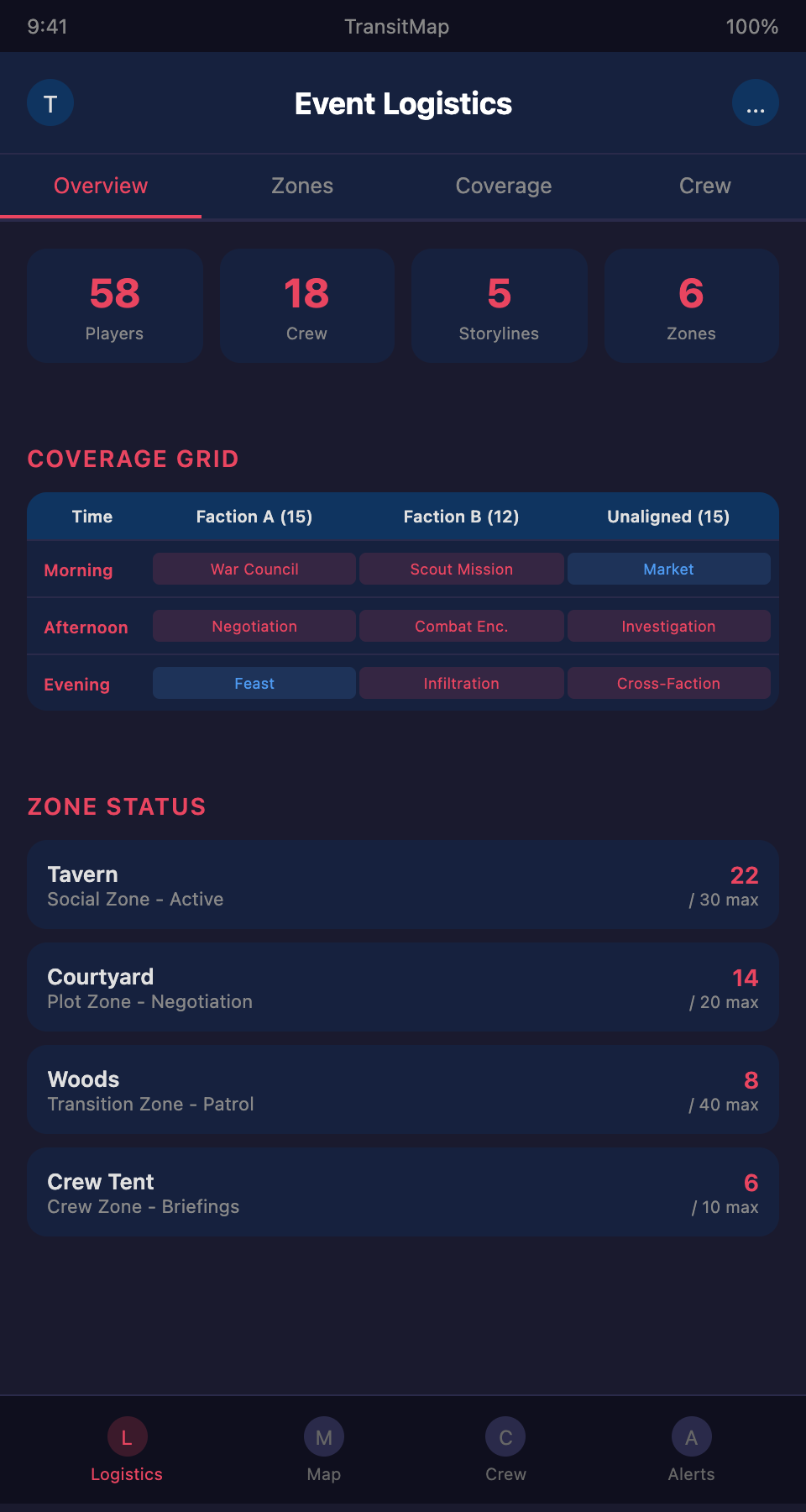
The coverage grid. Create a grid mapping time slots against player groups:
| Time | Faction A (15 players) | Faction B (12 players) | Faction C (10 players) | Unaligned (15 players) |
|---|---|---|---|---|
| Morning | Political negotiation | Scouting mission | Ritual preparation | Market / social |
| Afternoon | War council | Combat encounter | Ritual climax | Investigation quest |
| Evening | Feast / social | Infiltration mission | Faction meeting | Cross-faction intrigue |
The grid ensures no large group of players is ever without content. When forty players have nothing to do simultaneously, the event fails.
Content density targets. Aim for each player to have at least one meaningful interaction or story moment per two-hour block. For a twelve-hour event, that means six touchpoints per player. With fifty players, that is three hundred touchpoints to plan.
This sounds impossible, but most touchpoints are player-to-player interactions facilitated by the storylines you have designed. Your direct interventions (NPC scenes, triggered events, quest completions) are the catalysts. Player interactions are the reactions.
Layer 3: Crew Operations
With fifty-plus players, you need a crew of fifteen to twenty-five members. Managing crew is a logistical challenge in itself:
Shift scheduling. Divide your event into shifts and ensure crew members rotate between active duty and rest. A twelve-hour event should have at least two full shifts with overlap during peak periods.
Role specialization. At scale, general-purpose crew members are less effective than specialists:
- Combat NPCs — Physical performers who run combat encounters
- Social NPCs — Actors who run dialogue-heavy scenes
- Ambiance crew — Members who manage lighting, sound, props, and environmental effects
- Logistics crew — Members who manage props, costumes, food, and site operations
Communication hierarchy. With twenty crew members, a flat communication structure creates noise. Use a hierarchy:
- Lead storyteller communicates with line storytellers
- Line storytellers communicate with their assigned crew
- Crew members report up through their line storyteller
- Emergency communications (safety, medical) bypass the hierarchy entirely
Layer 4: Information Management
Large events generate enormous amounts of information. Without management, critical information gets lost:
The event bible. A single reference document containing all event-critical information: storyline summaries, NPC briefs, schedule, zone map, crew assignments, emergency procedures. Every storyteller gets a copy.
The live log. A running document (physical or digital) where storytellers record significant events as they happen. This is not polished — it is raw data. "2:15 PM — Faction B captured the spy. Taken to the tavern for interrogation."
The decision record. A log of all real-time decisions made by the lead storyteller. "2:30 PM — Decided to let the spy reveal partial information under interrogation to advance the investigation plotline."
Scaling Narrative Quality
The risk of logistics-heavy event planning is that narrative quality suffers. Events become efficient but sterile. Prevent this:
Protect intimate moments. Even in a large event, some of the best moments happen between two people in a quiet corner. Do not schedule every minute. Leave space for player-created scenes.
Maintain NPC depth. The temptation at scale is to reduce NPCs to quest dispensers. Resist this. Even a brief NPC interaction should have personality, motivation, and emotional texture.
Vary the scale of content. Mix large-set-piece scenes (battles, ceremonies, feasts) with small intimate scenes (private conversations, quiet discoveries, personal revelations). Large scale does not mean every scene is large.
Personalize within the mass. Within your coverage grid, identify three to five individual players per event who will receive personalized storyline attention. Rotate this across events so that every player gets a spotlight eventually.
Ready to manage large-scale LARP logistics without losing narrative quality? Join the TransitMap waitlist — coordinate fifty-plus players, multiple storylines, and crew operations on a single visual map that scales with your event.